FatemehSadat Seyed Nematollah Roshan1, Fatemeh Alhani2*, Armin Zareiyan3, Anoshirvan Kazemnejad4

¹PhD, Assistant Professor, Department of Nursing, Faculty of Midwifery and Nursing, Tehran Medical Sciences, Islamic Azad University, Tehran, Iran.
²PhD, Associate Professor from Nursing Department, Faculty of Medical Sciences, Tarbiat Modares University, Tehran, Iran.
³PhD, Associate Professor, Department of Community Health of Nursing School of AJA University of Medical Sciences, Tehran, Iran.
⁴Professor, Department of Biostatistics, Faculty of Medical Sciences, Tarbiat Modares University, Tehran, Iran.

*Corresponding author

*Fatemeh Alhani, PhD, Associate Professor from Nursing Department, Faculty of Medical Sciences, Tarbiat Modares University, Tehran, Iran.

Abstract

Background: Health may be affected by complex interactions between objective and subjective life satisfaction. Paying attention to women’s health and happiness as one of the most vulnerable groups in any society is vital. This explanatory mixed method research was done in two steps to assess women's life satisfaction through a valid tool and understand their point of view about predictors of happiness in their lives. In the quantitative step, 500 women were selected through a cluster random sampling method (from November 2017 to January 2018). SF36 questionnaire was used to gather information. After identifying the results, in the quantitative stage, 40 women were interviewed. Data was analyzed through eight stages of conventional content analysis as recommended by Zhang.

Based on the results the mean ± SD of life satisfaction of participants was 62. 48 ± 10. 18. Among aspects of life satisfaction, the highest mean was related to physical functioning (70. 58 ± 24. 52) and general health (67. 72 ± 27. 66), and the lowest was mental health (55. 27 ± 30. 22) and social functioning (57. 02 ± 30. 62). From the interviews, four main themes (pleasant communication, sense of receiving comprehensive support, health responsibility, and sense of security) were identified as predictors of happiness in women’s lives.

To conclude, the life satisfaction of the studied women is not very desirable specifically in mental health. Paying attention to predictors of women’s happiness could help healthcare providers and politicians to provide programs for promoting the life satisfaction of women, families, and community members.

Keywords: Happiness: Life satisfaction Nursing: Quality of life: Women

Introduction

The terms life satisfaction and 'happiness' are often identical (1). Happiness here is defined as the degree to which an individual judges the overall quality of her/his life as a whole favorably (2).  The experience of high levels of “happiness” is considered by some researchers. Thus, we perceive that an individual has a high degree of happiness when s/he is satisfied with life in a positive way. On the other hand, when someone experiences negative feelings such as worry and/or distress, s/he feels a low degree of happiness and is dissatisfied with her/his life (3).

Reversely, a low level of happiness is identified to be an early signal of maternal death, health problems (4). For this reason, in recent years, the health care system has more focused on preliminary health and happiness for all population (5). Life satisfaction is a phrase that is linked to communities from a variety of population groups and is related to factors such as age, culture, gender, qualification, class status, and social surroundings. Among the factors mentioned, the gender issue plays a key role in determining the life quality (6, 7). In accordance with the World Health Organization, women are considered one of the high-risk groups of the community because of their many roles in the family and society, spending different physiological periods such as puberty, menstruation, pregnancy, labor, and menopause and also a greater risk of suffering from poverty and gender discrimination illness (8, 9). In addition, Mussida and Patimo claim that the evaluation of women's health is important since they are the ones who care for children, parents, and husbands and are also responsible for many important social duties (10).

Women’s life satisfaction is among the studies conducted quantitatively to a large extent by numerous researchers during the recent decades in different communities (11). However, information from combined quantitative and qualitative studies on factors related to happiness and life satisfaction from the perspective of women in Iran is still not available. Feeling happy and satisfied with life is a subjective perception of well-being, and it has been argued that individual perceptions may be culturally influenced and should be recognized across societies (12). This could provide important information for local healthcare policymakers and other researchers to implement mental health interventions for women. Therefore, this study aimed to assess life satisfaction and identify predictors of happiness in women's lives.

Methods

This explanatory mixed-method research was done in two steps (quantitative and qualitative).

In the quantitative step, 500 women were selected through cluster random sampling from varied zones of Tehran Province (from November 2017 up to January 2018). To mention as an instance, Tehran benefits from 200 neighborhood houses. So, initially, the city was divided into five parts (north, south, center, west, and east). Then, two neighborhood houses from each part were randomly selected (a total of 10 neighborhood houses).

The inclusion criteria in this step were women aged 15-49, lack of disability, and other physical and psychological diseases.

A validated SF-36 questionnaire was used to gather information. The questionnaire SF-36 is a valid tool related to public health that examines health status in clinical operations and research. This is a multi-item scale that assesses eight areas namely general health (2 items), vitality (8 items), physical functioning (10 items), limitations in daily activities due to physical problems (4 items), bodily pain (2 items), mental health (5 items), role-emotional (3 items), and social functioning (2 items). The scores are ranged from 0 to 100 and higher scores represent better life satisfaction. The SF-36 questionnaire was translated and validated in Persian by Montazeri et al (13). As well as SF-36, a data sheet was used to record the demographic characteristics of the women including age, qualifications, ethnicity, occupation, total working experience, marital condition, etc.

After sampling and collection of data, they were entered into SPSS 22, and 0. 05 was considered as the significant level. The statistical description of the life satisfaction and socio-demographic variables was denoted by frequencies, percentages, means, and standard deviations.

In the qualitative step, data were gathered through semi-structured, in-depth individual interviews, which continued up to the data saturation point (40 women). Inclusion criteria were Persian-speaking women aged 15-49, excellent ability of communication and expression, and the desire to participate in the study.

To win the women’s trust, the interview launched with a general open question and then probing questions followed: “Please speak to me about your living conditions”, “Please let me know how you feel about your life?”, and “What makes you happy in your life?”.

To clarify the participants’ understanding, probing questions were also asked based on the information provided, such as “Do you mean …?”, and “Can you say more or example?”.

Each interview lasted for approximately 30 to 60 minutes, depending on the status of the women, and was tape-recorded. Sampling continued until data saturation was achieved with 38 participants: nevertheless, interviewing continued with two other women for further assurance.

The data analysis was performed using a conventional content analysis method. Qualitative content analysis is the analysis of the content of narrative data that we gain from participants, and it is a method to identify subthemes and patterns among themes and the researcher can reach a deeper perception of a phenomenon. The data processing was conducted with an 8-stage systematic and transparent method recommended by Zhang (14). The data was managed using the software MAXQDA Version 10.

Table 1: Demographic characteristics of study participants (N500)

Ethical Considerations: This study was approved by the research council and ethics committee of Tarbiat Modares University of Medical Sciences, (Code D52/1918/ Date 5. 6. 2016). Research ethical principles such as informed consent, anonymity, confidentiality, and the participants’ freedom to leave the study were observed. Also, before the interviews, participants were informed about the purpose of the study, and all the respondents were assured that they would be aware of the study results. Additionally for data trustworthiness, credibility, transferability, conformability, reliability, and dependability were evaluated (15).

Results

A total of 500 individuals participated in the study completed and returned the questionnaire packet (response rate 100%). The average age of the participants was 35. 40 ± 9. 12 years. The mean scores and standard deviation of total life satisfaction were 62. 48 (SD=10. 18). Other sociodemographic information, is presented in Table 1. The mean scores and standard deviation of total life satisfaction were 62. 48 (SD=10. 18). Among aspects of life satisfaction, the highest mean was related to physical functioning and general health, and the lowest was mental health and social functioning. Information about life satisfaction is presented in Table 2.

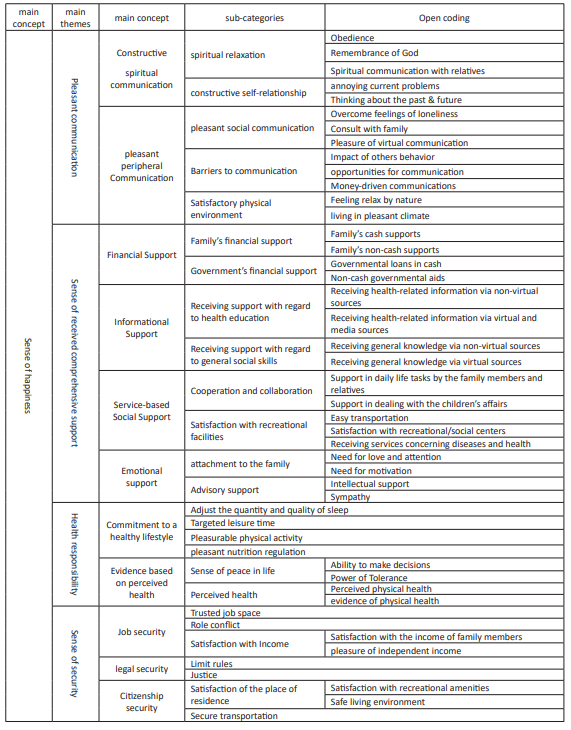
After identifying the above results, at the quantitative stage, 40 women (W) with the criteria for this research were interviewed and asked to disclose their experiences regarding issues affecting their lives and making them happier. In this stage, 661 primary codes, 26 subcategories, 11 categories, and four themes were concluded (Table 3). Examples of quotes from contributors are presented below:

Pleasant communication

This main theme consisted of two categories, including constructive spiritual communication and pleasant peripheral communication.

One of the respondents commented in this respect: “I'm always worried about what may happen in the future to my daughter. I'm afraid someone harms her. I do not know what fate awaits her. I am so concerned, even some nights I can’t sleep well”.  (W 19)

One other participant said: “Usually once a month my mother invites our relatives to our house. From morning till late night we are gathered. This gives me a sense of happiness and hope to be more life”.  (W 17)

Sense of receiving comprehensive support

This main theme consisted of four categories, including financial support, informational support, service-based social support, and emotional support.

One of the respondents stated in this regard: “A couple of years ago, my husband was admitted to a hospital for a while due to a stomach hemorrhage. My brother never asked me whether I wanted to live in assisted living or whether I was satisfied with my life. There was nobody, to pay attention to me and give me emotional care. My brother didn’t even ask me how you would pay the hospital costs or whether you would have any problem buying the medicines”.  (W 13)

Another participant commented on this issue as follows: “During the polluted days when the government announced the schools and kindergartens are closed, it would be great at home if the government also provided us with a babysitter: at least for those who need, because they normally announce late at night and we cannot plan for the next day. We must either refrain from going to work or take our children to the other side of the city under the polluted air to have one of our relatives keep them and then take them back home at night. ” (W27)

Table 2: Mean scores of life satisfaction in the studied women (N500)

Table 3: The trend of condensation-abstraction process for themes (N40)
Health responsibility

This main theme consisted of two categories, including commitment to a healthy lifestyle, and evidence based on perceived health.

One of the women in this regard states: “My friends send lots of health-related messages like the ways to alleviate the skin darkness or what to eat for weight loss. It is much better than paying to visit a doctor for a simple drug”.  (W28)

Another participant commented: “Until now I have not used pills without a prescription. We cannot even trust prescription medications too. I heard from people that someone even died because of a penicillin injection. It's not clear what medicine people give”.  (W26)

Sense of security

This main theme consisted of three categories, including Job security, legal security, and citizenship security.

One of the women in this regard said: “I've made some clothes and put them on the desk of one of my acquaintances in her shop to go on sale. So perhaps for some time, I could rent a desk. Occupation and ability to save money is very important on woman's personality in life. ” (W6)

Analysis of the content of the data from interviews with women led to the explanation of the concept of women's happiness. Accordingly, happiness from the point of view of women is a mental concept that expresses their feelings about peace in life, satisfaction with health status due to health responsibility, establishing a pleasant communication with self, God, surrounding environment, experiencing a sense of security and comprehensive support for realizing the ideal life.

Discussion

According to the results, the remarkable obtained score in women was related to the domains of physical functioning, and then general health, and the lowest one was recorded by mental health and social relationships. In the study by Ghasemi also the average score in the aspect of the physical health of life satisfaction was higher than the other dimensions (16) which is in line with the results of the present study. In addition, the result of the study by Fernandes et al. showed that psychological discomfort in women can affect their state of mind, feeling of happiness, and satisfaction from everyday life (17). In the present study, fortunately, the samples have relatively good physical health but it seems they are not mentally healthy and don’t sense of happiness in their life. If this trend continues, we must expect soon their physical health will deteriorate. Mental problems due to fast-paced and stressful living conditions and domestic violence are remarkable priority problems among women in Iran. Based on a systematic review, social determinants of health have a remarkable relationship with stressful living conditions not only in Iran but also on a worldwide scale (18). Therefore, this issue should still be widely considered by researchers in the field of health and be addressed by the authorities of each community to resolve it.

As a total result of the quantitative phase, life satisfaction in women in Iran is not desirable. The results were similar to those obtained in the studies by Rimaz and Solhi (19, 20). However, findings in the area of quality of life had laid much emphasis on the measures of life satisfaction and less on the subjective perception of predictors of happiness in women’s life. Due to this shortcoming, there is needed to explain the most important factors involved in women’s happiness. Therefore, we conducted a qualitative study to discover its hidden causes.  In the current research predictors of happiness from the perspective of women include pleasant communication, a sense of received comprehensive support, health responsibility, and a sense of security. According to statements by participants suffering from enough money to meet their needs, low levels of income, lack of receiving emotional and service-based support, lack of feeling safe in daily life, unhealthy physical environment, and unsatisfied personal relationships were linked with marked drops in scores of all investigated domains of happiness and led to their feeling sadness and sorrow in life. Charandabi et al. showed that lack of support, being unemployed, and low levels of household income are linked with reduced total life satisfaction, which was in line with the results of the present study (21).

A review of research by Veenhoven shows that happiness concurs with several qualities of the living environment, especially with economic affluence, security, freedom, and intimate ties (22) which is consistent with the findings of this study. Nevertheless, in the current research, as women pointed out in their quotes by setting the proper sleep pattern and goal-oriented in leisure time, doing physical activity, regulating nutrition, searching for health information, and health care, they were made responsible for their health and thus tried to follow a healthy lifestyle, which these made them higher score in physical functioning, and general health dimensions of life satisfaction in the quantitative phase. Findings of the Pekel study also showed that People who are more likely to have health promotion behaviors have a higher level of satisfaction than life, and there is a significant positive relationship between responsibility and life satisfaction. This result is in line with the findings of this study (23).

According to our information, there was no similar research in terms of method for this issue. Despite the limitations of this study, such as limited sample size and different working conditions in the quantitative phase, has some strengths like using the SF-36 standard questionnaire. Apart from that in the qualitative phase, we tried to use a maximum diversity sampling technique based on varied age, marital status, level of education, occupation and economic conditions, and social status which contributes to the transferability of the findings.

Conclusions

This study provides useful information from the perspective of women about the concept of happiness and its crucial dimensions. Based on the findings, paying attention to the field of communication, comprehensive support, health responsibility, and security may improve the quality of women. The results of this study can emphasize the importance of transferring care from the hospital to the community and the necessity of preventive measures at the first level which can be beneficial for health officials in terms of improving health care and providing awareness about women’s happiness.

Acknowledgments:  We would like to thank the Research Administration of Tarbiat Modares University and all the women in the study for sharing their experiences with us.

Competing interests: There is no conflict of interest.

Funding: We have received funding for research from the Research Administration of Tarbiat Modares University, Tehran, Iran.

References

  1. Ruggeri K, Garcia-Garzon E, Maguire Á, Matz S, Huppert FA (2020). Well-being is more than happiness and life satisfaction: a multidimensional analysis of 21 countries. Health and quality of life outcomes. Dec:18:1-6.
  2. Unanue W, Barros E, Gómez M. (2021) The longitudinal link between organizational citizenship behaviors and three different models of happiness. International journal of environmental research and public health. Jun 12: 18 (12):6387.
  3. Tarabeih M, Bokek‐Cohen YA. (2020) Between health and death: The intense emotional pain experienced by transplant nurses. Nursing Inquiry. Apr: 27 (2):e12335.  
  4. Sylvester OA, Tosin AO. (2016) Influence of Demographic Variable on Quality of Life among Women in Ibadan Metropolis, Oyo State of Nigeria. International Journal of Applied Psychology: 6 (3):56-63.
  5. Coo C, Salanova M. (2018) Mindfulness can make you happy-and-productive: A mindfulness controlled trial and its effects on happiness, work engagement and performance. Journal of Happiness Studies. Aug:19: 1691-711.
  6. Seyed Nematollah Roshan FS, Alhani F, Zareiyan A, Kazemnejad A. (2020) Pleasant Communication as an Integral part of Women’s Quality of life: A Qualitative Study. Crescent Journal of Medical and Biological Sciences. Vol. 7: No. 2: 170–176.
  7. Seyed Nematollah Roshan FS, Alhani F, Zareiyan A, Kazemnejad A. (2021) Exploring the concept of social support as a key factor in young women's quality of life. International Journal of Adolescent Medicine and Health. Jun 9: 33 (3): 189-94.
  8. Hadi N, Hajjari Z. (2013) Women’s Health in Iran: A Review. Shiraz E Medical Journal (SEMJ): 14 (3):172 188.
  9. Norozi E, Mostafavi F, Hasanzadeh A, Moodi M, Sharifirad Gh. (2013) Factors affecting quality of life in postmenopausal women, Isfahan. J Educ Health Promot 2: 58.
  10. Mussida C, Patimo (2021) Women’s family care responsibilities, employment and health: a tale of two countries. Journal of family and economic issues. Sep: 42 (3):489-507.
  11. Seyed Nematollah Roshan FS, Alhani F, Zareiyan A, Kazemnejad A. (2023) Quality of life assessment in Iranian working and non-working women with a native instrument. Knowledge of Nursing Journal 1 (1):65-73.
  12. Taghavi SA, Bazarganipour F, Jones SH, Hosseini N. (2015) Health-related quality of life in Iranian women with polycystic ovary syndrome: a qualitative study. BMC Womens Health: 15: 111.
  13. KhaledBiat S, Parandeh A, Alhani F, Salaree MM. (2014) Health-Related Quality of Life of Chemical Warfare Victims: An Assessment with the Use of a Specific Tool. Trauma: 19 (1): 1-6.
  14. Roshan FS, Alhani F, Zareiyan A, Kazemnejad A. (2023) Development and psychometric properties of Iranian Women’s Quality of Life Instrument (IWQOLI): mixed exploratory study. BMC Public Health. Oct 25: 23 (1):2098.
  15. Elo.S, Kariainen. M, Kanste. O, Polkki. T, Utriainen. K, Kyngas. H. (2014) Qualitative Content Analysis A Focus on Trustworthiness. SAGE Open: 4 (1): 1-10.
  16. Ghasemi SR, RjabiGilan N, Reshadat S. (2014) The Survey of Health-Related Quality of Life in Kermanshah Rural Women and Some Related Factors. J Mazand Univ Med Sci: 23 (109):186-94.
  17. Fernandes S, CarvalhoCoutinho E, CarvalhoDuarte J, BatistaNelas PA, CorreiaBalulaChaves C et al. (2015). Quality of life in women with Urinary Incontinence. Journal of Nursing Referencia: 5: 93-99.
  18. Joulaei H, Maharlouei N, Razzaghi A, Akbari M. (2016) Narrative review of women’s health in Iran: challenges and successes. International journal for equity in health: 15 (1):25-34.
  19. Rimaz SH, Dastoorpoor M, Vesali S, Saiepour N, Beigi Z, et al, (2014). The Survey of Quality of Life and its Related Factors in Female-headed Households Supported by Tehran Municipality, Ddistrict 9. Iranian Journal of Epidemiology: 10 (2): 48-55.
  20. Solhi M, Hamedan MS, Salehi M. (2016) Relationship between Quality of Life of Women-Headed Households and Some Related Factors in Iran. Global journal of health science : 8 (10):250-256.
  21. Charandabi SM, Rezaei N, Hakimi S, Montazeri A, Taheri S, et al. (2015) Quality of life of postmenopausal women and their spouses: a community-based study. Iranian Red Crescent Medical Journal: 17 (3):e21599.
  22. Veenhoven R. (2015) Social conditions for human happiness: A review of research. International Journal of Psychology: 50 (5), 379-391.
  23. Pekel A, Osman PE, Turan MB, Bahadir Z. (2015) The relationship with life satisfaction between health promoting behaviours of special education teachers (Kayseri city sample). International Journal of Science Culture and Sport (IntJSCS): 3 (3):125-32.
TOP