Anatomical Clue to The Etiology of Epilepsy at Autopsy-Corpus Callosum Agenesis Associated with Willis Polygon Anomaly, Holoprosencephaly

Ahmet Depreli1; Tugba Ataseven2; Mert Nahir3; Sefa Sonmez3; Selcuk Cetin4

¹Forensic Medicine Institute, Tokat Forensic Medicine Branch Directorate, Tokat, Turkey
²Tokat State Hospital Forensic Medicine Unit, Tokat, Turkey
³Tokat Gaziosmanpaşa University, Faculty of Medicine, Department of Anatomy, Tokat, Turkey
⁴Tokat Gaziosmanpaşa University, Faculty of Medicine, Department of Forensic Medicine, Tokat, Turkey

*Corresponding author

*Sefa Sonmez, Tokat Gaziosmanpaşa University, Faculty of Medicine, Department of Anatomy, Tokat, Turkey

Abstract

Willis polygon anomalies are rare variations in epilepsy. In this case, the right posterior communicating artery was agenesic and the anterior communicating artery was very thin when the brain of a 22-month-old female infant was examined during a routine autopsy. In addition, the corpus callosum was intermittently discontinuous, and the cerebral ventricles were dilated in the brain sections. This report presents the structural anatomical features of these rare variations and their significance in forensic medicine.

Keywords: Anatomy . Autopsy . Brain anomaly . Variation . Willis polygon

Introduction

Epilepsy is a common neurological disorder in children, with an incidence rate of 20-124 per 100,000 and a reported 5% likelihood of experiencing at least one seizure by the end of the second decade (1). The etiology of this disorder includes structural causes (cerebral dysplasia, polymicrogyria, trauma-induced structural changes), genetic, infectious, metabolic, and immune factors, as well as types with unknown causes (2, 3). Since trauma, one of the structural causes, is a significant risk factor in the development of epilepsy, it is essential to determine whether trauma is a contributing factor, especially in young children (4, 5).

Physical abuse may be an underlying, traumatic cause of epilepsy that remains undetected by judicial authorities or healthcare professionals. In cases of infant and child deaths, challenges arise, such as the lack of sufficient findings in postmortem examinations and classical autopsies, insufficient information from primary relatives, and the unavailability of medical records regarding the deceased's medical history. In infant deaths with a history of epilepsy, the findings obtained from examinations and autopsies that indicate natural causes of death are of great importance in forensic medicine.

This study presents a case report of a 22-month-old infant with a known history of epilepsy who was found dead in her bed in the morning. No preliminary information could be obtained from the primary caregiver. Postmortem examination and classical autopsy revealed anomalies in the circle of Willis and other areas. Medical records reviewed in the case file indicated that the infant had agenesis of the corpus callosum and semilobar holoprosencephaly.

Case report

This report details the case of a 22-month-old female infant who was found unresponsive in her bed in the morning and pronounced dead upon arrival at the hospital. The death was considered suspicious, and no detailed preliminary information beyond a history of epilepsy was obtained during the identification process. During the postmortem examination, the infant's height was measured at 83 cm, weight at 6 kg, and head, chest, and abdominal circumferences at 39 cm, 44 cm, and 35 cm, respectively. In the classical autopsy procedure, a coronal incision was made on the scalp between the zygomatic processes of the frontal bone. Subsequently, a sagittal incision was made along the midline, starting from the midpoint of this incision and ending at the level of the external occipital protuberance. Finally, a horizontal incision was made from the endpoint of the second incision, terminating at the level of the asterion, allowing the scalp to be reflected. The calvaria was cut with a bone saw, and after exposing the dura mater, the cranial nerves were carefully dissected from the base of the skull to remove the brain. No acute traumatic findings were observed in the brain. The brain, cerebellum, and brainstem together weighed 586 grams.

Figure 1: (A) Autopsy image showing Willis polygon anomaly. (B) Schematic representation of the Willis polygon anomaly. (a) Vertebral artery. (b) Basilar artery. (c) Superior cerebellar artery. (d) Posterior cerebral artery. (e) Left posterior communicating artery. (f) Internal carotid artery. (g) Middle cerebral artery. (h) Anterior cerebral artery. (i) Anterior communicating artery
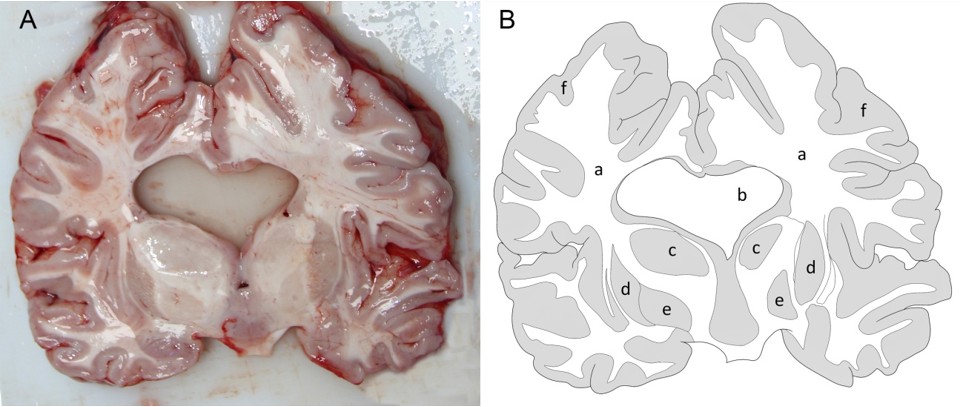
Figure 2: (A) Autopsy image of a coronal section of the brain showing dilated intracranial ventricles. (B) Schematic representation of a coronal section of the brain. (a) White matter. (b) Dilate intracranial ventricle. (c) Caudate nucleus. (d) Putamen. (e) Globus pallidus. (f) Grey matter

Upon examining the vessels on the basal surface of the brain, it was observed that the anterior communicating artery was very thin and the right posterior communicating artery was absent (Figure 1). Due to the limitations of the hospital facilities, the brain could not be sampled in its entirety. The brain section examination was suboptimal due to its softened consistency. The sections revealed significant asymmetry in the anatomy of the white and gray matter, with intermittent discontinuity of the corpus callosum and dilated intracranial ventricles (Figure 2). In this case, structural agenesis and variations were examined, and the etiology and clinical significance of epilepsy were discussed.

Discussion

In cases of infant deaths, distinguishing whether the death was due to natural causes is of paramount importance in forensic medicine. However, the inability to obtain medical records, insufficient information regarding the circumstances of death, and inadequacies in the scene investigation make this distinction challenging (6). This distinction is particularly crucial in cases of child deaths with a history of epilepsy. Given that mortality rates are found to be 2-5 times higher compared to the general population, forensic pathologists are likely to encounter early childhood death cases associated with epilepsy (7). Due to these challenges, evaluating the etiology of this disorder becomes difficult.

In cases of child deaths, physical abuse should always be suspected and ruled out. In cases of infant deaths, primary caregivers often cannot provide reliable information due to their emotional state, or no information can be obtained at all. In such situations, every finding in the postmortem examination and classical autopsy serves as an important clue. In our case, classical autopsy revealed that the anterior communicating artery was very thin, the posterior communicating artery was absent at the brain's base, and sections of the brain showed intermittent discontinuity of the corpus callosum.

In the literature, there are cases reporting that anomalies of the circle of Willis can be associated with holoprosencephaly (8, 9). Additionally, studies have documented the coexistence of cerebral artery anomalies identified through radiological examinations with agenesis of the corpus callosum (10). One case has reported that unilateral anterior cerebral artery anomalies were observed in conjunction with agenesis of the corpus callosum and epilepsy using radiological imaging (11). In our case, the combination of epilepsy and a history of seizures in the infant, along with anomalies of the circle of Willis and the corpus callosum, was directly observed through macroscopic examination in the classical autopsy.

Agenesis of the corpus callosum is reported as a rare congenital anomaly, typically inherited in an autosomal recessive, autosomal dominant, or X-linked manner. It is thought to result from an infection during pregnancy or from metabolic or mechanical effects during the second trimester that disrupt fetal brain development (12). Additionally, it has been noted that agenesis of the corpus callosum can occur in conjunction with holoprosencephaly (13-15). In our case, where agenesis of the corpus callosum and holoprosencephaly were observed together, it was found that the infant was the only child of the family, there was no known history of hereditary diseases among other individuals, including second and third-degree relatives, and no chromosomal anomalies were detected in the infant’s cytogenetic analysis.

Conclusion

Unlike studies conducted with radiological images, we believe that our study, performed with classical autopsy, will contribute to the literature. We consider that careful examination of the circle of Willis by forensic medicine and anatomy specialists during autopsies is crucial for forming a definitive opinion about the cause of death.

Ethical Approval: The design of this study was asked to the Ethics Committee, and the opinion was obtained that ethical permission was not required for case reports. Approval was obtained at the Education and Scientific Research Commission meeting of the Presidency of the Forensic Medicine Institute dated 22/02/2023 with the decision number 21589509/2023/175.

Conflict of interest statement: The authors declare that they have no conflict of interest in the publication of this case report.

Funding: This case report was not funded by a grant or public or non-profit sources.

Scientific Meeting: This study was presented as an oral presentation at the 7th International Health Sciences and Life Congress (IHSLC 2024), March 07-09, 2024.

Data Availability: Data from this case report may be made available upon reasonable request.

References

  1. Hauser WA, Pellock JM, Nordli DR, Sankar R, Wheless JW (1995). Epidemiology of epilepsy in children. Neurosurgery Clinics of North America; 6(3):419-430.
  2. Scheffer IE, Berkovic S, Capovilla G, Connolly MB, French J,et al (2017), classification of the epilepsies: Position paper of the ILAE Commission for Classification and Terminology. Epilepsia ;58(4):512-521.
  3. Shorvon SD (2011). The etiologic classification of epilepsy. Epilepsia ;52(6):1052-1057.
  4. Agrawal A, Timothy J, Pandit L, Manju M (2006). Post-traumatic epilepsy: an overview. Clin Neurol Neurosurg ;108(5):433-439.
  5. Aslan K, Bozdemir H, Demir T (2011). Kafa travmasının epileptik nöbetlerdeki yeri ve prognoz ile ilişkisi.
  6. Dinçer B, Karbuz A, Aslıyüksek H , Kara E (2022). İstanbul’da otopsisi yapılmış travmatik olmayan bebek ölümlerinin değerlendirilmesi. Adli Tıp Dergisi;36(1):8-17.
  7. Lhatoo SD, Johnson AL, Goodridge DM, MacDonald BK, Sander JW, Shorvon SD (2001). Mortality in epilepsy in the first 11 to 14 years after diagnosis: multivariate analysis of a long-term, prospective, population-based cohort. Ann Neurol;49(3):336-344.
  8. Van Overbeeke JJ, Hillen B, Vermeij-Keers C (1994). The arterial pattern at the base of arhinencephalic and holoprosencephalic brains. J Anat ;185(Pt 1):51–63.
  9. Arnold WH, Sperber GH, Machin GA (1996). Anatomy of the circle of Willis in three cases of human fetal synophthalmic holoprosencephaly. Anat Anz ;178(6):553-558.
  10. Handa J, Teraura T, Imai T, Handa H (1969). Agenesis of the corpus callosum associated with multiple developmental anomalies of the cerebral arteries. Radiology;92(6):1301-04.
  11. Koc Z, Koc F (2005). Epilepsia associated with severe callosal hypogenesia, lipomas, and single anterior cerebral artery. Neurosurgery Quarterly ;15(3):164-66.
  12. Franco I, Kogan S, Fisher J, Rifkinson-Mann S, Reda E, Levitt S, Roseman B (1993). Genitourinary malformations associated with agenesis of the corpus callosum. J Urol;149(5):1119-21.
  13. Barkovich AJ, Norman D (1998). Anomalies of the corpus callosum: correlation with further anomalies of the brain. AJNR Am J Neuroradiol ;9(3):493-01.
  14. Lacey DJ (1985). Agenesis of the corpus callosum. Clinical features in 40 children. Am J Dis Child.;139(9):953-55
  15. Marszal E, Jamroz E, Pilch J, Kluczewska E, Jablecka-Deja H, Krawczyk R (2000). Agenesis of corpus callosum: clinical description and etiology. J Child Neurol ;15(6):401-05.
TOP