
Two Cases of Complete Hepatocellular Carcinoma Regression Due to Direct-Acting Antiviral Treatment in Combination with Check-Point inhibition (CPI)
Irina Anatolievna Dzhanyan1, Vladimir Evgenievich Syutkin2, Elena Yurievna Antonova1*, Valery Vladimirovich Breder1
¹Blokhin National Medical Research Center of Oncology, Moscow, Russia
²Sklifosovsky Research Institute for Emergency Medicine, Moscow, Russia
*Corresponding author
*Elena Yurievna Antonova ,Blokhin National Medical Research Center of Oncology, Moscow, Russia.
DOI: 10.55920/JCRMHS.2025.09.001392

Figure 1: Abdominal Computer Tomography from 21.08.2017.

Figure 2: Abdominal Computer Tomography from 03.12.2018.

Figure 3: Abdominal Computer Tomography from 03.12.2018 Tumor size mRecisct 2,8х1.5 sm.

Figure 4: Growth dynamics by cycle of anticancer therapy.

Figure 5: Abdominal Computer Tomography from before the start of therapy from 16.01.2021, the main node is 12.7x10.5 cm and the tumor thrombus in the lumen of the portal vein trunk is up to 2.7 cm.
The treatment was continued as no clinical deterioration followed. In November 2018 the enhanced ALT (3.4ULN) and AST (5.3ULN) activity necessitated HCV RNA study (6*10 IU/ml). The lack of experience in immunotherapy in patients with viral hepatitis in 2018 made us associate increase of transaminase activity with either immune-mediated hepatitis or the worsening of viral hepatitis. The decision was made to begin AVT with Sofosbuvir (400 mg) and Velpatasvir (100mg) daily in December 2018. Sustained biochemichal and virological responses were achieved. In January 2019 CT showed the tumor debulking (-13% according to RECIST 1.1 and -48% according to mRECIST). The effect was achieved after 6 weeks.(Figure 3). In September 2019 the final dose of Pembrolizumab was administered (cycle 35). The positive tumor response has been observed up to the day of the present report (complete regression according to mRECIST). No clinically significant toxic effect has been reported. A study performed in January 2022 showed that tumor size remained unchanged, AFP was within normal limits, HCV RNA was not detected.54.3 months have passed since the time the diagnosis was established and 49.2 months since the beginning of Pembrolizumab therapy. The follow up period has been 64,8 months.
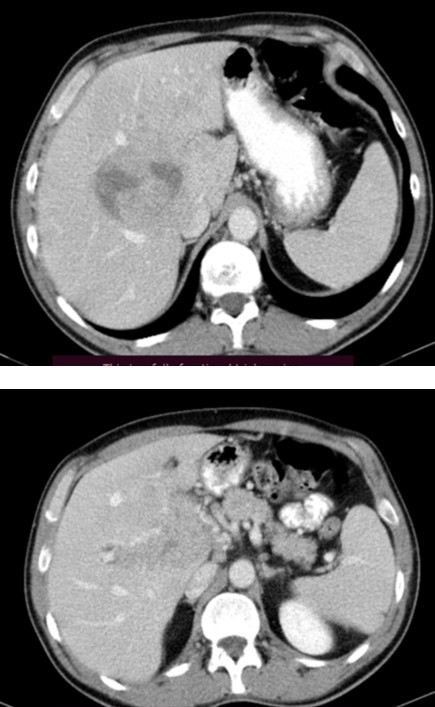
Figure 6: Abdominal Computer Tomography from before the start of therapy from 03.08.2021, the main node is 10,5х8,5 cm and the tumor thrombus in the lumen of the portal vein trunk is up to 3.5 cm.

Figure 7: Abdominal Computer Tomography from before the start of therapy from after 04.05.2022 the end of therapy, complete regression of the tumor is preserved.

Figure 8: Growth dynamics by cycle of anticancer therapy.
Liver biopsy confirmed HCC and liver cirrhosis-on the Child Pugh scale was 5 points.. The patient’s status was established as BCLC-C (portal vein thrombosis), T4N0M0, stage III. AFP before treatment was 45IU/ml. The increased activity of ALT (72 IU/l) and AST (63 IU/l) was observed. HCV RNA was 6*10 IU/ml. In February 2021 first-line therapy with Atezolizumab (1200mg) and Bevacizumab (15 mg/kg) intravenously was started. In March 2021 the increased ALT (156 IU/l) and AST (123 IU/l) were seen. Glecaprevir (300 mg) and Pibrentasvir (120 mg) combination daily for 12 weeks was started. By antitumor medicine administration 6 the process had been stabilized (according to RECIST 1.1 criteria). After administration 9 the patient developed eruption on the penis, accompanied by itch and ulceration (Figure 6).
Local and specified therapy for toxic dermatitis and herpes-associated genital infections resulted in positive effect. Thus, the treatment was interrupted for two weeks. A dramatic decrease of tumor size was seen on CT scan after 12 administrations(-57% according to RECIST 1.1 and -85% according to mRECIST 1.1) (Figure 7). Normal AFP (2 IU/ml) was first observed. PCR test showed minimal levels of HCV viremia and treatment was continued. In January 2022 a repeated CT showed a significant decrease of tumor size (-63% according to RECIST 1.1 and-100% according to mRECIST 1.1). A total antitumor course Included 19 dose administrations. In March 2022 the final Atezolizumab and Bevacizumab doses were administered. The objective response to therapy remained unchanged (-63% according to RECIST 1.1 and -100% according to mRECIST 1.1). No toxic manifestations were seen. The patient did not receive any therapy.
The final examination made in June 2022 showed no changes in tumor size, indicating a complete tumor regression. AFP was within normal limits. 21 months have passed since the time the diagnosis was confirmed and 20 months since the time of initial treatment. The follow up period has been 20 months.