Comparative Assessment of Pressure Technique with Different Needle Tips for Obturation in Primary Teeth: An in Vivo Study

Dr. Mansi Baviskar1, Dr. Shilpa Shetty Naik2, Dr. Ishani Ratnaparkhi3, Dr. Chinmaya Chaudhary4*,

¹Professor, Department of Pediatric and Preventive Dentistry, D.Y. Patil Deemed to be University School of Dentistry.
²Professor and Head of Department, Department of Pediatric and Preventive Dentistry, D.Y. Patil Deemed to be University School of Dentistry.
³Senior Lecturer, Department of Pediatric and Preventive Dentistry, D.Y. Patil Deemed to be University School of Dentistry.
⁴Post-graduate student, Department of Pediatric and Preventive Dentistry, D.Y. Patil Deemed to be University School of Dentistry.

*Corresponding author

*Dr. Chinmaya Chaudhary, Postgraduate student, Department of Pediatric and Preventive Dentistry, D.Y. Patil Deemed to be University School of Dentistry.

Abstract

Primary teeth are the best space maintainers and hence they should be preserved and retained as long as possible. Pulpectomy of primary teeth is indicated when there is inflammation of the pulpal tissue. The procedure consists of extirpation of the pulp tissue, filing of the canals to remove organic debris and obturating with an antibacterial, resorbable paste. Over the years, different materials and methods have evolved for obturation.

Aim: To evaluate and compare the pressure technique with different needle tips for obturation in primary teeth.

Materials and Method:  A total sample of 30 primary teeth with 2/3rd of root length was selected among the children between the age of 5-8years, which required pulpectomy and were randomly allocated into two groups, i.e., Group I: Tuberculin syringe with metal tip, Group II: Tuberculin syringe with plastic tip. Access cavity was prepared and the infected necrotic pulp tissue was removed followed by biomechanical preparation of the canals till 35 K-hand file (21 mm). Post this, all canals were obturated with Endoflas using a tuberculin syringe and any one allotted tip. The quality of obturation and presence or absence of voids was evaluated.

Results: Both groups showed maximum number of optimally filled canals (group 1- 49.1%, group 2 – 54.2%) and no statistically significant difference was seen. Group I had more number of underfilled canals and voids when compared to group II while group II had more overfilled canals.

Conclusion: No statistically significant difference was seen when plastic tip or metal tip was used with optimal obturation seen in both. Children showed more acceptance to syringe with plastic tip due to its less threatening appearance.

Keywords: Obturation, Primary teeth, Tuberculin syringe

Introduction

Pediatric dentistry has been evolved from an extraction-oriented practice to preservation, restoration and maintenance of primary teeth. Primary teeth should be retained since they help with chewing, aesthetics and phonetics, can intercept abnormal oral habits, and are the best space maintainers reducing malocclusion.[[i]] Pulpectomy consists of removal of necrotic pulp followed by canal preparation and obturation with resorbable filling materials. A fluid-tight seal is required for a successful endodontic treatment. Voids in the obturated canals hamper the prognosis, as these may provide pathways for leakage, bacterial growth and infection.

There are number of obturating techniques that have been used previously that can be divided into pressure techniques and non-pressure techniques. Some of the pressure techniques includes the Endodontic pressure syringe [Green berg 1963], Mechanical syringe [Green berg 1963], Jiffy tube [Rifficin 1980], Tuberculin syringe [Aylord and Johnson 1987], Pre mixed syringe [Nurko et al. 1994], Navi tip [Guelman et al. 2004], Disposable syringe technique [2012].

We have found number of studies comparing pressure syringe technique with non-pressure techniques using different pressure syringes, but none comparing the various needle tips available today, that is actual delivery mode of the material.

In this study by standardizing the syringe and the obturating material two different tips have been used. The aim of this study was to compare and assess pressure technique for obturation in primary teeth with two different needle tips i.e. tuberculin syringe with metal tip or plastic tip and to evaluate the quality of obturation and presence and absence of voids.

Material and Methods

Study design and ethical approval

This is a single blinded randomized clinical trial which included children between the age of 5-8yrs visiting the department of pediatric and preventive dentistry for treatment. Ethical approval was obtained from our Institutional review board [IREB/2023/PEDO/04]. It was registered under clinical trial registry (CTRI/2024/03/063811).

Sample size

A total sample of 30 primary teeth was involved in the study in accordance to the study done by Raju et al (2022).[[i]] The sample size was calculated using G*Power (Universitat Kiel, Kiel, Germany) sample size calculation software 3.1.9.7. Fifteen teeth per group met the minimum requirement for an alpha of 0.05 and a power of 0.95.

Sample size formula - n = (Zα/2+Zβ) 2 * (p1(1-p1)+p2(1-p2)) / (p1-p2) 2

Sample selection

Inclusion criteria -

  1. Children between the age-group of 5-8 years
  2. Primary molar indicated for pulpectomy
  3. Radiographically teeth with 2/3rd root remaining.
  4. Consent given by parents.

Exclusion criteria -

  1. Teeth with caries extending to the furcation.
  2. Root canals with evidence of internal or external resorption
  3. Children with any systemic disease
  4. Parents who do not give consent.

Intervention description

Thirty primary teeth of children between the age of 5-8 years were randomly divided into 2 groups using the chit system i.e., Group I-Tuberculin syringe with metal tip and Group II - Tuberculin syringe with plastic tip. Informed consent was taken from all the parents/guardians after explaining them the entire procedure before the treatment.

Clinical procedure

Local anesthesia (2% Lignocaine with adrenaline 1:80,000) solution in a cartridge (Lignospan Special, Septodont Healthcare, India) was administered. For mandibular teeth, inferior alveolar nerve block was given with a 27 gauge, 0.40 × 35-inch-long disposable needle (Septoject, Septodont Healthcare, India) and for maxillary teeth, maxillary infiltration with a 30 gauge, 0.30 × 26-inch-short disposable needle (Septoject, Septodont Healthcare, India)  along with a self-aspirating metal syringe were used. For isolation rubber dam was used. Using a high-speed air rotor handpiece, access cavity was prepared and the infected necrotic pulp tissue was removed. Working length was determined using the Ingle’s radiographic method and established 1 mm short of the radiographic apex. Canals were enlarged up to size 35 using standard hand K-files (Mani Co., Tokyo, Japan). The canals were repeatedly irrigated with 1% sodium hypochlorite solution and saline alternatively. The root canals were then dried using absorbent paper points (DiaDent Group International, Canada) and all the canals were obturated with Endoflas using the obturating technique assigned to that individual tooth.

Raju SS, Reddy RE, Rani TS, et al. Assessment of Four Obturation Methods in Deciduous Teeth Using Digital Radiography: An In Vivo Study. Int J Clin Pediatr Dent 2022;15(S-1):S52–S56.

Obturation technique

In group 1 tuberculin syringe with 26- gauge needle metal tip (Dispo Van) was used and in group 2 tuberculin syringe with plastic disposable tip (Meta Biomed) was used (Figure 1). To standardize the mix, one scoop of Endoflas powder was mixed with three drops of liquid to obtain thin, flowable consistency.[[i]] With the finger pressure on the plunger of the tuberculin syringe, the paste was introduced in the canal till it appeared to be visibly filled at the orifice by backward retraction of the needle.

Table 1: Comparison of Mean and standard deviation of age between Group 1 and Group 2

*Statistically significant at p<o.o5

Table 2: Percentage of under filled, optimally filled canals, and over filled canals obtained.

*Statistically significant at p<o.o5

Table 3: Comparison of distribution of study participants in Group 1 and Group 2 according to Voids present absent using Chi square test

*Statistically significant at p<o.o5

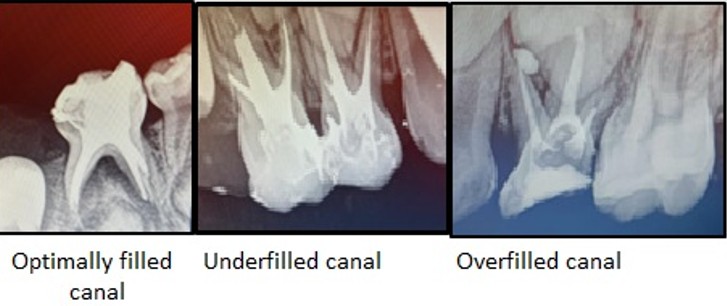
Post obturation RVG was taken and restoration was done using Glass ionomer cement. Stainless steel crown was placed in the next appointment. The quality of obturation and presence or absence of voids was evaluated on radiograph post obturation. (Figure 2)

Evaluation criteria

The comparison among two groups was determined radiographically by evaluating quality of obturation and voids in the obturated canals by a single radiologist who was blinded to the groups. Following criteria given by Coll and Sadrian (1999) was used for evaluation.

  1. Under filling (Score 1): All the canals were filled more than 2 mm short of the apex.
  2. Optimal filling (Score 2): One or more of the canals having obturating material ending at the radiographic apex or upto 2 mm short of the apex.
  3. Over filling (Score 3): Any canal showing obturating material extending beyond the radiographic apex.
  4. Voids: Obturated canals showing voids (presence/ absence).

Statistical Analysis:

The data collected was subjected to statistical analysis and was analysed using the IBM SPSS version 21(IBM Corp., Armonk, NY, USA) software. The demographic characteristics like the age and sex of the children were performed using the Chi-square test. Group comparison for quality of obturation and voids were performed using the Mann-Whitney U test and Chi-square test.

Results

Twenty five children between the age of 5-8 years participated in the present study. The mean age of the participants in Group 1 and Group 2 was 5.60 ± 1.05 years and 5.40 ± 0.63 years, respectively, with no statistically significant difference (P = 0.53). (Table 1).

Each group had allotted 15 teeth. In group 1 - 59 canals and in Group 2 - 59 canals in total were assessed. Out of 59 canals in Group 1- 22 canals (37.2%) were underfilled, 29 canals (49.1%) were optimally filled and 8 canals (13.7%) were overfilled. In group II out of 54 canals 12 canals (20.3%) were underfilled, 32 canals (54.2%) were optimally filled and 15 canals (25.5%) were overfilled canals. There was no statistical difference seen between the two groups P = 0.071). When metal tip was used most of the teeth showed underfilled canals 37.2% and when Plastic tip was used most of teeth showed overfilled canals 25.5%. (Table 2).

In case of Voids teeth in group I out of 59 canals 31 canals (52.4%) showed voids while in Group 2 out of 59 canals 39 canals (66.1%) showed voids. No statistically significant difference was seen between the groups (P = 0.79). (Table 3)

Discussion

In pediatric endodontics, zinc oxide eugenol (ZOE) is a commonly used obturation material with its share of disadvantages such as altering the eruption pathway of the sucedaneous teeth, causing anterior crossbite, palatal eruption, and ectopic eruption of sucedaneous teeth, necrosis of cementum and bone, varying or slow rate at which ZOE resorbs in comparison to root resorption, enamel defects in permanent successors, and soft tissue irritation due to which it fails to meet the ideal requirements of an obturating material.[[i]] Endoflas is a combination of three materials, i.e., ZOE, calcium hydroxide, and iodoform has gained popularity in the recent past as an obturating material in primary teeth. The rationale behind incorporating these three materials into endoflas is to compensate for the disadvantage of one individual material with the advantages of the other.[[ii]] It has various advantages such as greater antimicrobial activity, long-term substantivity, resorption pattern coincides with physiological root resorption and it has shown a success rate - 93.3%–95.1% (Ramar K et al).[[iii]] Fuks et al observed that Endoflas resorbed when overextended periapically, but it did not resorb intraradicularly. He also reported a 100% reduction in periapical radiolucency and a 70% clinical success rate with endoflas. Its high rate of clinical and radiographic success demonstrates its superior healing properties and full bone repair. Antimicrobial property and high pH of Endoflas minimises periapical inflammation and promotes periapical healing through increased alkaline phosphatase activity and periapical bone remineralization.[[i]]

A study done by Reddy and Shakunthala (1997)[ ] showed greater overfilling (25%) with tuberculin syringe with metal tip whereas in the present study greater overfilling was seen when plastic tip was used (25.5%). Another study done by Gandhi et al (2017)[ ] concluded that least number of voids (8.3%) was observed in canals filled with the disposable syringe using metal tip. In the present study, voids were seen more when metal tip was used (66.1%). Both the studies showed contradictory results to the present study.

Memarpour et al (2014)[ ] in his study concluded that tuberculin syringe with metal tip showed 36% of underfilled canals which showed similar results to the present study where 37.2% of underfilled canals were seen when metal tip was used. Nagarathna C et al (2018)[3] in his study found 66% of optimally filled canals and 23% of overfilled canals when disposable syringe with plastic tip was used which showed similar results to the present study where 25.5% of overfilled canals were seen when plastic tip was used. Another study done by Kalaskar R et al (2023)[ ] stated that optimal obturation was seen in 67.5% of root canals, whereas under-obturation and over-obturation was seen in 20 and 12.5% of root canals, respectively using Vitapex paste with plastic disposable tips. In the present study Endoflas obturation showed under-obturation and overobturation in 37.2% and 13.7% of root canals, respectively when metal tip was used and when plastic tip was used under-obturation and over-obturation was seen in 20.3% and 25.5% of root canals, respectively.

In the present study, RVG was used for evaluation instead of CBCT which could have given a 3-dimentional view but the radiation exposure of CBCT is more compared to RVG. Radiographic examination in children is crucial as they more susceptible to ionizing radiation compared to adults that is 2-10 times. [ ] The European Academy of Paediatric Dentistry (EAPD) recommended that for prescribing dental radiographs in children and adolescents, limit radiation exposure according to the ALADAIP principle (As Low As Diagnostically Achievable being Indication-oriented and Patient-specific).[ ]

During the course of the study we found certain clinical observations. As the setting time of Endoflas is 6-7 mins more amount of wastage of material was seen in both the groups. Flow of the material could be seen when plastic tips were used due to its transparency. They had good flexibility when compared to metal tips, hence can conform to the canal. The plastic tips could be cut to a desirable length if required for better flow and it was also seen that the children seemed to show more acceptance to syringe with plastic tip as it may have appeared less threatening.

Conclusion

No statistically significant difference found between the two different tips used for obturation in primary teeth. Both the techniques of obturation showed maximum number of optimal fillings although overfilled canals were seen more with tuberculin syringe using plastic disposable tips while underfilled canals and voids were seen more with tuberculin syringe using metal tips. More number of studies need to be carried out using different obturating materials with varying obturating techniques.

Acknowledgment: None

Source(s) of Support and Funding: Nil

Conflict of Interest: Nil Ethical Approval number: IREB/2024/PEDO/01

Contribution of authors: M.B., S.S.N. and C.C. conceived the ideas; C.C. collected the data; C.C. and I.R. analysed the data; and C.C. led the writing.

References

  1. Vashista K, Sandhu M, Sachdev V. Comparative Evaluation of Obturating Techniques in Primary Teeth: An in vivo Study. Int J Clin Pediatr Dent 2015;8(3):176-180.
  2. Raju SS, Reddy RE, Rani TS, et al. Assessment of Four Obturation Methods in Deciduous Teeth Using Digital Radiography: An In Vivo Study. Int J Clin Pediatr Dent 2022;15(S-1):S52–S56.
  3. Nagarathna C, Vishwanathan S, Krishnamurthy NH, Bhat PK. Primary Molar Pulpectomy Using Two Different Obturation Techniques: A Clinical Study. Contemp Clin Dent. 2018 Apr-Jun;9(2):231-236.
  4. Coll JA, Sadrian R. Predicting pulpectomy success and its relationship to exfoliation and succedaneous dentition. Pediatr Dent. 1996 Jan-Feb;18(1):57-63. PMID: 8668572.
  5. Rewal, Nivedita & Thakur, Arun & Sachdev, Vinod & Mahajan, Nanika. (2014). Comparison of Endoflas and Zinc oxide Eugenol as root canal filling materials in primary dentition. Journal of the Indian Society of Pedodontics and Preventive Dentistry. 32. 317-21. 10.4103/0970-4388.140958.
  6. Ramar K, Mungara J. Clinical and radiographic evaluation of pulpectomies using three root canal filling materials: An in vivo J Indian Soc Pedod Prev Dent 2010;28:25-9.
  7. Holan G, Fuks AB. A comparison of pulpectomies using ZOE and KRI paste in primary molars: a retrospective study. Pediatr Dent. 1993 Nov-Dec;15(6):403-7. PMID: 8153002.
  8. Subba Reddy VV, Shakunthala B. Comparative assessment of three obturating techniques in primary molars: An in vivo Endodontology 1997;9:13-6.
  9. Gandhi M, Tandon S, Vijay A, Kalia G, Rathore K. Clinical assessment of various obturating techniques for primary teeth : A comparative study. J Clin Diag Res 2017;11(7): ZC48-ZC51.
  10. Memarpour, M., Shahidi, S., Meshki, R. 2013. Comparison of different obturation techniques for primary molars by digital radiography. Pediatric dentistry, 35(3):236–240.
  11. Kalaskar R, Thosar NR, Kalaskar A. Evaluation of Novel Device “Obturagun” as a Root Canal Obturating Technique for Primary Teeth: An In Vitro Study. Int J Clin Pediatr Dent 2023;16(1):107– 111.
  12. Radiation protection no 172: cone beam CT for dental and maxillofacial radiology. Evidence based guidelines. European commission.
  13. Kuhnisch J, Anttonen V, Duggal MS, Spyridonos ML, Rajasekharan S, Sobczak M, Stratigaki E, Van Acker JWG, Aps JKM, Horner K, Tsiklakis K. Best clinical practice guidance for prescribing dental radiographs in children and adolescents: an EAPD policy document. Eur Arch Paediatr Dent. 2020;21:375–86.
TOP