
Beyond the Surface: Clinical and genetic insights in CEDNIK Syndrome
Dr Amodini Lakshmeswar1*, Dr Madhu Pujar2
¹Postgraduate in MD Pediatrics, Department of Pediatrics, JJM Medical College, Davangere, Karnataka, India.
²Professor, Department of Pediatrics, JJM Medical College, Davangere, Karnataka, India
*Corresponding author
*Dr Amodini Lakshmeswar , Post graduate in MD Pediatrics, Department of Pediatrics, JJM Medical College, Davangere, Karnataka, India
DOI: 10.55920/JCRMHS.2025.09.001384
Abstract
Background: Neurocutaneous syndromes are a group of disorders with shared embryonic origins involving neural and epidermal tissues. CEDNIK Syndrome (CErebral Dysgenesis, Neuropathy, Ichthyosis, and Keratoderma) is a rare genetic condition with an estimated global incidence of 0.043%. It results from mutations in the SNAP29 gene, which is vital for cellular trafficking and other essential processes. These mutations lead to developmental and clinical manifestations, underscoring the importance of early diagnosis and intervention.
Clinical Description: A 6-month-old male infant presented with developmental delay, poor response to auditory stimuli, and failure to achieve motor milestones. He was born to second-degree consanguineous parents with a history of antenatal oligohydramnios, single umbilical artery, and non-progressive dilatation of the cerebral lateral ventricles. On examination, he had microcephaly, dysmorphic features, palmoplantar keratoderma, ichthyosis, and generalized hypotonia. Further evaluations revealed normal ophthalmological and audiological findings, while MRI showed cerebral dysgenesis and partial agenesis of the corpus callosum.
Genetic Findings: Whole exome sequencing revealed a homozygous mutation (Chr22: g.20881101_20881102dup) in the SNAP29 gene, causing a frameshift and premature truncation of the protein. Both parents were heterozygous carriers of the mutation.
Management and Outcome: The patient received supportive care, including regular follow-ups and genetic counselling for the family. Management focused on symptomatic relief and early intervention to optimize developmental outcomes.
Discussion: CEDNIK Syndrome is characterized by severe developmental delay, intellectual disability, hypotonia, neuropathy, and progressive skin changes such as keratoderma and ichthyosis. Imaging findings include cerebral dysgenesis and white matter abnormalities. Early diagnosis, supported by genetic testing, is crucial for appropriate management and counselling. The condition has no definitive cure, and most patients do not survive beyond the second decade.
Conclusion: CEDNIK Syndrome underscores the complexities of neurocutaneous disorders, highlighting the importance of early diagnosis and genetic evaluation. Multidisciplinary care is essential for managing symptoms and improving patient quality of life.
Keywords: Neurocutaneous syndrome, rare genetic syndrome
Clinical Description
A six-month-old male infant, Master S, presented to our institute with delay in attainment of developmental milestones and inability to respond to auditory stimuli, noticed since the age of five months. He was the only issue of a second-degree consanguineous marriage as depicted in Figure 1. Antenatal scans had revealed oligohydramnios, single umbilical artery and non-progressive dilatation of cerebral lateral ventricles. He was a term IUGR neonate with a birth weight of 1.94 kg. He was admitted to the NICU for ten days for low birthweight care and feed establishment. Partial neck control had been attained. No bi-dexterous grasp, no cooing or social smile attained. Child did not startle or turn towards sound. Child had been appropriately immunized for age and was on direct breast feeds and complementary feeds.
On examination, child was hemodynamically stable with weight and length for age being below minus three Z score with microcephaly. He had an unusually fair complexion, flat occiput, non-specific dysmorphic facies, mild hypertelorism, alternating exotropia, high arched palate, short philtrum with bowed upper lip and low set ears. Palmoplantar keratoderma and generalized mild ichthyosis were noted, as seen in Figure 2. Nervous system examination revealed sluggish deep tendon reflexes and generalized hypotonia. Complete head lag was present and no startle response noted.
Management and Outcome
Ophthalmological evaluation revealed normal fundus picture. Oto-Acoustic Emission screening test was normal in bilateral ears and follow up BERA test normal. MRI Brain revealed diffuse thinning and partial agenesis of corpus callosum (absent splenium). Metabolic workup was done to rule out other differential diagnoses, including inborn errors of lipid metabolism like Refsum disease, Sjogren Larssen syndrome, and disorders of glycoprotein synthesis– amino acid profile by TMS and urine GCMS were normal. Whole exome and Sanger sequencing was done as shown in Figure 3, and a homozygous single base pair duplication in exon 3 of the SNAP29 gene
(Chr22:g.20881101_20881102dup; Depth: 112x) was detected, with the homozygous c.487 duplication of the coding region, which is the most commonly reported mutation in this syndrome. There isreplacement of the original amino acid serine at position 163 of the protein, by lysine, with a frameshift after this point, with a stop codon introduced at position 6 of the altered protein sequence, 6 amino acids after the frameshift, leading to premature truncation of the protein.


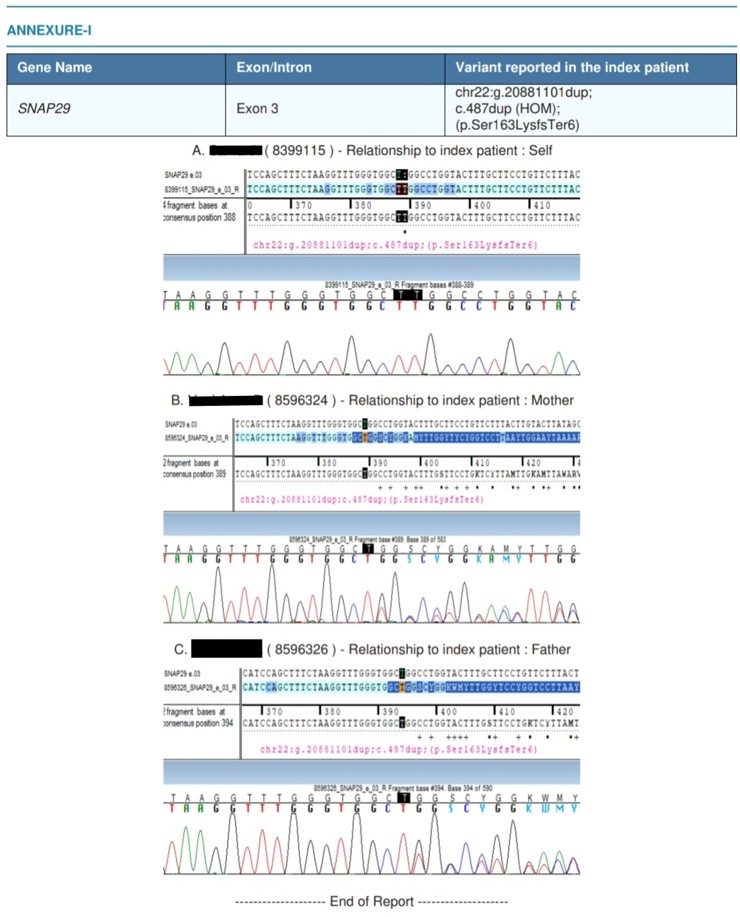
The same pathogenic variant was detected in the heterozygous condition in both the asymptomatic parents of the index case.
Genetic counselling was done for the family, the child was provided with supportive management and advised regular follow up.
Discussion
CEDNIK Syndrome, caused by loss-of-function mutations in the SNAP29 gene, exemplifies the intricate relationship between genetic abnormalities and their diverse clinical manifestations. This rare neurocutaneous syndrome was first described in 2005 and is characterized by cerebral dysgenesis, developmental delay, neuropathy, and skin changes such as ichthyosis and palmoplantar keratoderma [1]. Fewer than 25 cases have been reported globally, with only four documented from India [2,3,4, 5]. This case adds valuable insights by identifying a homozygous SNAP29 mutation (Chr22: g.20881101_20881102dup), which led to premature truncation of the SNAP29 protein, confirming the diagnosis.
The clinical features observed in this patient align with the previously described phenotypic spectrum of CEDNIK Syndrome. Dysmorphic features, ichthyosis, and global developmental delays are hallmark findings that reflect the critical role of SNAP29 in cellular trafficking, epidermal differentiation, and neural development [6, 7]. Imaging abnormalities, including partial agenesis of the corpus callosum and white matter changes, are diagnostic hallmarks [8]. These findings were consistent with reports by Sprecher et al. and Mah-Som et al., which documented similar neuroimaging anomalies including cortical dysplasia, as well as hypomyelination, white matter loss, and white matter signal anomalies suggestive of a leukodystrophy [8]. Importantly, this case also highlights antenatal findings, such as oligohydramnios and cerebral ventricular dilatation, which may serve as early clues in affected pregnancies.
Whole exome sequencing played a pivotal role in this diagnosis, emphasizing the importance of genetic testing in rare syndromes. Genetic counselling was crucial for the family, especially in the context of a consanguineous marriage, to provide information on recurrence risks and future reproductive options [4,7]. This underscores the significance of genetic evaluation in regions with a high prevalence of consanguinity, where rare autosomal recessive conditions are more frequently observed [6,8].
Management of CEDNIK Syndrome remains supportive, as no curative treatment exists, and expected lifespan is short, [7, 8] with most patients not surviving beyond the second decade, with the oldest patient reported as nineteen years of age. [8]. Early intervention with physical therapy, speech therapy, and multidisciplinary care can optimize developmental outcomes [5,6]. Dermatological management is equally essential, given the progressive nature of palmoplantar keratoderma and ichthyosis [9]. Mah-Som et al. have highlighted the limited life expectancy in CEDNIK Syndrome, with most patients not surviving beyond the second decade of life, emphasizing the importance of proactive and symptomatic management [6,7].
This report contributes to the growing body of literature on CEDNIK Syndrome, particularly in expanding the genotypic and phenotypic spectrum. By documenting this case in an Indian patient, it highlights the importance of awareness among clinicians, especially in resource-limited settings, to ensure timely diagnosis and comprehensive care. Increased vigilance and collaboration among paediatricians, dermatologists, neurologists, and geneticists are critical to improving outcomes and providing holistic care for affected individuals and their families [8, 9, 10].
Lessons learnt
- Identifying CEDNIK Syndrome through its clinical presentation is crucial for timely intervention, emphasizing the need for healthcare providers to be vigilant in recognizing the constellation of features that characterize rare syndromes, allowing for early diagnosis and management that can significantly impact patient outcomes.
- The identification of the homozygous SNAP29 mutation in this case and a heterozygous mutation in both asymptomatic parents underscores the importance of genetic testing in confirming diagnoses of complex disorders.
- Managing CEDNIK Syndrome effectively requires a coordinated, multidisciplinary approach that involves various specialists, including pediatricians, neurologists, dermatologists, and physical therapists.
References
- Sprecher E, Ishida-Yamamoto A, Mizrahi-Koren M, Rapaport D, Goldsher D, Indelman M, et al. A mutation in SNAP29, coding for a SNARE protein involved in intracellular trafficking, causes a novel neurocutaneous syndrome characterized by cerebral dysgenesis, neuropathy, ichthyosis, and palmoplantar keratoderma. Am J Hum Genet. 2005 Aug;77(2):242-51. Epub 2005 Jun 20. doi: 10.1086/432556. PMID: 15968592.
- Poojary S, Shah KS, Bhalala KB, Hegde AU. CEDNIK syndrome in an Indian patient with a novel mutation of the SNAP29 gene. Pediatr Dermatol. 2019 May;36(3):372-376. doi: 10.1111/pde.13761. Epub 2019 Feb 22.
- Bansal V, Tamhankar V, Mithbawkar S, Tamhankar P. CEDNIK Syndrome: Report of an Ultra Rare case from India. Neurol India. 2021 Dec;69(6):1861.
- Karunakaran S, Thomas B, Menon R, Nair M, Nair SS, Sundaram S. Cerebral Dysgenesis, Neuropathy, Ichthyosis and Keratoderma (CEDNIK) Syndrome with brainstem malformation. Ann Indian Acad Neurol. 2021 Nov-Dec;24(6):979-81.
- Bijarnia-Mahay, S., Bhatia, S., Gupta, D. et al.CEDNIK Syndrome – A Report of a Clinically Recognizable Disorder with Prenatal Diagnosis. Indian J Pediatr 91, 874 (2024).
- Smeele PH, Vaccari T. Snapshots from within the cell: Novel trafficking and non-trafficking functions of Snap29 during tissue morphogenesis. Semin Cell Dev Biol. 2023 Jan 15;133:42-52. Epub 2022 Mar 4. doi: 10.1016/j.semcdb.2022.02.024. PMID: 35256275.
- Fuchs-Telem D, Stewart H, Rapaport D, Nousbeck J, Gat A, Gini M, et al. CEDNIK syndrome results from loss-of-function mutations in SNAP29. Br J Dermatol. 2011 Mar;164(3):610-6. doi: 10.1111/j.1365-2133.2010.10133.x.Epub 2011 Feb 17. PMID: 21073448.
- Mah-Som AY, Skrypnyk C, Guerin A, Seroor Jadah RH, Vardhan VN, McKinstry RC, et al. New Cohort of Patients With CEDNIK Syndrome Expands the Phenotypic and Genotypic Spectra. Neurol Genet. 2021 Jan 12;7(1)
- Nunes N, Zamariolli M, Dantas AG, Cola P, de Agostinho Júnior F, Piazzon FB, et al. CEDNIK syndrome in a Brazilian patient with compound heterozygous pathogenic variants. Eur J Med Genet. 2022 Mar;65(3):104440. doi: 10.1016/j.ejmg.2022.104440. Epub 2022 Jan 29. PMID: 35093605.
- Lorenzo-Ríos D, Guerrero-García A, Colón-Fontánez F. Keratoderma and ichthyosis as valuable features for the diagnosis of CEDNIK syndrome. JAAD Case Rep. 2023 Sep 27;46:64-66. doi: 10.1016/j.jdcr.2023.09.005. eCollection 2024 Apr. PMID: 38590735.