Department of Pneumology, Hospital 20 Août 1953, CHU Ibn Rochd, Casablanca, Morocco.
*Soukaina Hallouli, Department of Pneumology, Hospital 20 Août 1953, CHU Ibn Rochd, Casablanca, Morocco.
Abstract
Unilateral pulmonary artery agenesis is a rare malformation affecting 1% of congenital heart defects. We report 2 clinical cases of two patients hospitalized in the respiratory diseases department of Hôpital 20 Août 1953, Casablanca, presenting complicated bronchial dilatations which revealed unilateral hypoplasia of the pulmonary artery localized on the left for the first patient and on the right for the second patient. They were respectively 69 and 33 years old, with no toxic habits and recurrent childhood respiratory infections. Their clinical symptomatology was dominated by a progressive purulent bronchial syndrome associated with worsening dyspnea, which became mMRC stage II. Clinical examination revealed diffuse bilateral snoring rales. Chest X-rays showed in both cases a hyper-clear, retracted hemithorax on the affected side, with a bronchial syndrome. Chest CT showed asymmetry of the 2 lung fields associated with localized bronchial dilatation and agenesis of the left pulmonary arteries in the 1st case and right pulmonary arteries in the 2nd case. Thoracic angioscan confirmed the diagnosis. Ventilation-perfusion scintigraphy showed that lung function was almost exclusively ensured by the lung contralateral to the pulmonary artery involvement. Flexible bronchoscopy enabled visualization of malformative anomalies of the bronchial axis on each affected side, and bronchial aspirations were negative. Cardiac echocardiography, in search of cardiac malformations that may have been asymptomatic, or complications such as pulmonary hypertension, was normal, as was the work-up for repercussions.
Keywords: AAgenesis, Pulmonary Artery, Malformation, Congenital Heart Disease, Thoracic Angioscan, Scintigraphy
Introduction
Unilateral pulmonary artery agenesis is a rare malformation affecting 1% of congenital heart diseases. Initially described by Fraentzel in 1868 (1), it is often asymptomatic but can have a variable clinical presentation. We report two medical cases of two patients aged 69 and 33 years, respectively, presenting with complicated bronchiectasis that revealed unilateral pulmonary artery hypoplasia. The first patient had left-sided hypoplasia, while the second had right-sided hypoplasia.
Patient and Observation
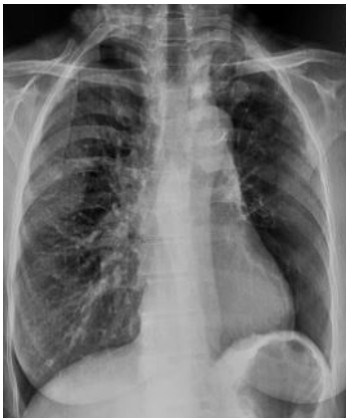
Observation 1: Mrs. B.H, aged 69, with no toxic habits, had repeated childhood respiratory infections, was known to have chronic dyspnea, and had hypertension for 3 years, treated with Amlodipine. She had undergone lumbar disc hernia surgery 20 years ago, but no records were available. For the past 3 months, she presented with a progressive purulent bronchial syndrome associated with worsening dyspnea, reaching mMRC stage II. This evolved in the context of afebrile illness and stable general condition. Clinical examination revealed bilateral and diffuse wheezing. The chest X-ray (Figure 1) showed a hyperlucent and retracted left hemithorax with alveolar images within it, and a right hemithorax with bronchial syndrome. The biological assessment at admission revealed neutrophil leukocytosis (11600/mm3 white blood cells, 8620/mm3 neutrophils) and an elevated C-reactive protein (40.7 mg/L). The cytobacterial examination of the sputum and GeneXpert were negative.
Figure 1: Anterior chest X-ray of the first case showing a hyperlucent and retracted left hemithorax.
Figure 2: Chest CT scan of the first case showing bronchiectasis at the apex with agenesis of the left pulmonary artery
Figure 3: Chest angio-CT scan of the first case confirming hypoplasia of the left superior and inferior lobar arteries as well as their segmental branches.
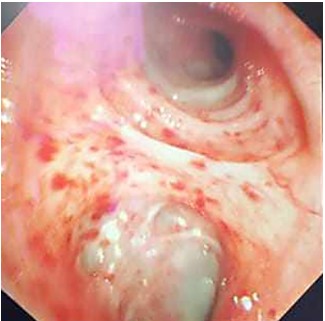
Figure 4: Flexible bronchoscopy of the first case showing diffuse second-degree inflammation with a reduction of the lingula opening, which is non-catheterizable.
Figure 5: Ventilation-perfusion scintigraphy of the first case showing pulmonary function almost exclusively provided by the right lung.
Figure 6: Anterior chest X-ray of the second case showing a retracted right hemithorax, bilateral bronchial syndrome, and dextrocardia.
Figure 7: Chest CT scan of the second case showing hypoplasia of the right pulmonary artery
Figure 8: Chest angio-CT scan of the second case showing hypoplasia of the right lung and its bronchovascular pedicle with deviation of the mediastinal structures and heart towards the right side.
A thoracic CT scan (Figure 2) revealed an asymmetry of the two lung fields associated with bronchiectasis located at the apex, and agenesis of the left superior and inferior lobar arteries and their segmental branches. A subsequent angioCT scan (Figure 3) confirmed the diagnosis.
The patient was started on empirical antibiotic therapy with a combination of Amoxicillin-Clavulanic Acid, respiratory physiotherapy for drainage, and abundant fluids. At 72 hours, there was a resolution of the purulent bronchial syndrome, disappearance of bilateral wheezing, and normalization of the biological results. A flexible bronchoscopy was performed to investigate possible bronchial axis anomalies and to conduct bacteriological studies given the presence of bronchiectasis. It revealed second-degree diffuse inflammation with a reduction in the opening of the lingula, which was non-catheterizable (Figure 4). Bronchial aspirations were negative.
Concerned about the possibility of an asymptomatic heart malformation or complications such as pulmonary hypertension, a cardiac ultrasound was performed and was normal. The ventilation-perfusion scintigraphy (Figure 5) showed that pulmonary function was almost exclusively provided by the right lung (93.2%) compared to the left lung (6.8%). Regarding perfusion, the right lung had homogeneous perfusion without defects, while the left lung was reduced in size with collapsed and homogeneous perfusion.
As for the impact assessment, plethysmography did not reveal obstructive or restrictive ventilatory disorders, with a Tiffeneau index (FEV1/FVC ratio) at 98% and a total lung capacity (TLC) of 94%. The six-minute walk test did not show desaturation, with a distance of 360 meters.
Concerned about the potential development of amyloidosis due to repeated respiratory infections, 24-hour proteinuria and a labial biopsy showed no abnormalities.
Observation 2: Mrs. XX, aged 33, with no toxic habits, had chronic dyspnea since childhood and repeated childhood respiratory infections. She presented with a gradually worsening purulent bronchial syndrome for the past 6 months, associated with worsening dyspnea reaching mMRC stage II. This evolved in the context of afebrile illness and stable general condition. Clinical examination showed bilateral diffuse wheezing, slight deviation of heart sounds to the right, and rightward apex beat. Chest X-ray (Figure 6) revealed a retracted right hemithorax, bilateral bronchial syndrome, and dextrocardia.
At admission, the biological assessment revealed neutrophil leukocytosis (12,800/mm3 white blood cells, 9420/mm3 neutrophils) and elevated C-reactive protein (50.8 mg/L). The cytobacterial examination of sputum and GeneXpert were negative.
Thoracic CT showed right pulmonary artery hypoplasia (Figure 7), with bronchiectasis located in the right upper lobe. A subsequent angio-CT scan (Figure 8) confirmed the diagnosis, showing hypoplasia of the right lung and its bronchial and vascular pedicle, with a deviation of the mediastinal and cardiac elements to the right.
The patient was started on empirical antibiotic therapy with a combination of Amoxicillin-Clavulanic Acid, respiratory physiotherapy, and abundant fluids. At 72 hours, the purulent bronchial syndrome resolved, bilateral wheezing disappeared, and the biological results normalized. A flexible bronchoscopy was performed to investigate possible bronchial axis anomalies and conduct bacteriological studies given the presence of bronchiectasis. It revealed second-degree diffuse inflammation with a reduction in the opening of the right superior lobar division, which was non-catheterizable. Bronchial aspirations were negative.
Concerned about a possible asymptomatic heart malformation or complications such as pulmonary hypertension, a cardiac ultrasound revealed rightward deviation of the heart.
Ventilation-perfusion scintigraphy was not performed due to patient refusal.
In terms of impact assessment, plethysmography did not reveal obstructive or restrictive ventilatory disorders, with a Tiffeneau index at 92% and a total lung capacity (TLC) of 104%. The six-minute walk test did not show desaturation, with a distance of 360 meters.
Due to concerns about amyloidosis from recurrent respiratory infections, 24-hour proteinuria and a labial biopsy showed no abnormalities.
Discussion
Pulmonary artery agenesis or hypoplasia is a rare congenital malformation that represents 1% of congenital heart diseases. Its prevalence is 1 in 200,000, with the right pulmonary artery being the most affected. It can occur in isolation in 40% of cases or be associated with other congenital heart diseases in 60% of cases (2).
Embryologically, the branches of the pulmonary artery are derived from the proximal portion of the sixth aortic arch. The disappearance of the proximal portion of the right or left arch leads to the absence of the corresponding pulmonary artery. Ipsilateral pulmonary hypoplasia occurs due to the parallelism between vascular development and alveolar growth. Therefore, the cessation of growth of a pulmonary artery leads to a defect in peripheral alveolar growth, resulting in diffuse pulmonary hypoplasia (3).
Clinically, pulmonary artery agenesis is often asymptomatic. It can present as dyspnea, exertional dry cough, or be discovered due to complications such as recurrent respiratory infections, as seen in our two patients, hemoptysis, pulmonary hypertension, or acute cardiogenic pulmonary edema (2).
Angio-CT is the gold standard for diagnosis, revealing the anomaly (4). Flexible bronchoscopy is useful for visualizing bronchial axis malformations on the affected side and in cases of complications, such as infections and hemoptysis. In our study, it revealed a reduction in the lingula opening in the first patient and a reduction in the opening of the right superior lobar division in the second patient, both of which were non-catheterizable.
Ventilation-perfusion scintigraphy is not necessary for diagnosis, but it shows absent or significantly reduced perfusion in the affected lung. It can guide therapeutic decisions and evaluate pulmonary function, as seen in our first patient, whose pulmonary function was almost entirely supported by the right lung. Cardiac ultrasound is crucial for diagnosing and monitoring, as it helps identify associated heart malformations such as Tetralogy of Fallot, atrial septal defect, patent ductus arteriosus, …, and detects pulmonary hypertension (5).
Therapeutic approaches should be individualized based on the patient’s symptoms, pulmonary artery anatomy, associated cardiovascular anomalies, and the presence of complications. Treatment for recurrent respiratory infections and hemoptysis may include medical treatment, embolization, or pneumonectomy, as well as treatment for pulmonary hypertension. No treatment is necessary for patients without signs of cardiorespiratory dysfunction.
Prevention is essential and relies on patient education and vaccination. The prognosis is often poor when associated with other congenital heart diseases or severe pulmonary hypertension. Mortality is reported at 7% (2).
Conclusions
Left pulmonary artery agenesis is a malformation that is often asymptomatic, especially when isolated. We emphasize the importance of early diagnosis in the presence of any clinical or radiological signs. Close followup is essential due to the risks of pulmonary hypertension, recurrent infections, and hemoptysis.