
Congenital Peribronchial Myofibroblastic Tumor: A Rare Tumor of the Fetus or Neonate
Danielle Weiss1*, Beverley Newman2, Terry L. Levin1
¹Department of Radiology Division of Pediatric Radiology, Montefiore Medical Center, 111 E 210th St Bronx, New York, 10467 USA.
²Department of Radiology, Stanford Childrens Hospital, Stanford University, 725 Welch Road, Palo Alto , CA 94304 USA.
*Corresponding author
*Danielle Weiss, Department of Radiology Division of Pediatric Radiology, Montefiore Medical Center, 111 E 210th St Bronx, New York, 10467 USA.
DOI: 10.55920/JCRMHS.2025.09.001381
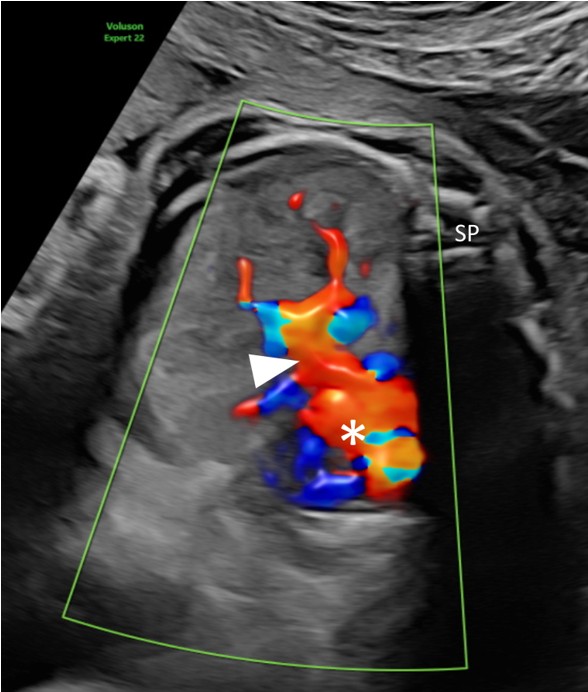
Figure 1a: Case 1. Female. Oblique axial, prenatal ultrasound image with color Doppler of the chest at 30 weeks’ gestation. There is prominent pulmonary arterial supply (arrowhead) to the right lower lung mass. The heart (asterix) is displaced to the left. SP=spine
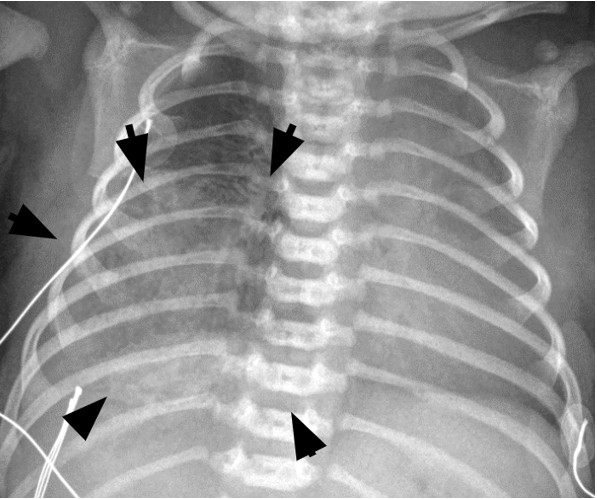
Figure 1b: Prenatal MRI at 30 weeks’ gestation: Coronal T2 weighted image with a large mass (arrows) in the right lower lung that is heterogeneous, mostly hyperintense with some hypointense areas, expands the right lower lobe and causes leftward shift of the heart (H).
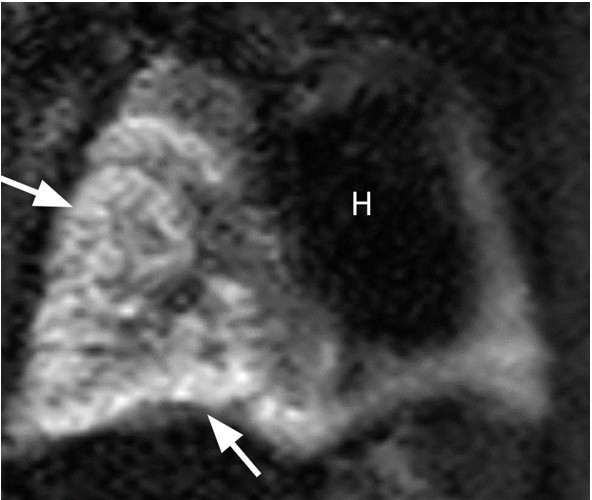
Figure 1c: Frontal chest radiograph at birth. There is a large right lower lobe opacity (arrows) causing leftward cardiomediastinal shift.

Figure 1d: Day 2. Post contrast coronal CT reformation of the chest, soft tissue window. kVp 80 DLP 32 mGycm. The large round mass (arrows) in the right lower lobe is shown. Note air bronchogram (arrowhead), and heterogeneous enhancement.
At birth, a chest radiograph revealeda large, rounded opacity in the right lower lobe with cardiomediastinal shift to the left (Fig1c). Sonographically, the mass measured 3.7cm, was solid, heterogeneous and had prominent internal vascularity. The diagnosis of mixed CPAM with components of sequestration was raised. A contrast enhanced computed tomography (CT) of the chest on day 2 showed a solid heterogeneously enhancing mass without a feeding systemic vessel. Air bronch ograms extended into the mass(Fig1d).
Due to respiratory compromise, the infant underwent right lower lobectomy on day of life 3. Pathology revealed a solid mass composed primarily of hyaline cartilage and smooth muscle, with focal adipose tissue and intervening respiratory epithelium and alveolar parenchyma. A diagnosis of pulmonary hamartoma was made which was subsequently revised to CPMT based on the finding of abundant spindle cell proliferation (smooth muscle actin positive and desmin negative) and immature-appearing oval cells. The infant did well and was discharged on day of life 25.

Figure 2a: Case 2.1day old male. Frontal chest radiograph. Large rounded intrapulmonary opacity extending from the right hilum to the lateral chest wall with mild leftward cardiomediastinal shift.

Figure 2b: Day1 CT with contrast. 70kVp, DLP 6mGycm. Sagittal reconstructed soft tissue window image. There is a large solid moderately enhancing mass in the posterior/inferior right upper lobe. The mass contains prominent vessels especially peripherally and air bronchograms (arrows).

Figure 2c: MR coronal T2-day 3. Study done as swaddle and feed examination without anesthesia. Large central right lung mass. T2 heterogeneous hyper- and hypo- intense areas on this early MR. Prominent vessels especially peripherally and central air bronchograms

Figure 2d: MR coronal T2 - day 38. Study done as swaddle and feed examination without anesthesia. Large central right mass becoming more uniformly T2 hyperintense on this later study. Prominent vessels especially peripherally and central air bronchograms. Small decrease in size of the lesion on this later study. The change in T2 signal over time may reflect maturation of the lesion with a ecreasing mesenchymal component.
The infant became clinically asymptomatic after the early newborn period and based on the size and location of the mass which predicted a difficult resection, surgery was postponed with chest radiographs and serial MR imaging surveillance. MR imaging showed an initial small decrease in the size of the mass with subsequent stabilization of size and increasing diffuse T2 hyperintensity (Fig 2d).
After several months, the child underwent surgical excision of the right upper lobe mass with preservation of the remaining lung and other major vessels and bronchi. Histologically, fascicles of bland spindle cells associated with irregular plates of cartilage tracking along bronchovascular bundles, interlobular septae and subpleural spaces, consistent with CPMT were identified. Tumor cells extended to the hilar margin of resection. The tumor was actin positive and desmin negative. The infant did well and was discharged home 10 days after surgery.