
Late-onset Multiple Acyl-CoA Dehydrogenase Deficiency with Histological Pattern of Necrotizing Myositis : A Case Report
Suporn Travanichakul, MD1*, Samasuk Thammachantha, MD2
¹Buriram Hospital, Buriram, Thailand.
²Department of Pathology, Neurological Institute of Thailand (NIT), Bangkok.
*Corresponding author
*Suporn Travanichakul, Buriram Hospital, Buriram, Thailand.
DOI: 10.55920/JCRMHS.2025.09.001375
Abstract
Background: Multiple Acyl-CoA Dehydrogenase Deficiency (MADD) is a rare inherited lipid storage myopathy. We reported the first case of late onset MADD whose muscle biopsy revealed the necrotizing myositis together with lipid storage myopathy.
Case report: A 45-year-old woman, previously had the problem of fatique, myalgia and proximal muscle weakness, presented with rhabdomyolysis and severe metabolic acidosis. Her past history was depression which treated by sertraline. MADD was diagnosed withplasma acylcarnitine profile and muscle biopsy. However, the muscle biopsy had additional necrotizing myositis. Her symptoms and creatine kinase (CK) were improved after riboflavin replacement therapy.
Conclusion: MADD should be included in the differential diagnosis of acute rhabdomyolysis and metabolic acidosis in subacute-onset proximal muscle weakness even in adult patients. And it could be presented as mimicking myositis.
Introduction
Multiple Acyl-CoA Dehydrogenase Deficiency (MADD) is a rare inherited lipid storage myopathy. The muscle biopsy showed cytoplasmic vacuoles under hematoxylin and eosin staining that were confirmed as lipid droplets when stained with oil red O without any features of myositis1. However, we reported the first case of late onset MADD whose muscle biopsy revealed the necrotizing myositis together with lipid storage myopathy.
Case Report
A 45-year-old woman presented to the hospital with acute respiratory failure due to severe lactic and normoglycemic ketoacidosis requiring ventilatory support. Her part medical history was obesity with depression disorder, taking 200mg of sertraline daily for 10 years. She presented 4 months earlier to neurology clinic with fatigue, myalgia and progressive proximal muscle weakness primarily affecting her lower extremities. This had developed over a period of 6 months after she started a low carbohydrate, calorie restricted diet for weight loss. The initial CK was normal. She developed severe vomiting a week before admission. Testing revealed arterial pH 7.10 (reference range: 7.35-7.45), beta hydroxybutyrate 6.76 nmol/L(reference range: 0.02-0.27 nmol/L), lactate 6.2 mmol/L (reference range 0.36-0.75) and rhabdomyolysis with CK 5,534 units/L (reference range: 29-168 units/L).She was treated with sodium bicarbonate, normal saline, empirical antibiotics. Her condition was improved within 24 hours. The antibiotics were discontinued after negative hemoculture. On neurological examination after recovery, she had generalized proximal muscle weakness with normoreflexia. Sensory testings and all cranial nerve testings were unremarkable. The blood testing showed normal thyroid function test. Antibody testing for ANA, anti-dsDNA, anti-Sm, ANCA, myositis antibody panels (Ku, PM-Scl 100, PM-Scl 75, Jo-1, SRP, PL-7, PL-12, EJ, OJ, RO-52, Mi-2 alpha, Mi-2 beta, MDA5, NXP2, SAE1, cN-1A, HMGCR) and anti-AChR were all negative. Nerve conduction study and Electromyography were normal. A vastuslateralis biopsy revealed moderate necrotic and regenerating fibers with severe mononuclear cell infiltrate without acid-fast bacilli, bacterial/ fungal infection. Additional immunohistochemistry stain (MHC class I, MxA, C5b-9, p62) were all negative. These suggestive of non-immune necrotizing myositis. However, vacuolated muscle fibers with lipid droplets which suggestive of a lipid storage myopathy were found. A plasma acylcarnitine profile revealed elevated small-, medium- and long-chain acylcarnitine species in a pattern suggestive of a defect in fatty acid oxidation. Seronegative phenotype of immune-mediated necrotizing myopathy was excluded by cancer screening program including Chest/ whole abdomen CT scan, mammography, Pap smear and nasopharyngeal examination. We diagnosed her with MADD. The riboflavin, carnitine, Coenzyme Q10 and thiamine supplement along with high carbohydrate and low-fat were administered. Her symptoms were improved together with normalized CK.
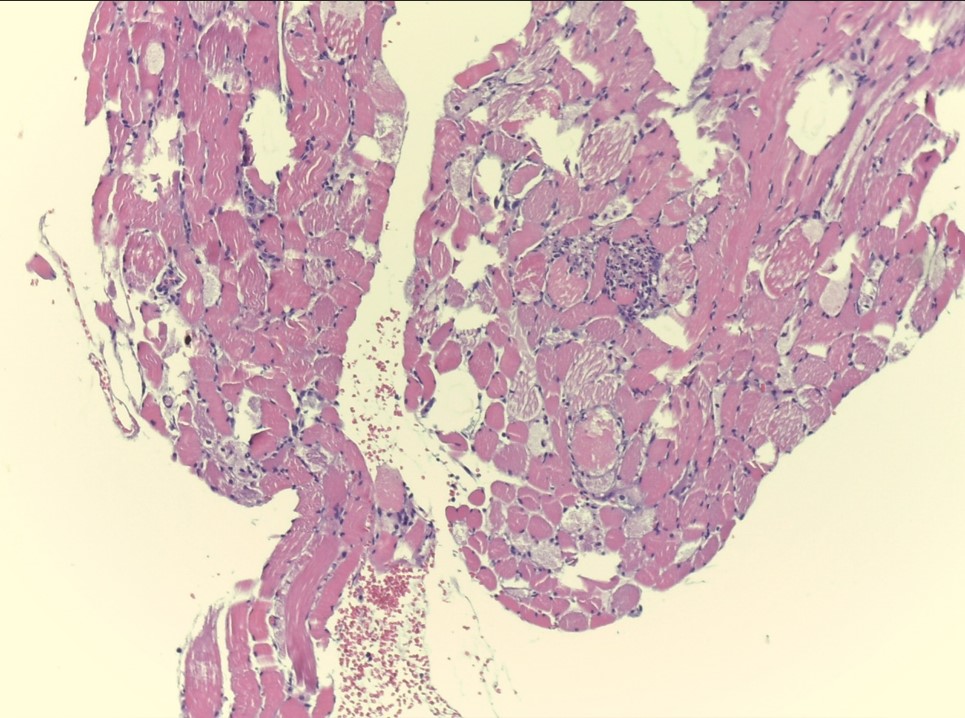
Figure 1: Variation of muscle fiber size and fibrosis (H&E: x40 magnification)
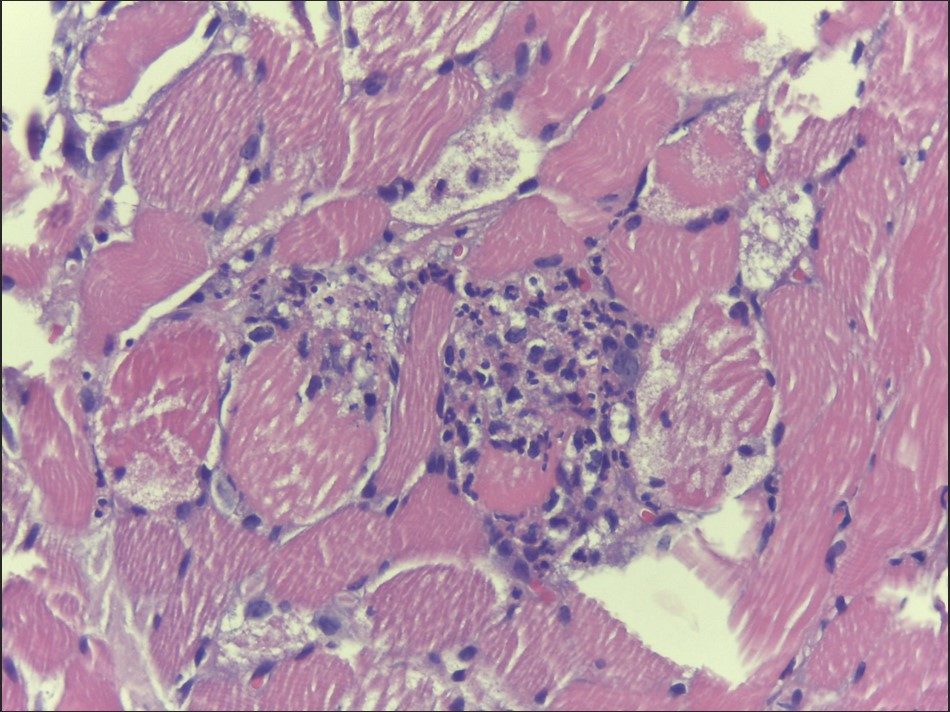
Figure 2: Photomicrograph shows severe tissue inflammation. There are mononuclear cell infiltrate, necrotic fibers and regenerating fibers (H&E: x100 magnification)
Discussion
MADD is also known as glutaric aciduria type II, is a rare, autosomal recessive, and clinically heterogenous inborn error of metabolism that affects fatty acid oxidation of mitochondrial energy. MADD may be classified as type I or type II with onset in the neonatal period, or type III with late onset. MADD type III is often characterized by nonspecific symptoms such as fatigue and muscle weakness2. Our patient was presented with severe metabolic acidosis and rhabdomyolysis. The subacute onset, adult-onset, hyper CKemia and history of myalgia were initially misdiagnosed as myositis3. Taking into the account the history of fasting, previous exercise tolerance together with negative all autoimmune panel testing, are suggestive of MADD. The plasma acylcarnitine and muscle biopsy confirmed the diagnosis in our patients.
Muscle biopsy of MADD exhibits cytoplasmic vacuoles on hematoxylin and eosin staining, plasma acylcarnitine analysis exhibits elevated acylcarnitines, and urine organic acid analysis exhibits elevated 2-hydroxy glutaric acid among others1. Necrotizing myositis pattern is uncommon in MADD. However, necrotizing myopathy is a broad term. Non immune-mediated necrotizing myositis was previous reported in drugs, dystrophies, infections and hypothyroidism4.We cannot yet conclude that necrotizing myositis is present in MAD. It may have occurred together by chance if patients had other co-diseases such as infections or toxins. Further studies are needed before one can formulate a conclusion.
Interestingly, our patient had history of taking sertraline. The previous study mentioned about sertraline-induced MADD. Studies in vitro and in model organisms have shown that sertraline has the potential to induce mitochondrial dysfunction, by inhibiting the oxidative phosphorylation complexes I and V, which could potentially lead to accumulation of lipids. Acylcarnitine profiles clearly improved in all cases after discontinuation of sertraline5.As a result, sertraline was discontinue in our patient, following the psychiatrist's assessment of the low risk of depression worsening.
Conclusions
MADD should be included in the differential diagnosis of acute rhabdomyolysis and metabolic acidosis in subacute-onset proximal muscle weakness even in adult patients. And it could be presented as mimicking myositis. Plasma acylcarnitine profile and urinary organic acid, or muscle biopsy indicating lipid storage myopathy, are important factors to evaluate to avoid overlooking a diagnosis of MADD.
References
- Grünert SC. Clinical and genetic heterogeneity of late-onset multiple acyl coenzyme A dehydrogenase deficiency. Orphanet J Rare Dis. 2014;9:117.
- Chakraborty A, Stanley W, Prabhu MM. A rare presentation of a rare metabolic disorder e multiple acyl CoA dehydrogenase deficiency presenting as rhabdomyolysis and renal failure. Biomedicine. 2021;41(4):862-864.
- Zheng Y, Zhao Y, Zhang W, Wang Z, Yuan Y. Late-onset multiple acyl-CoA dehydrogenase deficiency mimicking myositis in an elderly patient: a case report. BMC Neurol. 2020 Dec 2;20(1):436.
- Selva-O'Callaghan A, Trallero-Araguás E, Milisenda JC, Grau-Junyent JM. Differential diagnosis of necrotizing myopathy. Curr OpinRheumatol. 2021 Nov 1;33(6):544-553.
- Sunebo S, Appelqvist H, Häggqvist B, Danielsson O. Multiple Acyl-Coenzyme A Dehydrogenase Deficiency Is Associated with Sertraline Use - Is There an Acquired Form? Ann Neurol. 2024 Oct;96(4):802-811.