A Term Neonate with 1p36 Deletion Syndrome and 16p12 Deletion: A Case Report and Review of the Literature

Surasak Puvabanditsin, MD*, Amrryn Halari, M.B.B.S, Balaji Sutharsanam, MD, Su Young Park, MD, Rajeev Mehta, M

Associate Professor of Pediatrics, Robert Wood Johnson University Hospital, New Brunswick, New Jersey, USA

*Corresponding author

*Surasak Puvabanditsin. MD, Associate Professor of Pediatrics, Robert Wood Johnson University Hospital, New Brunswick, New Jersey, USA

Abstract

Background: Monosomy 1p36/1p36 deletion syndrome is a rare genetic disease causing developmental delay and intellectual disability of various degree are present in all patients.1p36 deletion syndrome is characterized by an extremely wide spectrum of features including hypotonia, structural brain abnormalities including white matter anomalies (e.g. periventricular leukomalacia, hypoxic ischemic encephalopathy-like phenotype, epilepsy, behavior disorder, hearing loss, ophthalmologic abnormalities, short stature, congenital heart defects (Ebstein’s anomaly, valvular anomalies, tetralogy of Fallot, ventricular septal defects), cardiomyopathy, genitourinary malformations, skeletal anomalies and variable dysmorphisms.

Monosomy 16p12.2/16p12.2 deletion is characterized by variable clinical findings that do not constitute a recognizable syndrome, children with intellectual disability and developmental delay; individuals with schizophrenia. Findings commonly seen with this deletion included: developmental delay, cognitive impairment (ranging from mild to profound), growth impairment (including short stature), cardiac malformations, epilepsy, and psychiatric and/or behavioral problems. Other findings can included: hearing loss, dental abnormalities, renal and genital anomalies (the latter in males), and cleft palate ± cleft lip.

Case Report: Here, we present a clinical report of a one day old term Indianmale neonate diagnosed with 1p36  deletion and 16p12.2 deletion. The patient was born with multiple anomalies including: intra uterine growth retardation, hypoplasia of the middle phalange of the fifth finger(single crease), glandular hypospadias, imperforate anus, perineal fistula, a choledochal cyst and periventricular cystic encephalomalacia.

Conclusions: This clinical case is a unique case of rare gastrointestinal system disorders(choledochal duct cyst and anal atresia and rectoperineal fistula). We established the cause of ventriculomegaly of the lateral ventricles as the result of choroid plexus hyperplasia leading to intraventricular hemorrhage.Monosomy 1p36, 1p36 deletion syndrome, interstitial deletion 16p12,

Keywords: 1p36 Deletion Syndrome, 16p12.2 Deletion, Genetic Disorder,Microdeletion, Imperforated Anus, Hypospadias, Choroid Plexus Cysts.

Introduction

1p36.3 deletions account for as much as 0.5-0.7% of idiopathic mental retardation. The prevalence is estimated to be one in 5,000-10,000 newborns, making it the most common terminal deletion syndrome. So far about 600 cases of monosomy 1p36 have been reported1-3. The main clinical manifestations other than mental retardations are distinctive facial anomalies, microcephaly, congenital heart defects, cardiomyopathy, brain malformations, hearing loss, short stature, and behavioral disorders.

16p12.2 deletion is characterized by variable clinical findings that do not constitute a recognizable syndrome. It was usually noted in clinical chromosomal microarray analysis of individuals with intellectual disability, developmental delay and schizophrenia. Other clinical findings included  hearing loss, dental abnormalities, renal anomalies, male genital anomalies  and cleft palate ± cleft lip(3).

Figure 1: Photo showed penile hypospadias (arrow).

Figure 2: Abdominal ultrasound showed a cystic structure adjacent to the gall bladder and common bile duct representing a choledochal cyst (arrow).
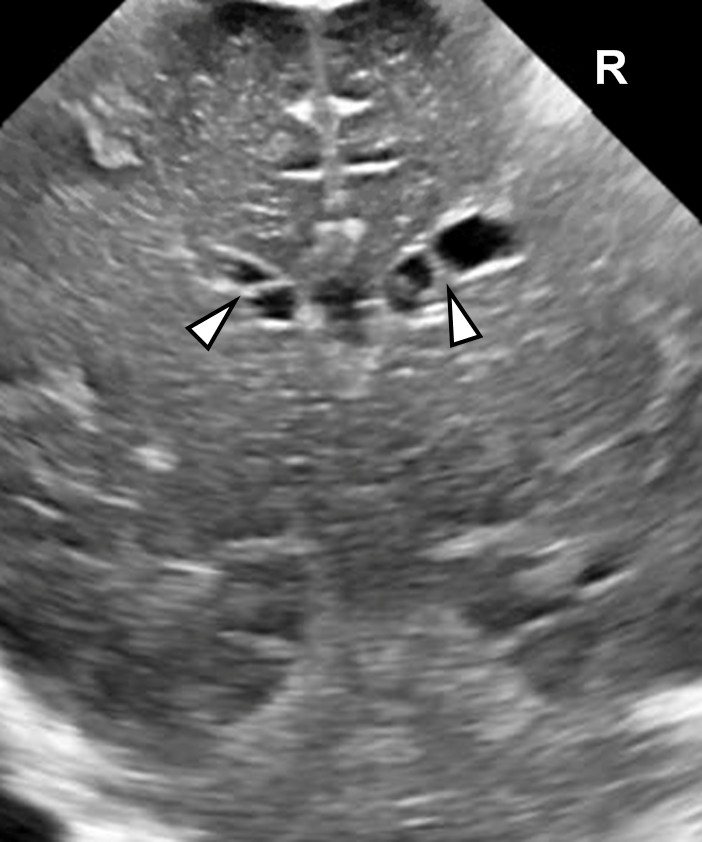
Figure 3a,3b: Coronal and saggital views of cranial ultrasound soon on the first day of life showed resolving bilateral intraventricular hemorrhage with intraventricular septations (arrows)

We report a term male newborn with periventricular cysts secondary to periventricular hemorrhage, gastrointestinal and genitourinary malformations. We establish a theory of brain malformation seen in a patient with deletions of chromosome 1p36 and 16p12.2 and report a new finding of the liver abnormality. We review the literature.

Case presentation

This is a 1620-g male neonate was born at 37 weeks of gestation to a 29-year-old primigravida Indian mother by cesarean section because of severe intrauterine growth retardation(IUGR). Apgar scores were 8 and 9 at 1 and 5 minutes respectively. Prenatal care was complicated with IUGR. The family history was unremarkable and there is no consanguinity. Prenatal sonogram revealed enlarged choroid plexuses and bilateral ventriculomegaly. The fetus karyotype was normal 46 XY on amniocentesis. Birth weight was 1620 g(<10th centile), length 42 cm(<10th centile), and head circumference was 31.5 cm(10th centile). The physical findings at birth were small for gestation age appearing neonate, dysmorphic facies, an enlarged anterior fontanelle, epicanthal folds, high arch palate, hypoplasia of the middle phalange of the fifth finger(single crease), glandular hypospadias (Figure 1), imperforate anus and perineal fistula. Echocardiography was normal. Abdominal ultrasound showed a cyst (3x3 mm) near the gall bladder representing a choledochal cyst (Figure 2). Neurosonogram (day of life #1) showed hypoechoic density of ependymal region of the left lateral ventricles with multiple septation in both lateral ventricles (Figure 3a, 3b). MRI (day of life # 31) of the head revealed left lateral periventricular cystic encephalomalacia (Figure 4a, 4b). He underwent a colostomy on day of life #2. He was discharged from the hospital after 35 days of hospitalization.

Figure 4a,4b: Cranial MRI T2 showed bilateral ventriculomegaly and encephaloma Lacia (arrows).

Cytogenetic and Molecular Studies: Whole genome SNP (Single Nucleotide Polymorphisms) microarray analysis was performed using the SNP oligonucleotide micro array analysis (SOMA) CytoScan HD platform which uses over 743,000SCN probes and 1,953,000 NPCN probes with median spacing of 0.88 kilobase(kb). Total genomic DNA was extracted from the patient’s blood sample and digested with NspI and the ligated to NspI adaptors. Polymerase chain reaction(PCR) products were purified and quantified. Purified DNA was fragmented and biotin labeled and hybridized to the Cytoscan HD Genechip. The data was analyzed using chromosome Analysis Suite which is based on the GRCh37/hg19 assembly. There was a 6.79 megabase(MB) terminal deletion of the short arm of chromosome 1: arr[hg19] 1p36.33p36.23 (849,466-7,638,032)x1 and 257 kilobase(Kb) interstitial deletion in the short arm of chromosome 16p12.2 (21,596,299-21, 852,932)x1. The SNP microarray analysis identified a considerable size and number of genes in terminal deletion of chromosome segment 1p, includes numerous OMIM genes [proximal gene[CAMTA1], consistent with 1p36 deletion syndrome. Also microarray analysis detected an interstitial deletion of chromosomal segment 16p12.2, this interval includes 3 OMIM genes (METTL9, IGSF6, OTOA). Mutations in OTOA have been associated with autosomal recessive deafness (OMIM: 607039)(4).

Discussion

Brain neuroimaging in 1p36 deletion syndrome has documented cerebral atrophy, ventricular dilatation, ventricular asymmetry, hydrocephalus, corpus callosum abnormalities, delay in myelination, focal cortical dysplasia, periventricular nodular heterotopia, and a leukodystrophic picture (2,5,6,21). Our patient has new clinical findings of brain abnormalities involving periventricular and intraventricular hemorrhage resulting in ventriculomegaly and encephalomalacia. Our case revealed the possible pathogenesis of the ventriculomegaly reported in the literature on the patients with 1p36 deletions. The findings of intraventricular septation and hemorrhage at birth signified in-utero event leading to the ventriculomegaly and brain abnormality(encephalomalacia). There is a report case of choroid plexus hyperplasia associated with 1p36.3 deletion patient(5). We postulated that the abnormality of choroid plexus would risk infant with 1p36 deletion to develop periventricular/intraventricular hemorrhage(PVH/IVH) leading to ventriculomegaly. Our patient developed ventriculomegaly and the encephalomalacia as the result of PVH/OH as well as. Recent published data showed 66% of patients with 1p36.3 deletion had brain malformations, 13/62 patients with abnormal corpus callosum, and 12/62 patients with ventriculomegaly(6).

While this syndrome has been increasingly studied over the years,linking of specific anatomic and physiologic defects to gene deletions is yet to be fully achieved, leaving clinicians to rely on reports of previously identified abnormalities. Recent reports of association of 1p36deletion syndrome with specific gastrointestinal (GI) abnormalities including duodenal atresia, intestinal malrotation, annular pancreas, and anomalous     arrangement of pancreaticobiliary duct presenting as pancreatitis, hepatic   steatosis, biliary atresia, bilobed gall bladder, anal atresia, rectovaginal fistula, (6,7,8,9,10,11). To our knowledge, our patient is the first report of choledochal duct cyst and the second case report of anal atresia and rectoperineal fistula in a patient with 1p36 deletion syndrome. Currently, there are no reports of genes in the region of chromosome 1p that have been linked to cause bile duct abnormality, an area that should be explored, given the mounting number of GI abnormalities seen in association with 1p36 deletion syndrome.       There are variable clinical findings that characterizes individuals with a 16p12.2 microdeletion, no recognizable syndrome has been established. Findings commonly observed in children with this deletion included: developmental delay, cognitive impairment, growth impairment, cardiac malformations, epilepsy, and psychiatric and/or behavioral problems. Other findings included: hearing loss, dental abnormalities, renal anomalies and genital anomalies in males, and cleft palate with or without cleft lip. The frequency is about 1 in 2,000 newborns have a 16p12.2 microdeletion and show signs and symptoms of the condition. Abnormal brain imaging was reported in 56%-63% of individuals with 16p12.2 microdeletion including cerebellar and cerebral atrophy, decreased white matter, unspecified periventricular changes, and agenesis of the corpus callosum (12,13,14). Individuals with a 16p12.2 microdeletion who have neurological or behavioral problems often have additional chromosomal abnormalities.

Conclusions

In conclusion, we described widening phenotypic spectrum of a neonate with monosomy 1p36 and monosomy 16p12.

Ethical Approvaland Consent to participate: Not applicable

Consent for publication: Written informed consent was obtained from the patient for publication of this case report and any accompanying images. A copy of the written consent is available for review by the Editor-in-Chief of this journal

Availability of data and materials: Data sharing is not applicable to this article as no datasets were generated or analyzed during the current study.

Competing interests: There are no competing interests.

Conflicts of Interest: The authors declare that they have no conflicts of interest.

Funding: There is no funding on the manuscript.

Authors' contributions:
AH, BS and SYP contributed in data gathering and patient's diagnosis and treatment.
SP, RM and AH contributed in drafting and revision of the main manuscript.

Acknowledgements: We thank Sylvia Sutton-Thorpe, Chrystal L. Puvabanditsin and Christina M. Vari for supporting this effort and preparing the manuscript.

References

  1. Jordan VK, Zaveri HP, Scott DA. 1p36 deletion syndrome: an update. Appl Clin Genet. 2015; 27(8):189-200
  2. Battaglia A. Del 1p36 syndrome: a newly emerging entity. Brain and Development 2005;27:358-61
  3. Girirajan S, Pizzo L, Moeschler J, Rosenfeld J, Adam MP, Feldman J, et al. 16p12.2 Recurrent Deletion. 2015 Feb 26 [Updated 2018 Sep 13]. In: Adam MP, Mirzaa GM, Pagon RA, et al., editors. GeneReviews® [Internet]. Seattle (WA): University of Washington, Se-attle; 1993- 2023. Bookshelf URL: https://www.ncbi.nlm.nih.gov/books
  4. Shahin H, Walsh T, Rayyan AA, Lee MK, Higgins J, Dickel D, et al. Five novel loci for inherited hearing loss mapped by SNP- based homozygosity profiles in Palestinian families. Eur J Hum Genet. 2010;18(4):407-13
  5. Puvabanditsin S, Garrow E, Patel N, D'Elia A, Zaafran A, Phattraprayoon N, Davis SE. Choroid plexus hyperplasia and Monosomy 1p36: report of new findings. J Child Neurology 2008;23(8):922-25
  6. Jacquin C, Landais E, Poirsier C, Afenjar A, Akhavi A, Bednarek N, et al. 1p36 deletion syndrome: Review and mapping with further characterization of the phenotype, a new cohort of 86 patients. Am J Med Genet A. 2023 ;191(2):445-58
  7. Minami K, Boshi H, Minami T, Tamura A, Yanagawa T, Uemura S, et al. 1p36 deletion syndrome with intestinal malrotation and annular pancreas. Eur J Pediatr. 2005;164(3):193-4.
  8. Kawashima H, Kinjo N, Uejima H, Loi H, Takekuma K, Nagae I, et al. A case of 1p36 deletion syndrome accompanied with anomalous arrangement of the pancreaticobiliary duct. Pancreas. 2011;40(1):171-3.
  9. Haimi M, Iancu TC, Shaffer LG, Lerner A. Severe lysosomal storage disease of liver in del 1p36): a new presentation. Eur J Med Genet. 2011;54(3):209-13
  10. Battaglia A, Hoyme HE, Dallapiccola B, Zackai E, Hudgins L, McDonald-McGinn D, et al. Further delineation of deletion 1p36 syndrome in 60 patients: a recognizable phenotype and common cause of developmental delay and mental retardation. Pediatrics. 2008;121(2):404-10
  11. Chawla V, Anagnost MR, Eldemerdash AE, Reyes D, Scherr R, Ezeanolue K, et al. A novel case of biliary atresia in a premature neonate with 1p36 deletion syndrome J Investig Med High Impact Case Rep. 2018;24(6):2324709618790613
  12. Girirajan S, Rosenfeld JA, Cooper GM, Antonacci F, Siswara P, Itsara A, et al. A recurrent 16p12.1 microdeletion supports a two-hit model for severe developmental delay. Nat Genet. 2010;42(3):203–9
  13. Pizzo L, Jensen M, Polyak A, Rosenfeld JA, Mannik K, Krishnanet A, et. al. Rare variants in the genetic back ground modulate cognitive and developmental phenotypes in individuals carrying diseaseassociated variants. Genet Med. 2019;21(4):816 25
  14. Neal J, Apse K, Sahin M, et al. Deletion of chromosome 1p36 is associated with periventricular nodular heterotopia. Am J Med Genet. 2006;140A(15):1692-95
TOP