
H Syndrome: A Case Series of 3 Patients was First Described in Syria and a Literature Review
Sajeda Alnabelsi*, Hussein Abdallah, Nemat Alsaghir, Kinda Alshawa
Damascus University, faculty of medicine, Hospital of Dermatology and Venerology, Damascus, Syria
*Corresponding author
*Sajeda Alnabelsi, Damascus University, faculty of medicine, Hospital of Dermatology and Venerology, Damascus, Syria.
DOI: 10.55920/JCRMHS.2024.08.001364

Figure 1: Patient no 1
(A).Plaques of hyperpigmentation and hypertrichosis on the thighs.
(B). Hyperpigmentation on the legs
(C). Flexion contractures in the last 3 fingers
(D). Scleral vessels dilation

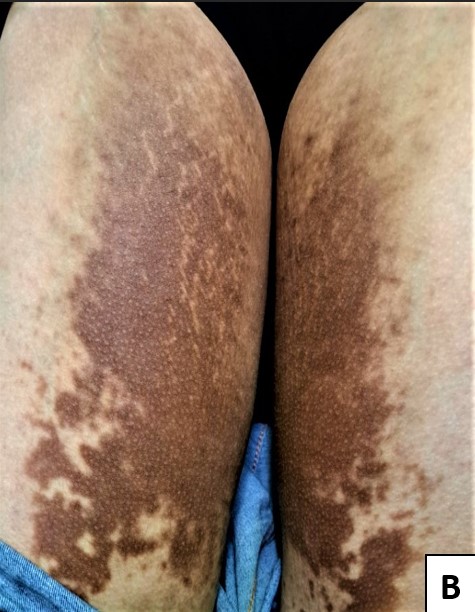


Figure 2:
(A, B, C). Hyperpigmentation in the inner sides of the thighs and legs.
(D). Flexion contractures in the fingers
(E). exophthalmos.
(F). in the top: inguinal echography shows edema in subcutaneous tissue. (the red line) In the bottom: Axillary echography shows multiple masses exceeding 1cm in diameter. (The red circle)

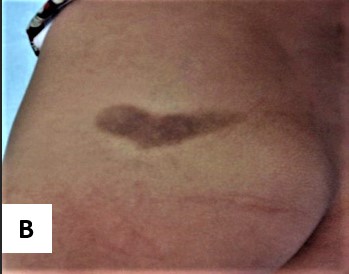

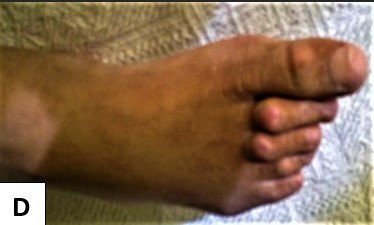


Figure 3:
(A, B). plaques of Hyperpigmentation and hypertrichosis on the inner sides of the thighs and the genitalia and buttock.
(C, D). flexion contracture in fingers and toes.
(E). hyperkeratosis, acanthosis, and increased melanin deposition in basal keratinocytes (H&E, x10).
(F). interstitial inflammatory infiltrate (H&E, x10).
(G). mix of histiocytes, dendrocytes, plasma cells, lymphocytes, and mast cells in the dermal infiltration (H&E, x40)

The diagnosis of H syndrome is suspected based on the clinical findings. Mutational analysis will confirm the diagnosis when there is uncertainty or in patients with mild or incomplete phenotypes, mainly by WES (Whole Exome Sequencing) and Sanger sequencing for scientific purposes and screening in families. However, no genetic tests were performed for any patient because they aren’t available in Syria.
H syndrome does not have any standard treatment for preventive and therapeutic approaches toward its cutaneous and systemic presentations apart from hypertrichosis that could be almost permanently removed by laser. However, the latest findings suggest that there is a possibility of prevention of short stature or other cutaneous and systemic complications in this syndrome with earlier diagnosis and treatment. There is no established treatment for H syndrome. Therapies that have been attempted include systemic corticosteroids, immunosuppressive agents, interferon-alpha, adalimumab, and radiotherapy (4).