Choledochal Cyst during a Elective Laparoscopic Cholecistectomy

Marcelo Pontillo-Walerovsky*; Iván Trostchansky-Vasconcellos; Roberto Valiñas-Sotelo.

Emergency Department, Hospital de Clínicas. Faculty of Medicine. University of the Republic. Montevideo, Uruguay

*Corresponding author

*Marcelo Pontillo-Walerovsky, Emergency Department, Hospital de Clínicas. Faculty of Medicine. University of the Republic. Montevideo, Uruguay.

Mini Review

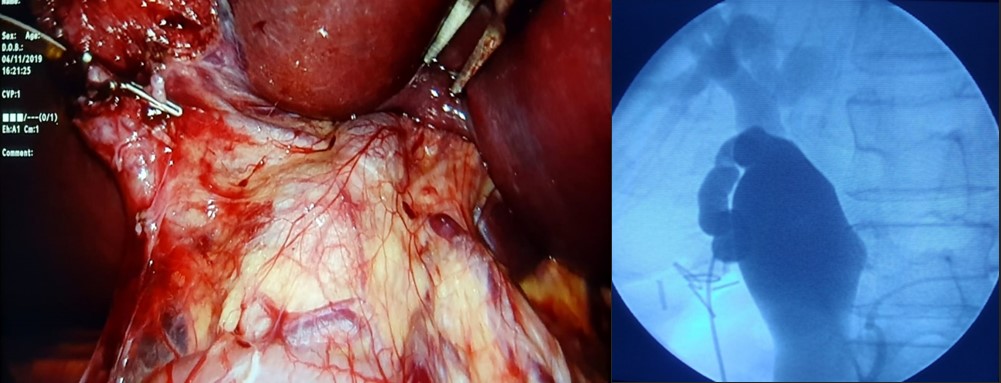
Female, 27 years old patient, healthy. During a laparoscopic cholecystectomy, a wide cystic duct (>1 cm) was found (Fig 1A). Cholangiography was performed and showed an extra hepatic bile duct dilation (>4 cm), without finding common bile duct stones inside (Fig 1B); the cholecystectomy was completed.

Magnetic resonance cholangiopancreatography was performed postoperatively, showing type IB choledochal cyst (Todani´s classification)1, a sacular dilation that only involves the extrahepatic bile duct; few choledocholithiasis were also found (Fig 2).

Choledochal cyst is a rare disease (incidence of 1 in 100000 – 150000)2 associated with primary choledocholithiasis, recurrent cholangitis, portal hypertension and increased risk of cholangiocarcinoma3,4. The patient underwent a resection of the extrahepatic bile duct and reconstruction with a ¨Roux-en-Y¨ hepaticojejunostomy4,5.

Lifelong strict follow up is necessary, due to an increased risk of biliary cirrhosis development. We therefore emphasize the importance of performing intraoperative cholangiography in the presence of anatomical alterations in biliary surgery.

Figure 1: A: laparoscopic view of the extrahepatic bile duct, evidence of a dilated common bile duct. 1 – B: intraoperative cholangiography, finding of choledochal cyst.
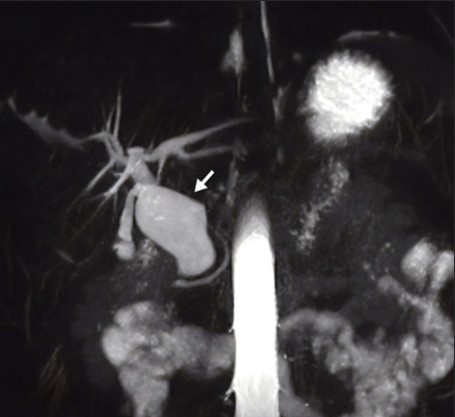
Figure 2: Cholangioresonance showing a type IB choledochal cyst (white arrow), without involvement of the main pancreatic duct.

References

  1. Miron A, Popa LG, Toma EA. TheCurious Case oftheCholedochalCyst-RevisitingtheTodaniClassification: Case Report and ReviewoftheLiterature. Diagnostics. 2023;13(6):1059.
  2. Tariq WB, Twayana AR, Sunuwar N et al. Case Report: a rare case ofcholedochalcyst. F1000Res. 2022; 11:919.
  3. Madadi-Sanjani O, Wirth TC, Kuebler JF et al. CholedochalCyst and Malignancy: A PleaforLifelongFollow-Up. Eur J PediatrSurg. 2019;29(2):143-149.
  4. Lee KF, Lai EC, Lai PB. Adultcholedochalcyst. Asian J Surg. 2005;28(1):29-33.
  5. Kowalski A, Kowalewski G, Kaliciński P, et al. CholedochalCystExcision in Infants-A Retrospective Study. Children. 2023;10(2):373.
TOP