Amin Saber Tanha1, MD; Nasrin Raeisi1, MD; Ehsan Soltani2, MD; Faeze Rabani1, MD; Atena Aghaee1, MD
¹Nuclear Medicine Research Center, Mashhad university of Medical Sciences, Mashhad, Iran
²Department of General Surgery, Imam Reza University Hospital, Mashhad University of Medical Sciences, Mashhad, Iran.
*Corresponding author
*Atena Aghaee, MD, Nuclear Medicine Research Center, Mashhad university of Medical Sciences, Mashhad, Iran.
Abstract
We present a case demonstrating a suspected occult fracture in the right anterior lower hemi-thorax, undetectable by radiographs and computed tomography (CT) scan. Confirmation of a recent contusion in the anterior aspect of the right 9th rib was achieved through a positive three-phase bone scan. Notably, a focal increase in [99mTc]Tc-methylene diphosphonate (MDP) uptake was observed in the inferior ramus of the left pubis, initially misconstrued as a traumatic lesion before pelvic single-photon emission computed tomography (SPECT)/CT. Subsequently, SPECT/CT images revealed urine contamination on the glans of the penis as the source of the misleading uptake in the inferior ramus of the left pubis.
Keywords: [99mTc]Tc-MDP whole-body scan, whole-body false-positive, Three-phase bone scan, Trauma, SPECT/CT
Introduction
While radiographs and computed tomography (CT) scans are commonly employed for the initial diagnosis of acute fractures in high energy traumas, bone scintigraphy stands out as a highly sensitive modality for early detection. In instances where radiographs and CT scans yield negative results or when the precise location of concern is unknown, a bone scan becomes valuable for uncovering occult fractures. In forensic medicine, particularly in cases involving legal considerations like assigning for wergild of trauma victims, requesting a whole-body bone scan is essential to prove acute fractures, especially when radiographs or CT scans show no evidence of injury.
Case presentation
A 54-year-old man, referred through forensic medicine, sought investigation for right anterior hemi-thoracic pain arising from a recent trauma during a car accident two weeks prior. He described pleuritic pain in the right lower hemi-thorax, exacerbated during exercise and right-side sleeping. Prior radiographs and thoracic CT scans yielded no abnormal findings, including in the ribs. Consequently, a three-phase bone study with [99mTc]Tc-methylene diphosphonate (MDP) was conducted to identify potential occult rib fractures.
Perfusion dynamic study and blood pool static images from the thoracic region, obtained after intravenous injection of 20 millicurie (mCi) of [99mTc]Tc-MDP, revealed focal increased perfusion and blood pool activity in the anterior aspect of the right 9th rib near the costochondral junction (Figure 1). Subsequent whole-body scanning three hours post-injection confirmed focal increased [99mTc]Tc-MDP uptake in the same region of the right 9th rib, supporting the diagnosis of a recent occult fracture.
Figure 1: Perfusion and blood pool images of the thoracic region depict a focal zone of radiotracer uptake in front of the liver (black arrow).
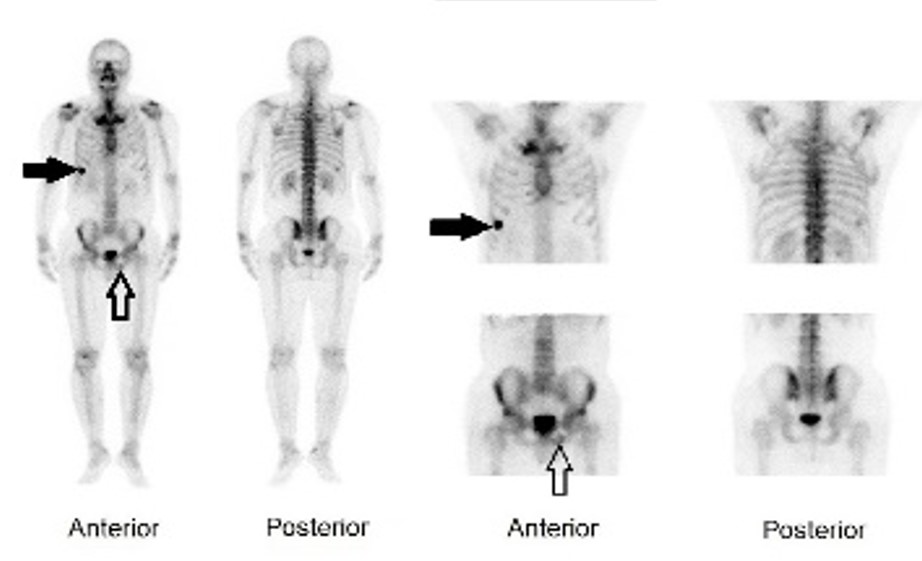
Figure 2: A focus of increased radiotracer uptake is observed in the anterior aspect of the right 9th rib (black arrow). Additionally, another focus of increased radiotracer uptake is noted in the inferior ramus of the left pubis (white arrow).
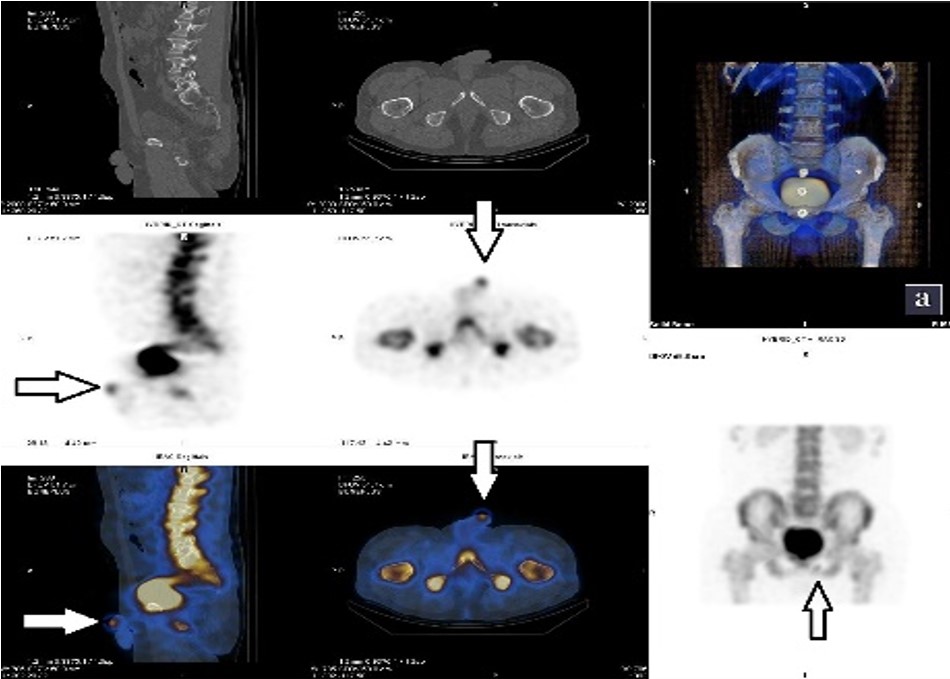
Figure 3: SPECT/CT images reveal that the focus of increased radiotracer activity observed on whole-body and static images corresponds to urine contamination on the glans of the penis (white arrow).
Interestingly, delayed whole-body and pelvic static images unveiled increased [99mTc]Tc-MDP activity in the inferior ramus of the left pubis, more prominently seen in the anterior view (Figure 2). Further history revealed intermittent pelvic pain over two years, worsening after the recent trauma. For precision, the patient voided for complete bladder emptying and after that pelvic single-photon emission computed tomography (SPECT)/CT localized the presumed left pubic ramus uptake to contamination on the glans of the penis (Figure 3).
Discussion
Bone scans, known for their cost-effectiveness and high sensitivity, serve as a valuable method for comprehensive whole-body surveys. They can be employed prior to magnetic resonance imaging (MRI) to identify occult acute fractures that may not be visible on CT or radiographs(1).Among technetium-labeled agents, [99mTc]Tc-MDP stands out for its rapid renal clearance, ensuring high-quality whole-body images(2).The use of a three-phase [99mTc]Tc MDP whole-body scan, coupled with SPECT/CT images, significantly enhances sensitivity and specificity in detecting occult fractures, especially in trauma patients(3–8).In the case presented, the clinical complaint of pelvic pain led to the consideration of focal [99mTc]Tc-MDP uptake in the left pubic ramus, to be also due to the contusion. However, pelvic SPECT/CT images revealed that the uptake was attributed to urine contamination on the glans of the penis, rather than indicating a traumatic lesion.
Conclusion
This report underscores the significance of SPECT/CT imaging as an integral component of bone scintigraphy, particularly when dealing with abnormal findings on whole-body planar images.
References
- Brenner AI, Koshy J, Morey J, Lin C, DiPoce J. The bone scan. Semin Nucl Med. 2012 Jan;42(1):11-26.
- Subramanian G, McAfee JG, Blair RJ, Kallfelz FA, Thomas FD. Technetium-99m-methylene diphosphonate--a superior agent for skeletal imaging: comparison with other technetium complexes. J Nucl Med. 1975 Aug;16(8):744-55.
- Müller V, Steinhagen J, de Wit M, Bohuslavizki KH. Bone scintigraphy in clinical routine. Radiol Oncol [Internet]. 2001 Mar. 1 [cited 2024 Jan. 16];35(1). Available from: https://www.radioloncol.com/index.php/ro/article/view/1462
- Mariani G, Bruselli L, Kuwert T, Kim EE, Flotats A, Israel O, Dondi M, Watanabe N. A review on the clinical uses of SPECT/CT. Eur J Nucl Med Mol Imaging. 2010 Oct;37(10):1959-85.
- Gnanasegaran G, Cook G, Adamson K, Fogelman I. Patterns, variants, artifacts, and pitfalls in conventional radionuclide bone imaging and SPECT/CT. Semin Nucl Med. 2009 Nov;39(6):380-95.
- Buck AK, Nekolla S, Ziegler S, Beer A, Krause BJ, Herrmann K, Scheidhauer K, Wester HJ, Rummeny EJ, Schwaiger M, Drzezga A. SPECT/CT. J Nucl Med. 2008 Aug;49(8):1305-19.
- Kuwert, T. Skeletal SPECT/CT: a review. Clin Transl Imaging. 2014 Dec;2(6) 505–517 (2014).
- Utsunomiya D, Shiraishi S, Imuta M, Tomiguchi S, Kawanaka K, Morishita S, Awai K, Yamashita Y. Added value of SPECT/CT fusion in assessing suspected bone metastasis: comparison with scintigraphy alone and nonfused scintigraphy and CT. Radiology. 2006 Jan;238(1):264-71.