Isolated Creatine Phosphokinase (CK) elevation as the main presentation for underlying Adrenal Insufficiency and Low Testosterone levels in a male patient with successful response to Hormonal replacement therapy

Sufian M Rifaei1, Shahd Etoom2, Bandar Ghazal1

¹Clinical Lecturer, Al-Balqa Applied University Faculty of Medicine, Salt, Jordan
²Medical Student, Al-Balqa Applied University Faculty of Medicine, Salt, Jordan

*Corresponding author

*Sufian M Rifaei, Clinical Lecturer, Al-Balqa Applied University Faculty of Medicine, Salt, Jordan

Abstract

We report a very unusual case of myalgia with raised Creatine Kinase (CK) level in a 39-year-old gentleman who was subsequently found to have adrenal insufficiency and Testosterone levels.

This patient was initially seen in the Cardiology and Internal Medicine clinics without a convincing diagnosis for his symptoms of myalgia, easy fatigability and feeling of low energy level.

Due to his fatigue symptoms, he underwent cardiac diagnostic investigations including

Echocardiography which did not reveal abnormalities. Blood tests included Creatine Kinase as part of assessment for myalgia problems. CK was moderately elevated.

This prompted a referral to Rheumatology. Subsequent clinical assessment led to further findings of low Testosterone and cortisol levels. The correction of these hormonal deficiencies resulted in resolution of his symptoms with parallel normalization of CK level which is interesting given that raised CK, though known to accompany a number of myopathies in the context of Endocrinopathies, is not commonly reported to be associated with hypoadrenalism or considered a usual presentation of low Testosterone levels in particular.

Key words: Creatine Kinase(CK), myalgia, Hypoadrenalism, Testosterone Addison’s Disease

Introduction

Muscle pain (myalgia) is a common symptom associated with a wide range of causes including. Occupational and functional causes such as overuse injuries and strains. In addition to infections, Neuromuscular disorders and inflammatory muscle diseases such as Polymyositis and Dermatomyositis. However, the hallmark for Inflammatory Myopathies is weakness which is associated with raised CK levels rather than isolated elevations in CK>

On the other hand, one cause of muscle pain with raised CK but without objective muscle weakness is Rhabdomyolysis.

Also, some medications most notably Statins are known to cause muscle pains, occasionally with myopathy and raised CK.

Case Description

We report a case of 38-year old year old male who works as a teacher who developed general myalgia involving all body part in addition to general fatigue and low stamina lasting few weeks prior to presentation.

He complained of no associated muscle weakness or joint swelling.

He was initially seen in the Internal Medicine clinic but no specific conclusions were found given that He had no muscle weakness or red flags indicating malignant diseases such as weight loss, impaired appetite or Bowel habit changes. He was otherwise not involved in any substance abuse practices and not a smoker.

Initial Investigations emonstrtaed within normal limits of Blood Count indices , Kidney and Liver Function tests. Thyroid function was within normal and so was B12 Levels, Serum Calcium and Bone Profile.

As he was also complaining of easy fatigability he was referred to the Cardiology clinic to screen for any

Cardiogenic causes but he was not found to have cardiac disorder but a CK test was ordered as part of Assessing for the myalgia problems which came back elevated at 980. He was therefore referred to the Rheumatology clinic for further evaluation.

On further questioning, the patient confirmed no problems of true muscle pain and he was on no chronic use of any medications.

However, he mentioned having some occasional impotence issues and a long-standing low mood but with no features of major depressive disorder or suicidal thoughts or any delusions or memory impairment issues.

On physical assessment, he had no specific systemic fining with full muscle tone and power and no sensory impairment or focal neurological deficits. Also, there were no skin changes such as orbital Heliotrope rash or Gottron’s lesions to suggest Inflammatory Dermatomyositis.

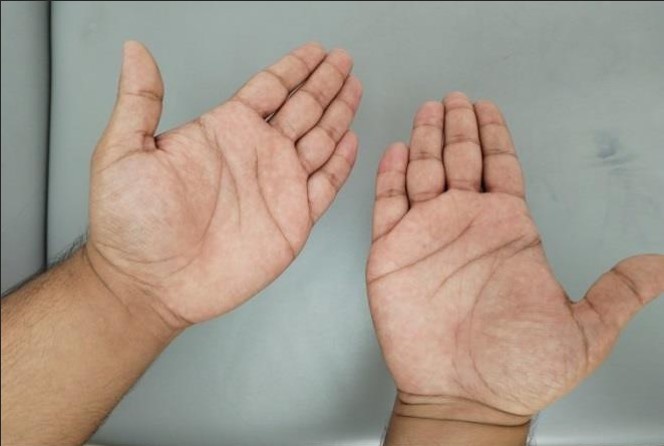
Examination of the hands demonstrated presence of mild pigmented hands creases.

There were no orthostatic changes in Blood pressure or Pulse rate.

Figure 1: 

Mild Palmar creases pigmentation.

Further Blood tests were arranged to check for any underlying Hormonal disorders including Thyroid Function Tests, AM Cortisol levels and Testosterone. These showed low levels of Cortisol and ACTH, Low total and free Testosterone levels.

Further assays showed Normal Prolactin, LH and FSH levels.

Table 1: The results of Hormonal studies

Pituitary MRI Scan for further evaluation to ensure no hypothalamic tumors or empty Sella syndrome was performed which showed normal Pituitary appearance.

Also, MRI of Proximal Hip and shoulder muscles was obtained an showed no acute or chromic changes.

Discussion

A crucial component of diagnosing patients with myopathies or rhabdomyolysis, as well as those with muscle weakness or myalgia, is measuring serum creatine kinase (CK). However, high creatine kinase (CK) can occasionally be discovered by accident in a patient who has neither muscle-related symptoms nor minor nonspecific muscular symptoms (such as cramps, spasms, or exhaustion) that do not substantially interfere with daily activities. This is known as "asymptomatic hyper-CK-emia."

Aspartate aminotransferase, alanine aminotransferase, lactate dehydrogenase, and aldolase are the other four muscle enzymes that could potentially be increased [1].

By race and sex, CK levels differ considerably.[2] Variations in total body mass or muscle mass as well as genetic variations in the sarcolemma's permeability to CK are potential causes.[3] As people age, their CK levels also somewhat decrease.[4]

Elevated CK that is asymptomatic or only mildly symptomatic may be from a primary neuromuscular disorder or from a number ofnonneuromuscular sources.[5]

The table below summarizes the overall causes of Creatine Kinase Elavation. [6]

Figure 2: Common causes of elevated Creatine Kinase levels [6].

In this case, the presence of general symptoms of myalgia led to the step of testing CK levels though this was on its own not helpful given no presence of other explanatory findings including absence of any muscular weakness or history of medications or Alcohol consumption.

An alternative approach was therefore adopted by thinking along the lines of fatigue etiology keeping in mind that hormonal deficiencies can be potential causes. On physical examination, there were no specific findings apart from mild hand crease pigmentation which can occur in the context of Addison’s disease though in this case the pathology was rather due to Central ACTH deficiency.

This led to implementation of further testing which revealed the findings of Low Cortisol and Testosterone levels (both Free and total).

The subsequent correction of these Hormonal deficiencies over the few issuing weeks resulted in progressive improvement until resolution of all fatigue symptoms and normalization of CK levels.

Statement:

The authors hereby state and confirm that the subject in this case was consented for his clinical details Be shared herein and for the subsequent article to be published online.

References

  1. Moghadam-Kia, S., C.V. Oddis, and R. Aggarwal, Approach to asymptomatic creatine kinase elevation. Cleveland Clinic journal of medicine, 2016. 83(1): p. 37.
  2. Prisant, M.L., et al., Efficacy and tolerability of lovastatin in 459 African-Americans with hypercholesterolemia. The American journal of cardiology, 1996. 78(4): p. 420-424.
  3. Wong, E.T., et al., Heterogeneity of serum creatine kinase activity among racial and gender groups of the population. American journal of clinical pathology, 1983. 79(5): p. 582-586.
  4. Lilleng, H., et al., Variation of serum creatine kinase (CK) levels and prevalence of persistent hyperCKemia in a Norwegian normal population. The Tromsø Study. Neuromuscular Disorders, 2011. 21(7): p. 494-500.
  5. Brewster, L. and M. De Visser, Persistent hyperCKemia: fourteen patients studied in retrospect. Acta neurologicascandinavica, 1988. 77(1): p. 60-63.
  6. Fanin M, Nascimbeni AC, Aurino S, Tasca E, Pegoraro E, Nigro V, Angelini C (2009) Frequency of LGMD gene mutations in Italian patients with distinct clinical phenotypes.
  7. Neurology 21(72):1432–1435
TOP