¹City Clinical Hospital No 64 (Vinogradov), Moscow.
²Department of Epidemiology and Evidence-Based Medicine of Erisman Institute of Public Health of Sechenov University
*Pryanikov G, City Clinical Hospital №64 (Vinogradov), Moscow.
Introducing
From the very beginning of the pandemic, lockdowns and social isolation measures were introduced in almost all countries to combat the spread of the infection, but in the context of a significantly increased burden on the healthcare system, healthcare workers continued to carry out their activities in conditions of increased risk [1,2]. WHO reported that in some countries, every tenth healthcare worker was infected with coronavirus [3]. According to other data, more than 9% of those affected by COVID-19 in 2020 were healthcare workers [4]. Analyzing the incidence among medical personnel and assessing the impact of risk factors in real time is fundamental to ensuring the effectiveness of measures to identify and prevent COVID-19 in healthcare institutions. The functional responsibilities of medical personnel, the nature of the infection source, the level of population morbidity, the duration of clinical services, the uncertainty of the mechanism and routes of infection transmission, cross-infection of personnel, vaccination status, as well as the practice of testing and using personal protective equipment (PPE), determine the epidemic risks for health workers, especially during peak growth in morbidity [5, 6].
Methodology
In the multidisciplinary emergency Vinogradov Clinical Hospital (Moscow), 1,212 health workers provided medical care to the population during the COVID-19 pandemic, of which 462 (38.12%) were doctors, and 720 (61.88%) were mid-level health workers. From March 1, 2020 to February 1, 2023, prospective observation was carried out on working health workers (n = 503) who underwent PCR testing to confirm infection with the SARS-CoV-2 coronavirus; it included doctors and mid-level healthcare workers who had at least one key symptom (fever, cough, shortness of breath) during the observation period or interacted with a contact who was confirmed or suspected of having COVID-19.
All healthcare workers were divided into three levels according to the risk of SARS-CoV-2 infection, depending on the symptoms, the nature of interaction with the infectious source, and the use of PPE: those with one or more key symptoms were classified as high risk, moderate risk was determined in cases of prolonged contact with a confirmed COVID-19 source (more than 15 minutes) at a distance of less than 2 meters or without proper use of PPE, and low risk if the contact with the source was less than 15 minutes or at a distance of more than 2 meters and the mandatory use of PPE.
Medical personnel from the analyzed cohort was surveyed to track key information during the pandemic. Centralized identification and assessment of new COVID-19 cases and systematic surveillance from the early stages of the pandemic until the emergence and spread of the highly contagious Omicron strain allowed standardizing data collection and minimizing the possibility of errors in filling out questionnaires by medical personnel. The information included personal data (age, gender), functional responsibilities, vaccination status, comorbid status, the list and date of onset of symptoms, the last date of work, the nature of interaction with an infectious contact (direct/indirect, protected/unprotected) and the type of identified contact (patient/colleague, population, family or unspecified). The onset of COVID-19 disease was determined based on the date of a positive test or the date of reporting a case to the infectious disease accounting system of the Regional State Infectious Diseases and Infection Control Department. Job responsibilities, information on the use of PPE and vaccination status were taken into account for each type of contact with the COVID-19 source and then compared using mathematical and statistical analysis. The cumulative incidence of COVID-19 was calculated for all cases and separately for each type of contact. The cumulative incidence by type of contact was calculated by dividing the number of cases in each category by the total number of medical personnel in each category. Contingency tables, relative risk calculation and odds ratio were used. Statistical significance and differences in groups of qualitative variables were determined at the statistical significance level of p<0.05. Statistical analyses were performed using SPSS V20.0
Results and Discussion
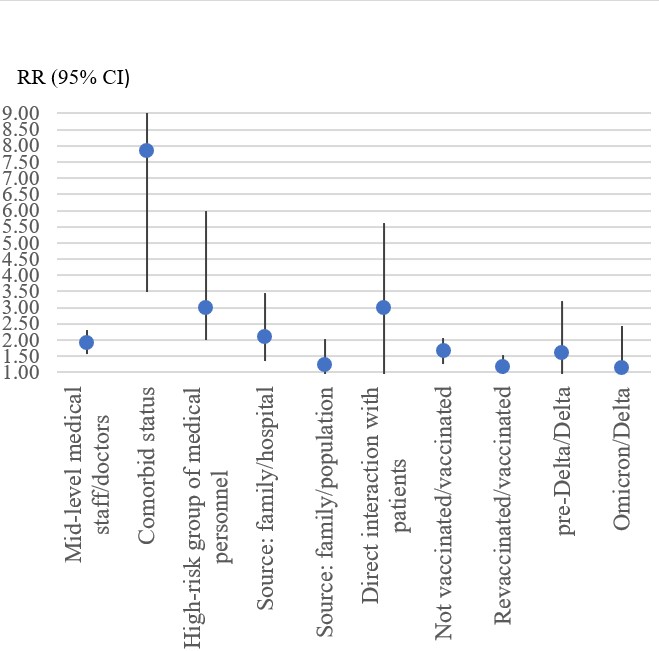
In the analyzed cohort (n=503), a positive test for SARS-CoV-2 was obtained in 45 cases (9.0%), including 6 cases (13.3%) of reinfection. The median age of the cohort was 37 years (IQR (interquartile range) 23-69); 64.2% (n=320) were women. For the majority of identified COVID-19 cases, the source of infection was not determined (n=15, 33.3%), followed by contacts in the family (n=12, 26.7%) and in the population (n=10, 22.2%). The probability of infection in the workplace (n=8, 17.8%) was significantly lower than from other sources (OR 0.27, 95% CI 0.1-0.7). Due to the increased risk of infection in the family compared to that in the workplace (RR 2.08, 95% CI 1.24-3.45) and in the population (RR 1.23, 95% CI 0.73-2.03), a healthcare worker in case of interaction with a confirmed source of COVID-19 in the family was included in the high-risk group with the implementation of all infection control measures for this group.
Figure 1: Sources of infection of medical personnel in different periods of COVID-19
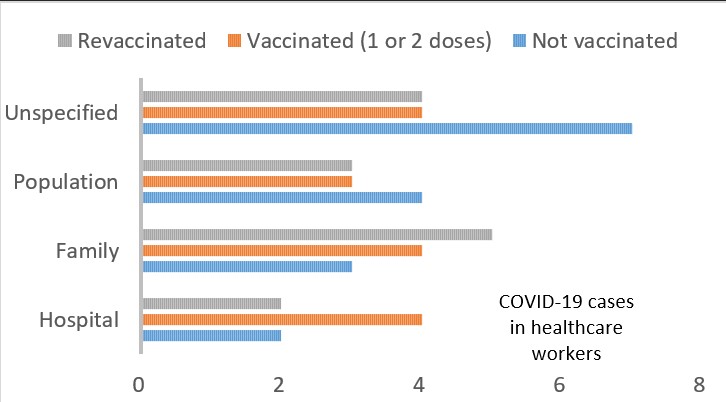
Figure 2: Vaccination status of healthcare workers and source of COVID-19 infection
Figure 3: Assessment of risk factors for COVID-19 in medical personnel.
There was statistically significant variability in the incidence rate depending on the functional responsibilities of the medical staff, with the highest probability of infection among mid-level medical personnel (n=29, 64.4% [RR 1.54, 95% CI 1.08-2.18]), followed by physicians in the main clinical departments of the hospital (n=12, 26.7%) and physicians in management and other positions (n=4, 8.9%). Statistically significant variability in the number of infections among medical staff was also determined by functional responsibilities and, consequently, the nature of interaction with an infected patient. The risk of infection for healthcare workers who, in accordance with their job responsibilities, had direct contact with the source of infection at the workplace was significantly higher than if the contact was indirect or absent (risk of infection almost 3.0 times; 95% CI 0.58-5.62).
Only three staff members reported non-compliance with PPE use rules during direct contact with an infected patient/colleague, so it was not possible to reliably estimate the impact of PPE use on COVID-19 incidence in this sample. Among the infected personnel members, the distribution by vaccination status was as follows: 26.7% (n=12) were fully vaccinated (two doses); 28.9% (n=13) were revaccinated; the proportion of infected unvaccinated members was 44.4% (n=20). The risk of SARS-CoV-2 infection in unvaccinated members compared to the vaccinated ones was expectedly higher (RR 1.67, 95% CI 1.25-2.07). Revaccination did not have a significant impact on the incidence rate, the risk of infection after revaccination was even slightly higher (RR 1.17, 95% CI 0.90-1.52); probably, vaccines against COVID-19 are only partially effective in preventing infection with new variants of SARS-CoV-2. The Omicron strain turned out to be more contagious; besides, active revaccination began less than a month before the next peak of COVID-19 caused by the Omicron strain. Almost all cases of recurrent disease (5 out of 6) occurred during this period.
There was a difference in symptoms between personnel members who tested positive for COVID-19 compared to those who tested negative. Cough was the most common symptom in those who tested positive (36.8% vs 25.0%; 95% CI 0.9%-23.3%), followed by fever (28.4% vs 7.4%; 95% CI 6.9%-40.3%) and shortness of breath (6.6% vs 1.1%; 95% CI 0.5%-12.4%). Anosmia was the only symptom statistically associated with positive COVID-19 tests (5.0% vs 0.0%; 95% CI 0.8%-11.1%). Other reported symptoms included fatigue (23.4%; 95% CI 12.7%-39%), headache (15.1%; 95% CI 9.0%-24.1%), sore throat (13.3%; 95% CI 8.2%-20.9%), nausea (11.8%; 95% CI 5.8%-22.6%), and diarrhea (10.6%; 95% CI 5.9%–18.9%). Not to be overlooked is the high number of complaints about mental disorders such as anxiety, psychological stress, and sleep disturbances, which have been described in detail in a number of studies [7].
The number of healthcare workers who reported an existing comorbid status was 2.59% (n=13), of which 69.2% (n=9) tested positive for SARS-CoV-2. Among the comorbidities, hypertension, CVD, diabetes, and COPD were noted in descending order. Thus, the risk of COVID-19 in medical personnel with an aggravated comorbid status was significantly higher (RR 9.85; 95% CI 8.75-10.91), which determines the need for additional attention to this group [8].
In 97.7% (n=44) of cases, COVID-19 in members of medical personnel was mild/moderate in severity, only one case required short-term hospitalization to correct the treatment of a chronic disease.
Low-risk personnel members were advised to self-monitor symptoms and adhere to necessary epidemiological safety measures; PCR testing was performed as needed. For the moderate-risk group, a COVID-19 test was recommended 72 hours after the contact with a confirmed infectious source and mandatory use of a surgical mask during work until the test result is known. High-risk members (RR 1.86; 95% CI 1.05-2.77) were to immediately stop work, undergo COVID-19 testing and remain in quarantine until the test results determine further tactics. All the members with a positive test were isolated at home for two weeks, with a repeat test at the end of quarantine. If the test was still positive, another one was performed after seven days. Since the pandemic period when Omicron became the prevailing strain (February 2022), the quarantine was reduced to seven days.
Thus, anti-epidemic and preventive measures based on the analysis of COVID-19 risk factors guaranteed the necessary level of control and epidemiological safety for healthcare workers and patients, reducing the likelihood of cross-infection within the healthcare facility.
Conclusion
The COVID-19 pandemic had a significant impact on healthcare workers and the healthcare system as a whole. Anti-epidemic measures in high-risk settings are fundamental to combat the spread of infection among healthcare workers and patients. Optimization of infection control measures ensured the earliest possible return of healthcare workers to their duties, eliminating unjustified quarantine, which helped avoid an acute shortage of medical personnel and maintain the functional capacity of the healthcare facility during the peak periods of the pandemic.
The majority of healthcare workers (33.3%) were unable to identify the source of SARS-CoV-2 infection. The probability of infection of healthcare workers in a healthcare facility was lower (RR 0.27) than from other sources. The ranking of infection risks by different sources did not depend on the periods of the pandemic.
The incidence of COVID-19 among healthcare workers directly correlated with that in the population, which emphasizes the need to strengthen epidemic control measures for all potential sources of infection, especially during periods of peak incidence. The highest risk of infection of the medical staff was from a confirmed source in the family (RR 2.08).
Full vaccination (2 doses) reduced the risk of infection (RR 0.63). Revaccination did not reduce the incidence of COVID-19 in the medical staff. Comorbid status in the medical staff significantly increased the risk of the disease (RR 9.85).
Factors such as the functional role of the medical staff in the hospital, the nature of interaction with the source of infection, the incidence rate in the population, vaccination status, testing practices and anti-epidemic measures in the medical institution were key ones influencing the epidemiological safety of medical personnel during the COVID-19 pandemic.