Hemolytic Anemia Due to Severe Vitamin B12 Deficiency Associated with Pernicious Anemia: A Case Report

Mustafa Şentürk1*, Alara Tavares2, Deniz Arıca3, Aylin Yıldırır4

¹Department of Internal Medicine, Başkent University Faculty of Medicine, Ankara, Turkey.
²Medicine Student, Başkent University Faculty of Medicine, Ankara, Turkey.
³Department of Medical Hematology, Başkent University Faculty of Medicine, Ankara, Turkey.
⁴Department of Medical Cardiology, Başkent University Faculty of Medicine, Ankara, Turkey.

*Corresponding author

*Dr. Mustafa Şentürk, Department of Internal Medicine, Başkent University Faculty of Medicine, Ankara, Turkey.
Email: senturk96mustafa@hotmail.com

Abstract

Pernicious anemia is an autoimmune disorder. Symptoms often develop after 10-20 years, with initial neuropsychiatric and hematological manifestations. Once vitamin B12 deficiency manifests, common symptoms include fatigue, dyspnea, and pallor. The hallmark feature is macrocytic anemia, while pancytopenia and hemolysis are rare.

A 78-year-old malepresented with fatigue, tachycardia, and dyspnea. He had no history of gastrointestinal bleeding or weight loss. On physical examination, he was pale and jaundiced.  Laboratory results revealed hemoglobin of 7 g/dL, platelets of 92000/μL, and MCV of 127 fL. Haptoglobin was <8 mg/dL, reticulocyte count was 2.21%, total bilirubin was 3.60 mg/dL and LDH was 3472 U/L. Vitamin B12 was <148 ng/L, homocysteine was 90.7 μmol/L, and folic acid was 3.3 μg/L. The peripheral smear showed anisocytosis, macrocytic erythrocytes and hypersegmented neutrophils. The anti-parietal cell antibody was weakly positive. Intramuscular B12 injections were initiated.

Three weeks later, laboratory results showed hemoglobin of 10 g/dL, platelets of 460000/μL, and leukocytes of 9840/μL, indicating the resolution of the bicitopenia. MCV was 99.7 fL, haptoglobin was 236 mg/dL, and reticulocyte count was 1.97%. %. Total bilirubin decreased to 1.20 mg/dL and LDH to 238 U/L. Vitamin B12 increased to 586 ng/L, homocysteine was 9.54 μmol/L, and folic acid was 14.3 μg/L. The patient's symptoms resolved, and follow-up was scheduled in one month.

Megaloblastic pernicious anemia due to severe vitamin B12 deficiency presents significant diagnostic challenges due to elevated hemolytic parameters accompanying the production defect caused by bone marrow suppression. Early recognition of hemolysis in B12 deficiency prevents misdiagnosis, unnecessary treatment, and complications by distinguishing it from other causes of hemolytic anemia.

Key words: Anemia, Hemolytic Anemia, Megaloblastic Anemia,Vitamin B12, Vitamin B12 Deficiency

Introduction

Pernicious anemia is an autoimmune disease that causes a deficiency in vitamin B12 (cobalamin) due to antibodies targeting intrinsic factor (IF) or parietal cells. This condition arises from the disruption of mechanisms directly affecting the absorption of cobalamin. Intrinsic factor is secreted by parietal cells in the gastric mucosa and forms a complex with vitamin B12, facilitating its absorption in the small intestine. The presence of antibodies disrupts the absorption process by either inhibiting the production of intrinsic factor or preventing it from binding to vitamin B12 [1]. Patients with pernicious anemia are asymptomatic for 10 to 20 years before diagnosis. The clinical manifestations of the disease can present as neuropsychiatric and hematologic symptoms. These patients frequently exhibit general symptoms such as fatigue, shortness of breath, and pallor. Hematologically, pernicious anemia is typically characterized by macrocytic anemia [2]. Pancytopenia and hemolysis are rare features of pernicious anemia, particularly in developed countries like the United States.In general, hemolysis due to vitamin B12 deficiency is rare, occurring in only 1.5% of cases [3]. In this article, we present an elderly male patient who was admitted with severe anemia due to newly diagnosed pernicious anemia. Laboratory findings indicated hemolysis accompanied by a production defect, and the hemolytic condition improved rapidly with the prompt replacement of vitamin B12.

Case

A 78-year-old male patient presented to the cardiology clinic with complaints of fatigue, tachycardia, and shortness of breath. His medical history included paroxysmal atrial fibrillation and a history of cerebrovascular event. Laboratory tests revealed a hemoglobin value of 7 g/dL, upon which he was admitted to the ward. The patient did not report any history of hematemesis, hematochezia, or melena. There was no history of weight loss, changes in bowel habits, or fever. He also had no recent history of NSAID use or blood transfusions. On physical examination, his vital signs were stable, he was afebrile, with a heart rate of 96 beats per minute and blood pressure of 110/70 mmHg. Digital rectal examination was normal. The patient appeared pale and jaundiced.

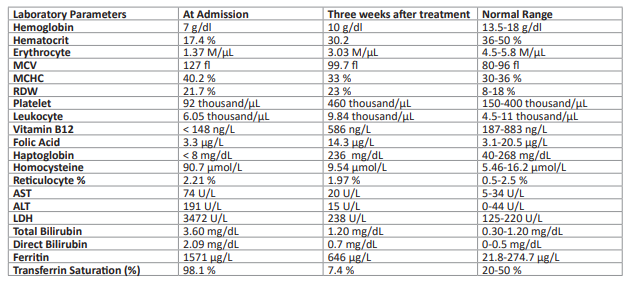
Initial laboratory tests showed hemoglobin of 7 g/dL, platelets of 92000/μL, and leukocytes of 6050/μL, indicating bicytopenia. The MCV value was 127 fl, haptoglobin was<8 mg/dL, and reticulocyte count was 2.21%. Direct and indirect Coombs tests were negative. Total bilirubin was 3.60 mg/dL, ALT was 191 U/L, AST was 74 U/L, and LDH was 3472 U/L. Other nutritional parameters showed ferritin of 1571 μg/L and transferrin saturation percentage of 98.1%. The patient's vitamin B12 level was <148 ng/L, homocysteine was 90.7 μmol/L, and folic acid level was 3.3 μg/L. An abdominal ultrasound showed normal spleen size and grade 1 hepatic steatosis in the liver.The peripheral blood smear showed marked anisocytosis, macrocytic erythrocyte morphology, and hypersegmented neutrophils (Figure 1). No schistocytes were observed in the peripheral smear. Anti-intrinsic factor antibody, anti-endomysial IgA antibody, and anti-transglutaminase IgG and IgA antibodies were negative, but the anti-parietal cell antibody was weakly positive. ADAMTS-13 activity was normal.

Due to clinical symptoms and moderate hemodynamic intolerance, the patient received2 units of red blood cell suspension. Vitamin B12 supplementation was initiated with 1000 mcg of intramuscular cyanocobalamin daily for 10 days, and the continuation of the treatment was planned as an intramuscular dose of 1000 mcg of cyanocobalamin once a week for 5 weeks, followed by an intramuscular dose of 1000 mcg of cyanocobalamin once a month for life. Oral folate supplementation was planned with 5 mg every other day for one month, followed by 5 mg twice weekly.

Figure 1: The patient's peripheral blood smear. A: Hypersegmented neutrophil. B: Macrocytic erythrocyte.

Table 1: Laboratory results at the time of admission and three weeks after treatment.
Transthoracic echocardiography revealed moderate degree aortic stenosis (aortic mean gradient 27mmHg, mean aort valve are of 1.0 cm2) and severely depressed left ventricular systolic function (left ventricular ejection fraction of 32%). A transesophageal echocardiogram (TEE) was performed after atrial fibrillation was observed on the follow-up ECG of the patient, whose initial ECG showed sinus rhythm. TEE showed dense spontaneous echo contrast (SEC) in the left atrium, with a 1.2x0.7 cm thrombus in the left atrial appendage. Therefore, cardioversion could not be performed, and the patient was planned to be monitored with anticoagulation therapy. Esophagogastroduodenoscopy, planned due to anti-parietal antibody positivity, was postponed after cardiac further evaluations of the patient. The patient was discharged with a prescription for apixaban 2x2.5 mg and scheduled for follow-up in 3 weeks. Cardiac catheterization and coronary angiography were planned to investigate the etiology of left ventricular dysfunction after correction of the anemia.

Three weeks after treatment, laboratory tests showed improvement in bicytopenia with a hemoglobin level of 10 g/dL, platelets of 460000/μL, and leukocytes of 9,840/μL. The MCV value was 99.7 fl, haptoglobin was 236 mg/dL, and reticulocyte count was 1.97%. Total bilirubin decreased to 1.20 mg/dL, ALT to 20 U/L, AST to 15 U/L, and LDH to 238 U/L. Regarding other nutritional parameters, ferritin was 646 μg/L and transferrin saturation was 7.4%. The patient's vitamin B12 level was 586 ng/L, homocysteine was 9.54 μmol/L, and folic acid level was 14.3 μg/L. The patient's complaints of fatigue, tachycardia, and shortness of breath completely resolved, and a follow-up appointment was scheduled for one month later.

Discussion

Vitamin B12 deficiency generally stems from two main causes: insufficient intake of cobalamin-rich foods and malabsorption issues. Malabsorption can result from pernicious anemia or from gastric surgeries [4]. In our patient, the presence of anti-parietal cell antibodies led to the development of pernicious anemia.

Macrocytic and megaloblastic changes are characterized by reduced cell division due to decreased nucleic acid metabolism and normal cytoplasmic maturation. This leads to a nuclear-cytoplasmic asynchrony. Severe B12 deficiencies can hinder the maturation of all bone marrow cell lines, causing anemia, thrombocytopenia, and leukopenia [5]. Our patient had bicytopenia (anemia and thrombocytopenia), but the white blood cell counts were normal.

Our case exhibited a macrocytic anemia along with hemolysis with normal reticulocyte count as indicated by high indirect bilirubin, high LDH, low haptoglobin in laboratory tests. The exact process of hemolysis in megaloblastic anemia patients is not fully understood, but it is primarily believed to stem from the destruction of abnormal, immature nucleated erythrocytes in the bone marrow, resulting from a process known as ineffective erythropoiesis [6].

Hemolysis due to vitamin B12 deficiency can be confused with microangiopathic hemolytic processes, such as thrombotic thrombocytopenic purpura (TTP) and hemolytic uremic syndrome (HUS). This condition can present as hemolytic anemia with low platelet counts and is sometimes referred to as pseudo-thrombotic microangiopathy (TMA). In a study by Noel et al. [7], patients with pseudo-TMA due to vitamin B12 deficiency were compared with TTP patients, and it was found that reticulocyte counts were low in pseudo-TMA cases. Very high LDH and low reticulocyte counts indicate pseudo-TMA and cobalamin deficiency rather than a true thrombotic process. Identifying hypersegmented neutrophils and low cobalamin levels, along with elevated methylmalonic acid and/or homocysteine, is crucial in determining that hemolytic anemia is due to B12 deficiency [8]. In our case, TTP was ruled out by a negative ADAMTS-13. Flow cytometric analysis with the PNH flair test did not detect PNH clones in erythrocytes or granulocytes.

Starting treatment promptly for pernicious anemia is essential. While anemia typically resolves within four to six weeks, neurological symptoms may take several months to improve. Treatment for pernicious anemia involves intramuscular injections of vitamin B12 to improve bioavailability. The standard regimen includes daily 1000 mcg B12 injections for one week, followed by weekly injections for four weeks, and then lifelong monthly IM injections [9]. In our case, we opted for daily IM injections initially for 10 days instead of a week, followed by weekly injections for five weeks, and then lifelongmonthly treatment.

Conclusions

Our case presents a combination of megaloblastic pernicious anemia and hemolytic anemia due to severe vitamin B12 deficiency. Early recognition of hemolysis in vitamin B12 deficiency prevents the misdiagnosis of other etiologies of hemolytic anemia, avoids complications from unnecessary and harmful treatments, and reduces costs for the individual. Consequently, vitamin B12 deficiency, particularly in patients with risk factors such as chronic atrophic gastritis, a history of gastric surgery, or absorption disorders, should be considered as a cause of severe hemolysis.

Conflicts of Interests: The Authors declare that there are no competing interests.

Patient Consent: The patient provided verbal consent for publication of her clinical information and treatment.

References

  1. Socha, D. S., DeSouza, S. I., Flagg, A., Sekeres, M., & Rogers, H. J. (2020). Severe megaloblastic anemia: Vitamin deficiency and other causes. Cleveland Clinic journal of medicine, 87(3), 153–164.10.3949/ccjm.87a.19072.
  2. Sahu, P., Thippeswamy, H., & Chaturvedi, S. K. (2022). Neuropsychiatric manifestations in vitamin B12 deficiency. Vitamins and hormones, 119, 457–470. 10.1016/bs.vh.2022.01.001
  3. Andrès, E., Affenberger, S., Zimmer, J., Vinzio, S., Grosu, D., Pistol, G., Maloisel, F., Weitten, T., Kaltenbach, G., & Blicklé, J. F. (2006). Current hematological findings in cobalamin deficiency. A study of 201 consecutive patients with documented cobalamin deficiency. Clinical and laboratory haematology, 28(1), 50–56.10.1111/j.1365-2257.2006.00755.x
  4. Shipton, M. J., & Thachil, J. (2015). Vitamin B12 deficiency - A 21st century perspective . Clinical medicine (London, England), 15(2), 145–150.10.7861/clinmedicine.15-2-145.
  5. Pelling, M. M., Kimura, S. T., Han, E. J., & Shin, Y. M. (2022). Severe Vitamin B12 Deficiency Presenting as Pancytopenia, Hemolytic Anemia, and Paresthesia: Could Your B12 Be Any Lower?. Cureus, 14(9), e29225.10.7759/cureus.29225.
  6. Ballas SK: Abnormal erythrocyte membrane protein pattern in severe megaloblastic anemia . J Clin Invest. 1978, 61:1097-101. 10.1172/JCI109009
  7. Noël, N., Maigné, G., Tertian, G., Anguel, N., Monnet, X., Michot, J. M., Goujard, C., & Lambotte, O. (2013). Hemolysis and schistocytosis in the emergency department: consider pseudothrombotic microangiopathy related to vitamin B12 deficiency. QJM : monthly journal of the Association of Physicians, 106(11), 1017–1022.10.1093/qjmed/hct142.
  8. Savage, D. G., Lindenbaum, J., Stabler, S. P., & Allen, R. H. (1994). Sensitivity of serum methylmalonic acid and total homocysteine determinations for diagnosing cobalamin and folate deficiencies. The American journal of medicine, 96(3), 239–246.10.1016/0002-9343(94)90149-x.
  9. Stabler S. P. (2013). Clinical practice. Vitamin B12 deficiency. The New England journal of medicine, 368(2), 149–160.10.1056/NEJMcp1113996.
TOP