Lahjouji Achraf*, Nabili Yousra, Rajaallah Abdessamad, Rahmi Mohamed, Rafai Mohamed

Resident in orthopedic and Traumatologie surgery, Morocco.

*Corresponding author

*Lahjouji Achraf*, Resident in orthopedic and traumatologie surgery, Morocco.

Introduction

Essential bone cyst, also known as solitary or unicameral bone cyst, is a benign lesion that forms in long bones, mainly in children and young adults.

Essential bone cyst of the acetabulum is a rare lesion that can affect the hip joint. Although complications are rare, they can sometimes lead to pathological fractures if the surrounding bone is sufficiently weakened. This may require specific management to stabilize the affected area and prevent complications.

Our study aims to draw attention to the clinical and paraclinical features of essential bone cysts of the acetabulum, as well as to the specific management of this type of cyst.

Observation

We present the case of a 28-year-old female patient with no particular pathological history, admitted to our department for chronic right hip pain evolving for 3 months, in an atraumatic context with preservation of general condition.

General examination: patient in good general condition with a BMI of 19, walking with the aid of a crutch and a dodging limp. Osteoarticular examination revealed pain on palpation and mobilization of the right hip, with no inflammatory signs or swelling. Hip joint amplitudes were preserved, with no downstream vasculo-nervous disorders.

In view of this clinical signs, a frontal pelvic X-ray was taken, showing a lytic image at the level of the right acetabulum roof, approximately 3 cm in diameter, with a clear contour and no cortical effraction. (Figure 1) CT scan of the pelvis showed a lytic image in the anterior wall of the acetabulum, with thinning of the bony cortex, no cartilaginous or bony matrix and no signs of locoregional aggressiveness, in favour of a slowly progressive benign lesion.

MRI shows an intramedullary cystic lesion in the anterior region of the right acetabulum, lobulated in shape, with clear borders, liquid signal, T1 iso signal, T2 intense hyper signal, STIR hyper signal, no diffusion restriction, with enhancement of a thin peripheral membrane lining the cyst and the intracystic septa.

The lesion measured 28x46x27 mm in transverse, anteroposterior diameter and height respectively, with significant cortical thinning opposite, without signal abnormality or enhancement of the perilesional soft tissues, in favor of a benign-looking cystic intraosseous tumor of the right acetabulum. (Figure 2) A phospho-calcium test was ordered, which came back normal.

Figure 1: Lytic image of the right acetabulum, approximately 3cm in diameter, with a clear contour and no cortical invasion.
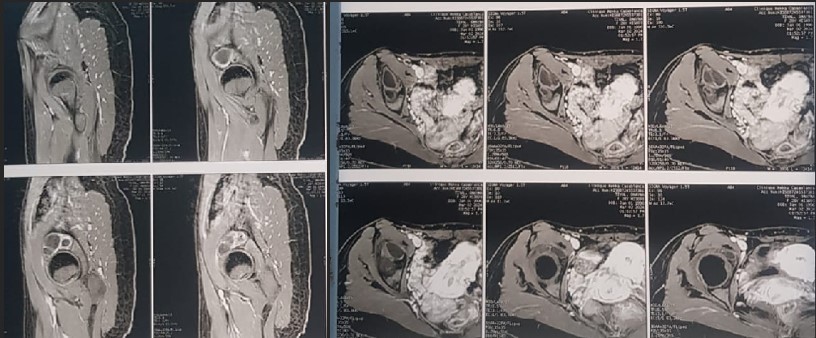
Figure 2: Benign intrabony cystic tumour of the right acetabulum

Figure 3: Radio control at Day 1

The patient underwent surgical biopsy, and the specimens showed regular, calcified bone lamellae with a few bone sequestrations delimiting fibrous, richly vascularized, non-inflammatory logettes, with a histological appearance in favor of an simple bone cyst.

In the operating room, the acetabulum was approached via an anterior Hueter approach, and the cyst contents were excised by curettage, followed by placement of a synthetic bone substitute with a bone graft (harvested from the iliac crest), closed plane by plane.

In the post-operative management, a strict rest with off-loading for 6 weeks was prescribed to the patient with introduction of medical treatment (1/2 th level analgesic, LMWH) with a follow-up radiograph at d1, d21, d45. (Figure3)

Discussions

Symptoms may vary. Some patients may be asymptomatic, while others may experience hip pain, particularly during physical activity or movement.

As with other simple bone cysts, the exact origin in the acetabulum is not fully understood, but is likely to be related to growth abnormalities or local inflammatory responses in the bone.

Although the exact cause of simple bone cysts is not fully understood, several theories have been put forward. Some experts believe they may result from an accumulation of fluid in a bone due to an imbalance between bone formation and resorption during growth. Other theories suggest a traumatic origin or a local inflammatory response that leads to the formation of a fluid-filled cavity. (1)

The diagnosis of an simple bone cyst is usually established by radiography, although other imaging techniques such as MRI can sometimes be used to assess the extent of the lesion. Clinical follow-up is often recommended to monitor the progression of the cyst and assess whether there are any symptoms or complications that require medical intervention.

Most essential bone cysts have a benign course. They are often discovered incidentally during X-ray examinations carried out for other reasons. In many patients, these cysts can resolve spontaneously as the individual grows and the bone develops. However, in some patients, cysts may persist or even increase in size, potentially posing problems such as pain or the risk of pathological fracture. This may require specific management to stabilize the affected area and prevent future complications.(2)(3)

Treatment of simple bone cysts depends on clinical presentation, but is mainly conservative, especially when asymptomatic. Options include observation with periodic X-rays to monitor progress, as well as pain management as required. In cases where symptoms are persistent or there is a risk of fracture, more active interventions may be considered, such as curettage (surgical excision of the cystic cavity) or corticosteroid injection to promote reduction in cyst size and relieve symptoms. (4)

Conclusions

Although rare, simple acetabular bone cyst can affect the hip joint and requires careful evaluation and sometimes clinical management to ensure optimal quality of life and prevent potential complications.

References

  1. Pathogenesis and treatment of unicameral bone cysts - Mascard E, Gomez-Brouchet A, Lambot K. Orthop Traumatol Surg Res. 2013 Feb;99(1 Suppl)
  2. The natural history of bone cysts - Neer CS 2nd, Francis KC, Johnston AD, Kiernan HA Jr. A study of 311 cases.
  3. Management of unicameral bone cysts - Dormans JP, Pill SG, Fracture Management for the Primary Care Physician.
  4. Bone cysts: unicameral and aneurysmal bone cyst - Wilson SC, Davila JA. Orthop Nurs. 2003 Sep-Oct;22(5):322-8.
TOP