
Energy Drinks and Cardiac Complications: A Case Report of ST-Elevation Myocardial Infarction in a Young Man
Augusto Esposito1*, Ilenia Foffa1,2, Simone Sorbo1, Cecilia Vecoli1,2, Maria Giovanna Colombo1, mberto Paradossi1 and Sergio Berti1,2.
¹Ospedale del Cuore, Fondazione Toscana "G. Monasterio," Massa, Italy.
²Institute of Clinical Physiology, CNR, Massa, Italy.
*Corresponding author
*Dr. Augusto Esposito, Via Aurelia Sud 54100, Massa, Italy. Email: augustoesposito1990@gmail.com
DOI: 10.55920/JCRMHS.2024.08.001325

Figure 1: Electrocardiogram displaying sinus rhythm with marked ST elevation in the anterolateral leads (V2-V5, I, aVL) and reciprocal changes in the inferior leads (III and aVF)
Genetic screenings for thrombophilia resulted negative. As regard laboratory data, we found only a slight hypercholesterolaemia and glomerular filtration rate (GFR) values lower than normal for age in relation to a nephrosclerosis from urinary infections occurring in childhood. In addition, study for patent foramen ovale (PFO) paradoxical embolism, echo-abdomen and chest CT scan to exclude neoplastic embolism and toxicological tests were all negative. The post-procedural course was normal with discharge of the patient after 7 days of hospitalisation. Follow-up at one month showed suspected left ventricular apical thrombotic apposition, in the context of severe left ventricular dilatation and apical akinesia in toto. Subsequent follow-up with cardiac MRI confirmed the suspicion (Figure 3). The patient started warfarin therapy for 3 months with complete resolution of the apical thrombosis. He is currently on six-monthly follow-up with good response to the prescribed therapy.
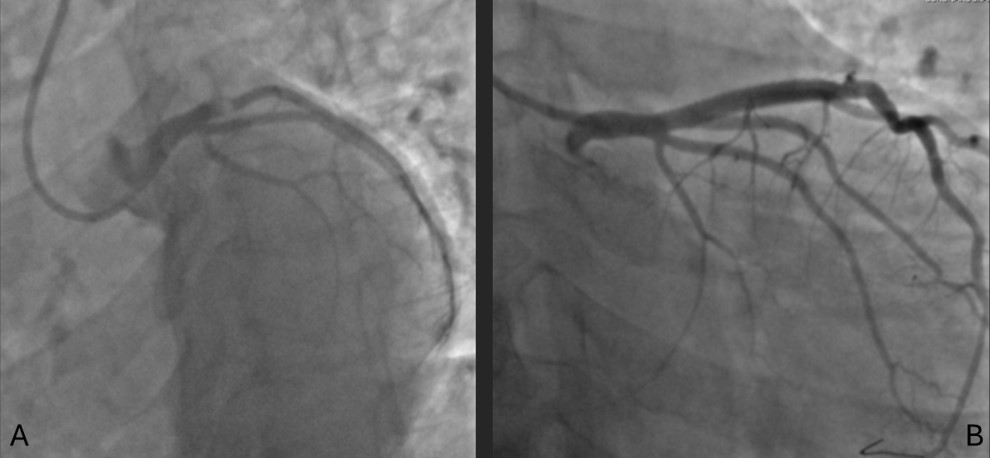
Figure 2: Coronarographic study pre (2A) and post percutaneous revascularization procedure (2B)
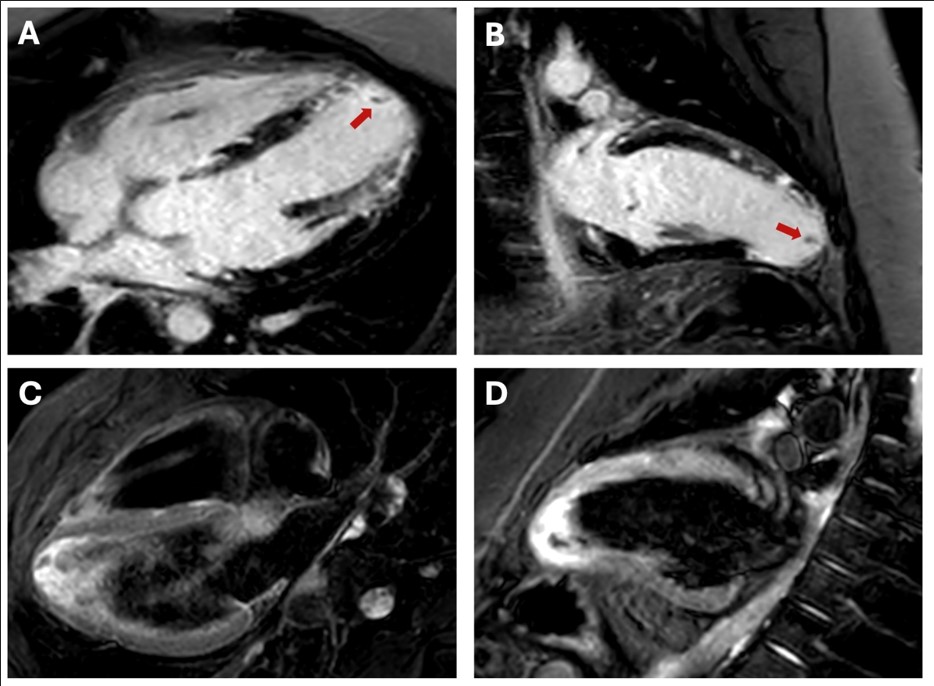
Figure 3: Follow-up cardiac magnetic resonance (CMR) one month after the acute event. Late gadolinium enhancement (LGE) images: A) 4-chamber view and B) 2-chamber view show LGE with a subendocardial-transmural pattern (ischemic pattern) in the mid-distal anterior wall and the apex, with a small apical thrombus (red arrow). T2-weighted STIR images: C) 4-chamber view and D) 2-chamber view show hyperintensity in the apex, suggestive of myocardial edema due to the recent ischemic event.
In particular, caffeine has a direct chronotropic and positive inotropic effects on the heart and at high doses, it induces vascular smooth muscle contraction, increases peripheral vascular resistance and blood pressure slightly (Cappelletti, 2018). It is claimed that taurine and gluconolactone are the main components responsible for the effects attributed to Red Bull. Specifically, taurine, a derivative of the amino acid cysteine, has recently been shown to protect against ischemia and heart failure and is found in abundance in cardiac and skeletal muscles where regulate potassium, calcium and sodium levels thus, affecting the excitability of the myocardium [Lake, 1987; Satoh, 1998]. In a recent review, Costantino et al. reported nine cases of cardiac arrest, three of which were fatal with an aetiology attributed to the inherent neurostimulant properties of these beverages (Costantino, 2023). Furthermore, it was found that the risk of cardiovascular outcomes is increased in individuals with pre-existing structural or hereditary heart disease and that adverse cardiovascular effects have also been found with the use of other substances, such as alcohol. Also, experimental studies on animal model reported acute and chronic adverse health effects related to use of EDs consistent with observations in humans affecting various organs or systems (Sali, 2018; Ellermann, 2022; Demirel, 2023). However, although the pathophysiology between energy drink intake and myocardial ischaemia has not been fully elucidated, the preponderance of data suggests that these drinks are not harmless. There is still a substantial amount of unknown information on EDs despite their consumption behaviour remains very high, especially among teenagers, and the absence of regulatory oversight has resulted in aggressive marketing of energy drinks. This uncertainty leads us to conduct further research and, it is prudent to recommend limited consumption of such drinks. Nadeem et al, in a recent review, recommend in fact that individuals avoid frequent energy drink consumption (5-7 energy drinks/week) and avoid co-consumption with alcohol since the document coingestion of energy drinks with alcohol significantly increased the risk of adverse events (Needem, 2021). Moreover, in the future, children, adolescents and young people should be better informed about the ED-associated risk to prevent adverse health effects. So, there is a pressing need for a deeper understanding of novel risk factors that contribute to Acute Myocardial Infarction in young patients and the screening of emerging novel markers is important in preventing young patients with Acute Myocardial Infarction particularly where conventional risk factors are absent (Ranjan, 2024). The Abuse of energy drinks could be a new emerging novel risk factors associated with young STEMI which need intervention to reduce morbidity and mortality.
Funding: “The authors declare that no funds, grants, or other support were received during the preparation of this manuscript.”
Competing Interests: “The authors have no relevant financial or non-financial interests to disclose.”
Author Contributions: “All authors contributed to the study conception and design. Clinical, Coronagraphic and percutaneous revascularization procedures were performed by Augusto Esposito, Simone Sorbo, Umberto Paradossi. Genetic screening for thrombophilia was performed by Maria Giovanna Colombo. The first draft of the manuscript was written by Ilenia Foffa, Augusto Esposito and Cecilia Vecoli and all authors commented on previous versions of the manuscript. Sergio Berti critically reviewed the manuscript as supervisor. All authors read and approved the final manuscript.”
Ethics approval: All procedures performed in studies involving human participants were in accordance with the ethical standards of the institutional and/or national research committee and with the 1964 Helsinki declaration and its later amendments or comparable ethical standards.
Consent to participate: “Informed consent was obtained from all individual participants included in the study.”
Consent to publish: “The authors affirm that human research participants provided informed consent for publication of the images in Figure(s) 1,2,3.”