
Acute Abdomen due to Congenital Transmesenteric Internal Hernia in a 12-Year-Old Patient: Case Report San Juan De Dios General Hospital, Guatemala February 2022
Dr. Gaby Ajcip*. Advisor: Dr. Jacqueline Carrera
Department of Pediatric Surgery , Guatemala, Spain.
*Corresponding author
*Dr. Gaby Ajcip, Department of Pediatric surgery , Guatemala, Spain. Email: gaby.ajcip@gmail.com
DOI: 10.55920/JCRMHS.2024.07.001310

Figure 1: Standing X-ray, obstruction data.

Figure 2: Defect in mesentery 2.3 meters from the duodenojejunal angle.

Figure 3: Intestinal loops inside through transmesenteric hernia (white arrow), dilated loops with irreversible ischemic changes (light blue arrow).
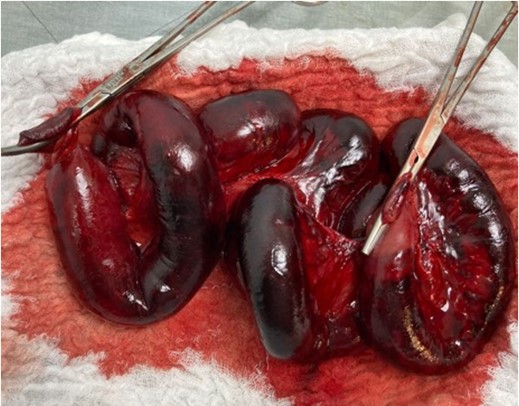
Figure 4: Intestinal portion with irreversible ischemic changes resected.
The patient's clinical picture did not improve. The abdomen continued to be painful and tense, with a palpable mass in the left hemiabdomen. The patient was therefore taken to the operating room for acute abdomen, with intestinal intussusception or volvulus being one of the suspected diagnoses. The approach was through a supraumbilical transverse incision. The findings showed a defect in the intestinal mesentery 2.3 meters from the duodenojejunal angle, approximately 4 cm in diameter and with regular edges (see figure 2). Dilated intestinal loops were found inside, with irreversible ischemic changes 2.4 to 3.7 meters from the duodenojejunal angle (see figure 3) and 400 cc of inflammatory fluid in the cavity. Upon evidence of these findings, the hernia was reduced and a 1.3-meter intestinal resection was performed (see figure 4) and an end-to-end anastomosis of 2.4 to 3.7 meters of the duodenojejunal angle with 5-0 polypropylene with monoplane hemo-seal with single, separated serosubmucosal sutures. No leaks were seen and the diameter was adequate. The hernia defect and the mesentery of the anastomosis were closed with 4-0 polyglactin, inflammatory fluid was aspirated, the cavity was washed with saline solution,
aspiration was performed and hemostasis was verified, definitive closure of the fascia with polydioxanone 1, continuous single sutures and skin with 3-0 nylon single sutures.
The patient was evaluated in his immediate postoperative period by pediatrics who decided to leave him under mechanical ventilation and move him to the pediatric intensive care unit, where he remained for 72 hours under mechanical ventilation. Due to clinical and metabolic improvement, he was successfully extubated and on his fourth postoperative day he was transferred to the pediatric surgery unit. He was started on an oral diet with liquids and progressed until he tolerated a free diet. He was on antibiotic treatment for 10 days with metronidazole and ceftriaxone. On his tenth postoperative day he was discharged successfully.