A Huge Mandibular Chondrosarcoma: A Case Report and Review of the Literature

Dr Othmane Naanani*, Dr I.Larhrabli, Pr M. loudghiri, Pr W. Bijou, Pr Y. Oukessou, Pr S.Rouadi, Pr R.L. Abada, Pr M. Roubal, Pr M. Mahtar

ENT and Cervicofacial Surgery Department, CHU Ibn Rochd, Faculty of Medicine and Pharmacy, Hassan II University, Casablanca, Morocco.

*Corresponding author

*Dr Othmane Naanani, ENT and Cervicofacial Surgery Department, CHU Ibn Rochd, Faculty of Medicine and Pharmacy, Hassan II University, Casablanca, Morocco.

Abstract

Chondrosarcomas are malignant cartilage tumours that rarely occur in the maxilla. They are characterized by a generally slow evolution over time, and by a high tendency for locoregional recurrence after surgical treatment. Their prognosis will depend on their histological grade, as well as the quality of tumor excision.We report the case of a 22-year-old woman with a chondrosarcoma of the mandibule.

Introduction

Chondrosarcomas (CS) are malignant mesenchymal tumors with cartilage differentiation that rarely affect the maxillofacial region. They account for around 11% of malignant bone tumours [1]. These tumors are particularly aggressive, with a strong tendency to late recurrence and delayed metastasis.

Medical observation

A 22-year-old female patient, with no particular pathological history, presented for consultation with a right mandibular tumefaction, progressively increasing in volume over the past 2 years, without pain, later complicated by a trismus. The situation was evolving in a context of apyrexia and preserved general condition.

On physical examination, the patient presented with an enormous swelling of the right jugal area, with marked limitation of mouth opening. Examination of the oral cavity revealed a budding mass with healthy mucosa, associated with abnormal mobility of the opposing teeth.

Figure 1: CT scan; Axial section of the lesion

Figure 2: CT scan; Coronal and 3D sections of the lesion

Figure 3: MRI image of the lesion across axial section

Figure 4: MRI image of the lesion across sagittal section

Figure 5: MRI image of the lesion across coronal section
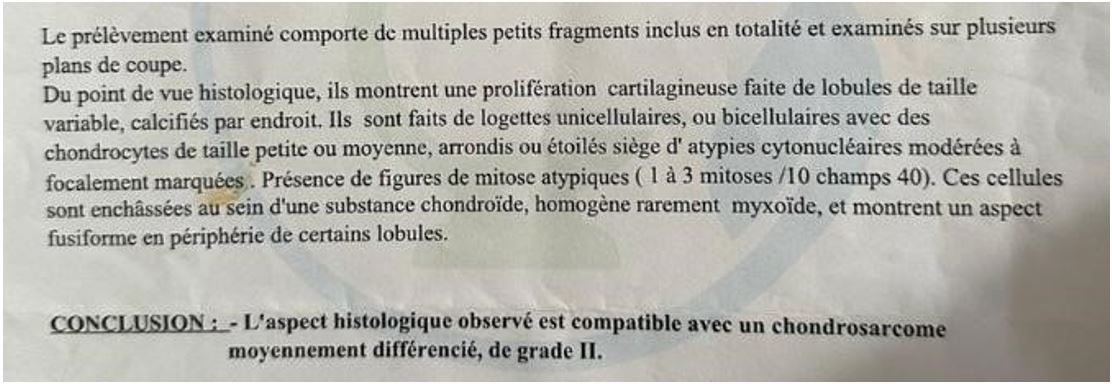
Figure 6: Histopathology of the lesion

Figure 7: Per-operative photograph of patient

Figure 8: Post-operative photograph of patient

The CT scan (fig. 1, 2) showed a voluminous expansive process centred on the right mandibular horizontal ramus and angle, with a significant periosteal reaction in the form of a grass fire, suggesting in the first instance a sarcomatous origin. MRI (Fig. 3,4,5) also showed a voluminous right mandibular process with significant locoregional extension, muscle invasion and bilateral lymph node involvement, also suggesting a sarcomatous origin at first. A biopsy was performed, which showed a grade II, moderately differentiated mandibular chondrosarcoma (Fig. 6)

Our patient's treatment consisted of a right hemimandibulectomy with pelvectomy, combined with triangular lymph node dissection. The mandible was reconstructed with an angled maxiplate, and the floor of the mouth with a flap of the pectoralis major muscle (Fig. 7,8). Post-operative adjuvant radiotherapy was performed on the tumour site and lymph nodes.

Discussion

Chondrosarcoma is the second most common primary malignant bone tumour in humans [2]. It accounts for 0.1% of all head and neck tumours [3]. Chondrosarcoma is rare in the maxilla [4], and mandibular localization is even less frequent than maxillary localization [5]. Age of onset varies between 17 and 75 years [6], with an average age at diagnosis of 58 years [7]. As for gender, some authors describe a female predominance [6], while others give an equal gender distribution [8,9,10].

The clinical presentation is non-specific. The swelling is slow-growing, firm and usually painful [5,7,11]. This slow evolution explains the delay in diagnosis, with an average delay of 12 months. In our case, the diagnosis was established after 2 years of evolution.

Computed tomography (CT) allows us to study the characteristics of the tumor and its precise extent. However, there are no pathognomonic radiological signs. Bone destruction is often present, and mottled densities caused by calcification are sometimes observed [12,13]. The "sunburst" appearance is not pathognomonic [10,11].

Magnetic resonance imaging (MRI) is used to study tumour extension into soft tissue and its relationship with adjacent structures (nerve, vascular and bone).

The literature classifies chondrosarcomas into three grades of increasing severity, depending on the degree of tumour differentiation. Very well-differentiated chondrosarcomas (grade I) pose problems of differential diagnosis with chondromas, hamartomas and chondrogenic osteosarcomas [7,14].

Surgical treatment represents the basic therapy for this pathology, regardless of the surgical technique used [15,16,17].

Surgery is often mutilating and aggressive. Surgical management of lymph nodes does not appear to improve survival [18]. The role of radiotherapy and chemotherapy is poorly defined. Most authors consider chondrosarcomas to be radio- and chemoresistant [7].

Chondrosarcomas have a slow evolution, with extension to neighboring anatomical structures. Local tumor recurrence is frequent. Distant metastasis is very rare, with the lung being the most frequently affected.

Conclusion

Mandibular chondrosarcoma is a rare malignant tumor. It progresses relatively slowly and is often diagnosed late. Treatment is based essentially on surgical excision. Postoperative radiochemotherapy is recommended. Prognosis depends on local recurrence, which is frequent - hence the importance of long-term surveillance - and metastases, which are rare.

References

  1. Chondrosarcome mésenchymateux de la mandibule : un rapport et une revue de cas rares Priyanka Singh 1, Anil Singh 1, Sujata Saxena 2, Sanjay Singh 3
  2. Kaufman JK, Pritz MB, Righi PD, Bizal JC (1999) Craniofacial resection of nasoseptal chondrosarcoma: case report and review of the literature. Surg Neurol 52:265–9
  3. Koch BB, Karvell LH, Hoffman HT, et al (2000) National cancer database report on chondrosarcoma of the head and neck. Head Neck 22:408–25
  4. Oujilal A, El Alamin MN, Lazrak A, et al (2001) Chondrosarcomes des os maxillaires : une localisation mandibulaire. Rev Stomatol Chir Maxillofac 102(2):115–8
  5. Garrington G, Collet W (1988) Chondrosarcome of the jaw: analysis of 39 cases. J Oral Pathol 17:12–20
  6. Morris MR, Clark SK, Porter BA, et al. Chondrosarcoma of the temporomandibular joint: case report. Head Neck Surg 1987;10:113
  7. Saito K, Unni k, Wllan PC, Lund BA (1995) Chondrosarcoma of the jaw and facial bone. Cancer 76:1550–8
  8. Megers SP, Hirsch WL, Curlin HD, et al (1992) Chondrosarcome of the skull base, MR imaging features. Radiology 184:103–8
  9. Molla MR, Ijuhin N, Sugata T, Sakamoto T (1987) Chondrosarcome of the jaw:
  10. report of two cases. J Oral Maxillofac Surg 45:453–7
  11. Murayama S, Suzuki I, Nagase M, et al (1988) Chondrosarcoma of the mandible.
  12. Report of case and a survey of 23 cases on the Japanese literature. J Craniomaxfac Surg 16:287–92
  13. Reychler H (1988) Les tumeurs cartilagineuses des maxillaires. Rev Stomatol Chir Maxillofac 89:321–9
  14. Gingrass RP. Chondrosarcoma of the mandibular joint: report of a case. J Oral Surg (Chic) 1954;12:61
  15. Saini R, Abd Razak NH, Ab Rahman S, et al. Chondrosarcoma of the mandible: a case report. J Can Dent Assoc 2007;73:175Y178
  16. Ovmiston IW, Poette E, Tidoman H, Wu PC (1994) Chondrosarcoma of the mandible presenting as perodontal lesion: report of 2 cases. J Craniomaxillofac Surg 22:231–5
  17. Gorsky M, Epstein JB. Craniofacial osseous and chondromatous sarcomas in
  18. British ColumbiaVa review of 34 cases. Oral Oncol 2000;36:27
  19. Penel N, Van Haverbeke C, Lartigau E, et al. Head and neck soft tissue sarcomas of adult: prognostic value of surgery in multimodal therapeutic approach. Oral Oncol 2004;40:890
  20. Aziz SR, Miremadi AR, McCabe JC. Mesenchymal chondrosarcoma of the maxilla with diffuse metastasis: case report and literature review. J Oral Maxillofac Surg 2002;60:931
  21. Zachariades N, Vairak taris E, Mezitio M, et al (1987) Chondrosarcoma of the orofacial region. Review of the literature and report of 2 cases. Rev Stomatol Chir Maxillofac 88:382–7.
TOP