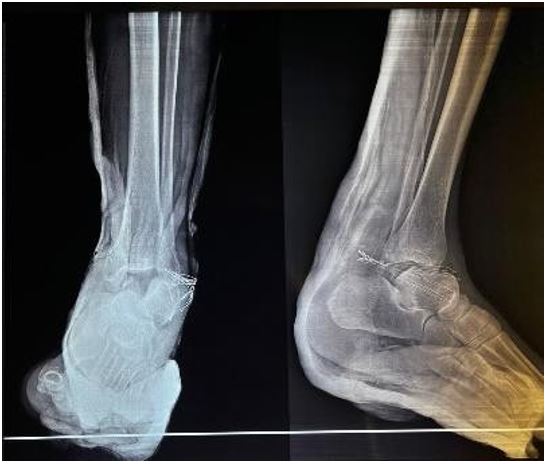
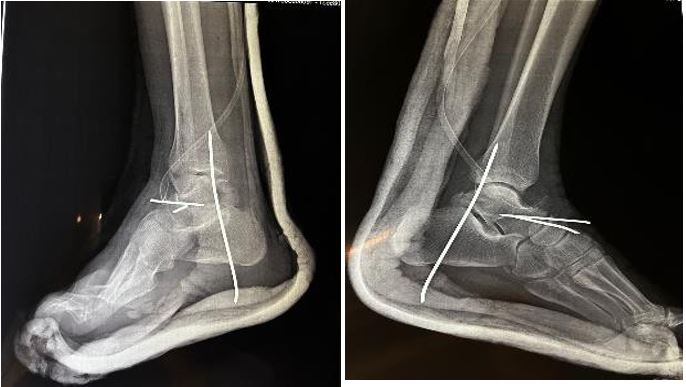
The talus is exposed to significant traumatic risk due to the intermediate position between the leg and the foot and the absence of muscular or tendinous insertion. It is subjected to considerable stress during walking and other activities and is at the center of a highly mobile joint complex.
Talus Enucleation isn’t an usually lesion that has rarely been described in the literature. The functional prognosis of the ankle is compromised by the risk of osteonecrosis. The direction of enucleation can var.most often is dislocated anterolateraly but the displacement may also be anteromedial or, and less in posteromedial.
However, the pathophysiological mechanism is still debated. For Pennal [6], anterolateral enucleation is performed through a dual process of forced plantar flexion and inversion. Plantar flexion results in rupture of the collateral ligament, while inversion leads to a tear of the talocalcaneal ligaments. The most precise study of enucleation mechanisms is that of Leitner (in 2), who described enucleation as the ultimate stage of supination trauma—in other words, the ultimate stage of medial subtalar dislocation. The treatment advocated by the various authors is far from unequivocal. Currently, the trend go for a conservative treatment for acute enucleations [2], reserving arthrodesis for secondary septic complications and late arthrosicevolution. The reduction of talus dislocation should be an emergency in order to prevent skin and vascular complications [7]. Tibiocalcaneal arthrodesis was adopted by Detenbeck and Kelly [3] but is a source of significant stiffness. Butel and Witvoet [9] noted the poor functional results of talectomy in enucleations of the talus and recommended triple arthrodesis as the firstline procedure, using the talus as a graft. Some authors recommend closed reduction with the aid of transcalcaneal traction [7]. Tibiocalcaneal arthrodesis was adopted by Detenbeck and Kelly [3] but is a source of significant stiffness. Butel and Witvoet [8] noted the poor functional results of talectomy in enucleations of the talus and recommended triple arthrodesis as a first-line treatment, using the talus as a graft. Some authors recommend closed reduction with the aid of transcalcaneal traction [7]. In the event of failure, the bloody approach is recommended [9,10]. Once the talus has been reduced, open focus allows the capsuloligamentous structures to be repaired [7,11]. Immobilization is achieved with a cast for four to eight weeks [7] or with a pin [11]. The evolution of talus enucleation is fraught with complications the main one being osteonecrosis after conservative treatment. Some authors consider this necrosis inevitable [2,9]. This is thought to be due to destruction of the capsuloligamentous attachments and complete rupture of the entire vascular supply [2]. As a few cases of enucleation of the talus have escaped this type of complication, several hypotheses can be put forward. Shahparee [2] suggested that the persistence of some ligamentous attachments, particularly the deltoid ligament, explains the inconsistency of necrosis. The tarsal canal artery is a branch of the posterior tibial artery and constitutes the main vascularization site of the body of the talus [13]. Its integrity at the time of the accident could explain the absence of talus necrosis in some anterolateral enucleations. Biga and Defives [1] reported a case of pure anterolateral enucleation of the talus treated by simple reduction.
At the two-year follow-up, we found no radiological signs of talar necrosis in any of our patients.