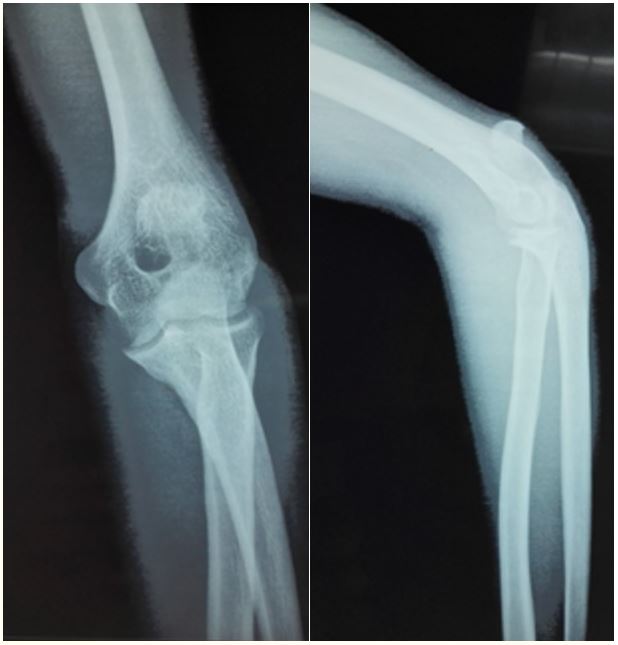
This involved a 23-year-old patient, a smoker and an alcoholic, without a profession, admitted to our training for the management of an open trauma to the left elbow following a stabbing attack. Before the trauma, the patient felt a firm, painless mass on the posterior aspect of the left elbow, isolated from the olecranon. This non-symptomatic mass had not been the subject of any exploration. On physical examination of the left elbow, we noted a wound of approximately 3 cm on the posterolateral aspect of the elbow, no vascular-nervous damage, nor impairment of mobility of the elbow. Frontal and lateral X-rays of the left elbow showed a bony fragment with a regular edge next to the olecranon (Figure 1). The diagnosis of olecranon fracture is made and surgery is indicated. The patient was placed in the operating room in lateral decubitus position with arm on arm position. We widened the wound so that we reproduced the posterior approach to the elbow. Intraoperatively, we found an intact triceps tendon with a regular rounded bone fragment approximately 3 cm from the beak of the olecranon embedded in this tendon reminiscent of the anatomy of the patella (Figure 2). This bone fragment was resected at the patient's request. At 6 months follow-up, the patient did not complain of a change in the functionality of the elbow.