Floating knees: lesional and therapeutic aspects (about 74 cases)

Dr. Bensaka Mohammed*, Dr. Chafai Alaoui Karim, Dr. Mnina Ayoub, Dr. Khanouch Marouane, Dr. Miloudi Mouad, Dr. Mghabar Elbachir, Dr. Alaoui Rachid, Pr Abid Hatim , Pr. Elidrissi Mohammed, Pr. Elmrini Abdelmajid

Residence Jnane Pasteur, Boulevard Abdelmoumen, Casablanca, Morocco.

*Corresponding author

*Bensaka Mohammed, Residence Jnane Pasteur, Boulevard Abdelmoumen, Casablanca, Morocco

Introduction

Floating knee is a fracture association in the lower limb described by Blake and Mcbryde [1] in 1974 to designate ipsilateral fractures of the femur and tibia. It most often occurs in the context of multiple trauma causing associated brain, thoracic and abdominal lesions that endanger the patient's vital prognosis. Management must be multidisciplinary, early and optimal with the essential goals of: stabilization of vital functions in the multiple trauma patient, effective and definitive treatment allowing early recovery, maximum prevention of complications and well-conducted rehabilitation. Our work aims to clarify this traumatic entity by analyzing the lesional and therapeutic aspects and evaluating the functional results of treatment in order to compare them with those in the literature.

Materiel And Methods

This is a retrospective study covering all patients operated on for floating knees at the Traumatology Orthopedics Department B4 of the Hassan II University Hospital of Fez, over a period of 22 years, going from January 2010 to December 2022. We excluded our study: 1) patients aged less than 16 years; 2) patients leaving medical advice; 3) incomplete files (non-usable). At the end of our operation, 74 floating knees were retained. The data was analyzed based on an operating sheet; the statistical study was carried out on Microsoft Excel 2016

Results

We have noted a clear increase in the annual incidence of floating knees. The average age of our patients is 27 years with a male predominance of 91%, the left lower limb was affected in 68.05% of cases and in 03 cases (2.77%) the involvement was bilateral.

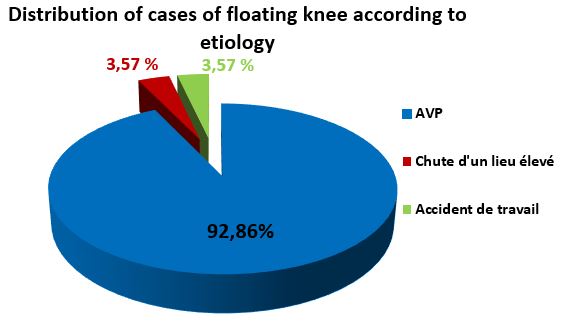
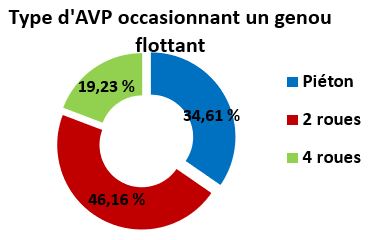
Direct shock is the most incriminated in 83.33% of cases, the etiologies are dominated by public road accidents (AVP) in 66 cases or 91.66%.(Figure A)

Figure 1: Distribution of cases according to Fraser classification.

Figure 2: Functional results based on Karlstrom criteria

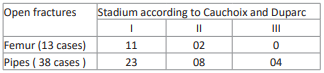
Table 1: Distribution of open fractures according to the Couchoix and Duparc classification.

Table 2: Different therapeutic means used

Discussion

The studies influencing these results are: skin opening, joint damage in fractures classified as Fraser stage II, thus we noted 70% excellent and good results in cases of floating knee with at least one open fracture versus 91% for closed floating knees with more satisfactory results for Fraser stage I (57% excellent and good results).

Floating knee can occur at any age with a predominance for young male subjects in the majority of series of literature, which is similar to our series.

AVP represents the etiology of floating knee in 91.66% of cases in our series as well as in all the series of other authors.

The rate of skin opening exceeds half of the cases in most series, as well as our study series and we see that open fractures predominate at the level of the tibia compared to the femur, and this is explained by the fact that at the tibial level the bone is located under the skin at the level of the antero-internal face of the leg.

The majority of authors report the occurrence of floating knee in the context of polytrauma in more than 20% of cases, notably 46.1% for Zrig and 32.2% for Karlstrom with an average ISS score which remains high, which shows the seriousness of the problem. this trauma. Radiologically, Fraser type I is the most reported in the majority of series in the literature.

Intramedullary nailing remains the most used therapeutic method in all series (Table 3). The most reported complications are infection, malunion, joint stiffness and nonunion.

For our functional results, they are consistent with those of the literature with a predominance of excellent and good results in all studies, moreover, open fractures and Fraser stage II fractures remain with an unfortunate prognosis with acceptable to poor results.

Conclusion

Floating knees represent a potentially serious traumatic entity with frequent associated injuries making their multidisciplinary management requiring appropriate resuscitation measures and appropriate surgical treatment.

References

  1. MC Bryde AM, Blake R. The floatingknee:ipsilateral fractures of the femur and tibia. J. Bone and Joint. 1974; 56-A: 6.
  2. Fraser RD, Hunter GA, Wadell JP. Ipsilateral fracture of the femur and tibia. J Bone and Joint. 1978;60-B(4): 510-515. PubMed| Google Scholar
  3. Rethman U, Yesupalan RS, Nair R. The floatingknee:epidemiology, prognosisindicators and outcomefollowingsurgical management. J Trauma ManagOutcomes. 2007 Nov26;1(1): 2. PubMed| Google Scholar
  4. Hwan Tak H, HoPoh W, Yin Peng L, Leann M. Predictors of outcome of floatingknee injuries in adults. Acta OrthopScand. 2001 Aug;72(4): 385-94. PubMed| Google Scholar
  5. Pietu G, Jacquot F, Freron JM. The floatingknee:aretrospectiveanalysis of 172 cases. Rev Chir OrthopReparatrice. 2007;(6): 627634. PubMed| Google Scholar
  6. Zrig M, Mnif H, Hammouda I, Abbadi A, Allagui M, Hamdi MF et al. Le genou flottant : étude rétrospective de 39 cas. Tunisie Orthopédie. 2008;1(2): 165-170.
  7. Karlstrom G, Olerud S. Ipsilateral fracture of the femur and tibia. J Bones Joint Surg (Am). 1977 Mar;59(2): 240-3. PubMed| Google Scholar
  8. Marco FA, Rozim AZ, Piedade SR. Knee joint stability in a floatingknee condition. Acta Ortop Bras. 2008;16(1): 32-36. Google Scholar
  9. Veith RG, Winquist RA, Hansen ST. Ipsilateral fractures of the femur and tibia. J Bone and Joint. 1984;66-A(7): 991-1002. PubMed| Google Scholar
  10. Hung SH, Lu YM, Hvang HT, Lin YK. Surgicaltreatment of type II of floatingknee: comparaison of the results of type IIa and type IIbfloatingknee. KneeSurg Sports TraumatolArthrosc. 2007;15(5): 578-586. PubMed| Google Scholar
TOP