Benign Metastasizing Leiomyoma Associated With Lung Metastases : A Case Report

Donia Dhib*

Medical Oncology department, Abderrahmane Mami Hospital, Ariana Tunisia, Tunisia.

*Corresponding author

*Donia Dhib, Medical Oncology department, Abderrahmane Mami Hospital, Ariana Tunisia, Tunisia.

ABSTRACT

Benignmetastasizingleiomyoma (BML) is a rare clinicalentityobserved in women of reproductive or premenopausalagewith a history of uterinemyomectomy or hysterectomycharacterized by the presence of benignuterineleiomyomasthatmetastasize to extrauterine sites, mostcommonlyto the lung.

This literature casereviewaims to provide a comprehensiveoverview of the currentunderstanding of BML, includingitspathogenesis, clinicalpresentation, diagnosis, management, and areas of ongoingresearch.

Introduction

Benignmetastasizingleiomyomais a rare condition that challenges the traditionalunderstanding of uterineleiomyomas. This condition has been documented in womenwith a history of uterineleiomyomas, with the metastatic nodules appearingpredominantly in the lungs. The pathogenesis of BML remainsincompletelyunderstood, and thereis a paucity of high-qualityclinicalevidenceregardingits optimal management. The exact mechanismunderlying BML developmentisstill a subject of debate. Severaltheories have been proposed, includinghematogenous spread, lymphaticdissemination, and intraperitonealseeding. The mostcommon sites of metastases are the pulmonary, and other sites can includeheart, lymphnodes and bladder(1–6). Hormonal factors, such as estrogen and progesterone, are believed to play a role in BML'sgrowth and progression.

Case Presentation

A 40-year-old female patient with a history of uterinefibroidsurgerypresentedwith multiple bilateraldisseminatedpulmonary nodules.The patient underwenther first uterinefibroidsurgery 3 yearsagowhichrevealedasepticnecrobiticuterineleiomyomawith no histologicalsigns of malignancy. Sheunderwent a second reductionmyomectomy, withincompleteresection, for recurrence of a uterine mass, whichhistologicalexaminationshowed a leiomyoma. Immunohistochemistrystainshowedthat the tumorcellswere positive for caldesmone and CD10. A follow-up pelvic MRI, performed 1 monthlater, showed a voluminousbilateralmedian and paramedianpelvic mass measuring 12*6 cm withheterogeneous signal enhancingafter injection of Gadolinium, associatedwith a second mass at the uterine site measuring 72*42 mm with a large central necroticcavitywithoutbladder invasion. Sheunderwenthysterectomy, and the pathology report showed a leiomyoma. Eight monthsafterthisepisode, dysuria set in, and a pelvicrecurrencewasdiagnosed, with the discovery of disseminatedbilateralpulmonary nodulesinthe chest scan. The largest ofthesenodules waslocated in the right medio-basal region and measured 26*15mm, associatedwith a 47mm leftanteriormediastinal mass with a bilobed, lymphnode-like appearance. The patient had no respiratory or thoracicsymptoms.

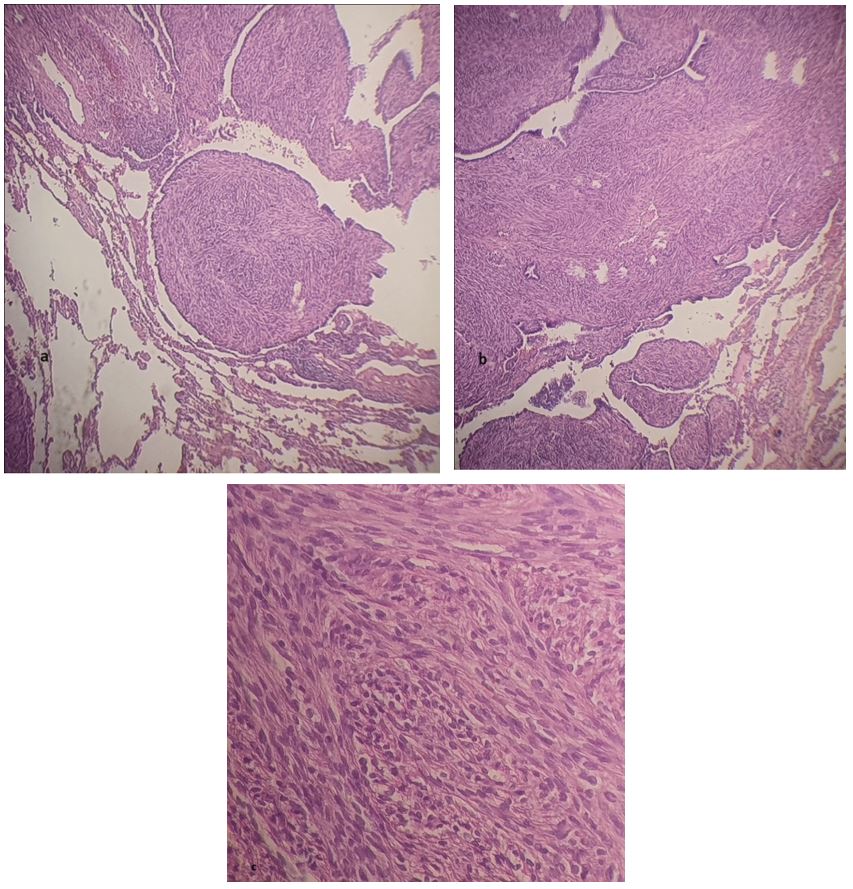
Histology of the BML. (a) A well-circumscribed leiomyoma mass in the normal lung parenchyma (H & E, ×100). (b) Benign-appearing spindle-shaped cells arranged in intersecting fascicles (H & E, ×200). (c)The cell morphology was consistent, without atypia and without mitoses (H & E, ×400)

A biopsy of the pelvic mass revealed a leiomyoma. Given the discrepancybetweenleiomyoma and secondarypulmonarylesions, a biopsy of a pulmonarylesionwasperformedsurgically. Histologicexaminationrevealed a proliferation of blandeosinophilicspindlecellswithelongatenuclei and tapered ends consistent withsmooth muscle. Cytologicatypia, necrosisand mitotic figures were not identified.Immunohistochemistrystainshowedthat the tumorcellswere positive for muscle-specificactin, estrogen and progesteronereceptors and negative for TTF1. The ki67 index was 5%. The diagnosis of metastazingbenignleiomyomawas made. The patient beganchemical castration with LH-RH analogues. The first CT scan at 4 monthsshowed a 15% reduction in tumourburden. Untillnow, we are at 8 yearsof follow-up intotreatment, with  stable disease.

Discussion and Conclusions

Benignmetastasizingleiomyoma (BML) is an uncommon condition wherehistologicallybenignsmooth muscle tumors spread to locations outside the uterus(7). Few cases of BML have been documented in medicalliterature. This diseasetypically affects women in theirlate reproductive or premenopausalyears, many of whom have a history of surgicallytreatedleiomyomasthroughmyomectomy or hysterectomy. Our patient underwent 3 surgeries for recurrentuterineleiomyoma.

The mostfrequentclinical manifestations include progressive dyspneaduring exertion, pneumothorax, and chylous effusions. Conversely, the absence of systemicsymptoms or anysymptoms, coupledwith a history of uterinefibroids or prioruterinesurgery, stronglysuggests BML. In our case, No respiratory or thoracicsymptomswerereprted by the patient.

The mostcommonsite for metastasisis the lungs, accounting for 80% of cases. Otherreported sites of metastasiscan include the heart ,liver, lymphnodes, skeletal muscle and central nervous system. Zong et al (8)report in hispaper, the case of a 51 yearoldwomanwith a history of uterineleiomyomapresentendwith an osteolytic damage and spinal canal compression. Lymphnodesmetastasis are rare but not excluded as exemplified in this case. .

CT imaging of the chest and abdomen mayindicatemalignancy or infection. BML typicallyappears as well-definedlung nodules on CT scans. Bilaterallung nodules are more commonthan multiple unilaterallesions or solitary nodules. These nodules can vary in size and maycavitate, resulting in thin-walled or thick-walledcysts(9). In our case,too, the chest CT showed diffuse bilateralpulmonary nodules.

Ultimately, a histologicaldiagnosisisnecessary to establish the diagnosis of BML. This couldinvolvelungbiopsy and lesionresection.Therefore,immunohistochemistryis the key to accuratediagnosis. The typicalimmunophenotypes of PBML cellsinclude SMA (+), desmin (+), ER (+), and PR (+), whereas Ki-67 index isgenerallylessthan 1%(10).In this case, immunohistochemistryshowedpositivity for smooth muscle actin, ER, PR, and ki67 index was 5%.

The exact origin of BML remainsunclear and subject to controversy and varioushypotheses have been proposed.  The mostwidelyacceptedtheorysuggestshematogenous spread of a monoclonal elementwithin a benignsmooth muscle tumor. It isalsosuggestedthattheremaybe a derivation of an independentsmooth muscle proliferation or potentialderivation of a low-grade leiomyosarcoma(11).In this report, Wu et al. (12)usedparallelsequencing and genome-wide copy number to detectlung and uterineleiomyoma in synchronized tissue samples. It wasfoundthat the somatic mutation and copy number aberrations were the same inchromosomalabnormalitiespairedpulmonary and uterineleiomyoma. A potentiallydeleterioussomaticheterozygous mutation in the bonemorphogeneticprotein 8B genemayplay a facilitatoryrole in the metastasis of BML(13). It hasalso been detectedin 25% of thesetumors, such as balanced translocation, trisomy 12, or 6p rearrangement of 6p(14). Wewereunable to complete a geneticstudy for our patient.

Due to the rarity of thisdisease, no standardizedtreatment for BML has been proposed. Various articles published in the literaturesuggestthat the treatment can includeregular and vigilant observation ,surgicalresectionwithoophorectomy( surgical castration),medical castration using aromatase inhibitors, estrogenreceptorblockers (such as tamoxifen and raloxifene) , GnRH agonists ,progesteronetherapy, tyrosine kinase inhibitors (such as imatinib), (15,16).Our patient benefitedfromchemical castration with GnRH analogues withtumorstabilityafter 8 years follow-up.

In conclusion, the prognosis for BML patients isgenerally favorable, and pulmonarylesions are typicallydiscoveredseveralyearsafterhysterectomy or myomectomy, showing slow growth. Although rare, simultaneousmetastases to retroperitoneallymphnodes post-surgeryrequireprolonged surveillance for earlydetection of recurrence or distant metastases.

Givenlimitedtherapeutic options, thereis a need to explore and consider new drugs or therapeuticstrategies. Long-term follow-up isalsorecommended to betterunderstandtheir implications in clinical practice.

References

  1. Jo JH, Lee JH, Kim DC, Kim SH, Kwon HC, Kim JS, et al. A Case of Benign Metastasizing Leiomyoma with Multiple Metastasis to the Soft Tissue, Skeletal Muscle, Lung and Breast. Korean J Intern Med. sept 2006;21(3):199‑201.
  2. Kwon YI, Kim TH, Sohn JW, Yoon HJ, Shin DH, Park SS. Benign Pulmonary Metastasizing Leiomyomatosis: Case Report and a Review of the Literature. Korean J Intern Med. sept 2006;21(3):173‑7.
  3. Kaplan C, Benirschke K, Johnson KC. Leiomyomatosis peritonealis disseminata with endometrium. Obstet Gynecol. janv 1980;55(1):119‑22.
  4. Takemura G, Takatsu Y, Kaitani K, Ono M, Ando F, Tanada S, et al. Metastasizing uterine leiomyoma. A case with cardiac and pulmonary metastasis. Pathol Res Pract. juin 1996;192(6):622‑9; discussion 630-633.
  5. Yoon G, Kim TJ, Sung CO, Choi CH, Lee JW, Lee JH, et al. Benign metastasizing leiomyoma with multiple lymph node metastasis: a case report. Cancer Res Treat. juin 2011;43(2):131‑3.
  6. Egberts JH, Schafmayer C, Bauerschlag DO, Jänig U, Tepel J. Benign abdominal and pulmonary metastasizing leiomyoma of the uterus. Arch Gynecol Obstet. août 2006;274(5):319‑22.
  7. Bakkensen JB, Samore W, Bortoletto P, Morton CC, Anchan RM. Pelvic and pulmonary benign metastasizing leiomyoma: A case report. Case Rep Womens Health. 31 mars 2018;18:e00061.
  8. Zong D, He W, Li J, Peng H, Chen P, Ouyang R. Concurrent benign metastasizing leiomyoma in the lung and lumbar spine with elevated standardized uptake value level in positron-emission tomography computed tomography. Medicine (Baltimore). 6 juill 2018;97(27):e11334.
  9. Pacheco-Rodriguez G, Taveira-DaSilva AM, Moss J. Benign Metastasizing Leiomyoma. Clin Chest Med. 1 sept 2016;37(3):589‑95.
  10. Kayser K, Zink S, Schneider T, Dienemann H, André S, Kaltner H, et al. Benign metastasizing leiomyoma of the uterus: documentation of clinical, immunohistochemical and lectin-histochemical data of ten cases. Virchows Arch Int J Pathol. sept 2000;437(3):284‑92.
  11. Lee HJ, Choi J, Kim KR. Pulmonary benign metastasizing leiomyoma associated with intravenous leiomyomatosis of the uterus: clinical behavior and genomic changes supporting a transportation theory. Int J Gynecol Pathol Off J Int Soc Gynecol Pathol. juill 2008;27(3):340‑5.
  12. Wu RC, Chao AS, Lee LY, Lin G, Chen SJ, Lu YJ, et al. Massively parallel sequencing and genome-wide copy number analysis revealed a clonal relationship in benign metastasizing leiomyoma. Oncotarget. 18 juill 2017;8(29):47547‑54.
  13. Sõritsa D, Teder H, Roosipuu R, Tamm H, Laisk-Podar T, Soplepmann P, et al. Whole exome sequencing of benign pulmonary metastasizing leiomyoma reveals mutation in the BMP8B gene. BMC Med Genet. 31 janv 2018;19(1):20.
  14. Esteban JM, Allen WM, Schaerf RH. Benign metastasizing leiomyoma of the uterus: histologic and immunohistochemical characterization of primary and metastatic lesions. Arch Pathol Lab Med. oct 1999;123(10):960‑2.
  15. Hague WM, Abdulwahid NA, Jacobs HS, Craft I. Use of LHRH analogue to obtain reversible castration in a patient with benign metastasizing leiomyoma. Br J Obstet Gynaecol. mai 1986;93(5):455‑60.
  16. Nasu K, Tsuno A, Takai N, Narahara H. A case of benign metastasizing leiomyoma treated by surgical castration followed by an aromatase inhibitor, anastrozole. Arch Gynecol Obstet. févr 2009;279(2):255‑7.
TOP