
Spontaneous or nonsurgical pneumoperitoneum: A retrospective study with a review of literature
Dr Saumya Chopra1*, Dr Sunder Goyal2
¹Assistant Professor, Department of Surgery ESICMCH Faridabad, India.
²Professor, Department of Surgery ESICMCH Faridabad, India.
*Corresponding author
*Saumya Chopra, Assistant Professor, Department of Surgery ESICMCH Faridabad, India.
DOI: 10.55920/JCRMHS.2023.06.001260
Abstract
Background: Free air in the peritoneal cavity is called pneumoperitoneum. It is an emergency that requires immediate laparotomy. It is present in about 90% of the cases with a hollow viscous perforation. On the other hand, spontaneous, nonsurgical or idiopathic pneumoperitoneum is a benign surgical entity that needs no immediate surgery. It is a diagnostic dilemma for the surgeon as the clinical presentation and radiological findings imitate perforated viscous and may result in unnecessary laparotomy. History and physical examination are very important to rule out visceral perforation.A diagnostic peritoneal lavage,CECT, contrast studies, or laparoscopic evaluation can help prevent a patient from having unnecessary laparotomy.
Methodology: This retrospective study was done from Jan 2021 to June 2022. Fifty cases of pneumoperitoneum due to visceral perforation were admitted during this period. Only one case of spontaneous pneumoperitoneum was reported with a diagnostic dilemmatreated conservatively.
Conclusion: This retrospective study identifies the presence of such a surgical entity, which can be managed conservatively, thus preventing the needless surgical burden of morbidity and mortality.
Keywords: Spontaneous pneumoperitoneum, visceral perforation, laparoscopic evaluation, diagnostic peritoneal lavage, CECT.
Introduction
Pneumoperitoneum is described as free air under the diaphragm 1.Intraperitoneal free air indicates hollow viscous perforation in over 90% of the patients, which is considered a surgical emergency. Rarely,the presence of pneumoperitoneum may not be due to intra-abdominal perforations (10 -15%) and thus may not require unnecessaryemergency exploratory laparotomy. Sucha condition poses a diagnostic dilemma to treating surgeons or ICU critical care teamand is termed a "nonsurgical", "spontaneous", or "idiopathic" pneumoperitoneum. The causes may be intrathoracic, intra-abdominal, gynaecological and idiopathic2,3. Emergency surgical intervention is important in patients with perforated viscous as delay may cause major morbidity and mortality due to sepsis, third space volume shift resulting in shock and multiple organ dysfunction syndrome4. The surgeons tend to operate at the earliest for pneumoperitoneum due to suspected perforated viscous. The patients might undergo unnecessarysurgical intervention in case of spontaneous pneumoperitoneum, adding morbidity to the already sick patients.The decision to go for laparotomycannot be made solely on the presence of pneumoperitoneum without any signs of peritonitis.
In cases of high suspicion of perforated viscus, laparoscopy provides a good diagnostic and therapeutic tool. So, surgeons must know about this rare "spontaneous pneumoperitoneum" entity and should avoid unnecessary laparotomy. Hereby,we present a case of a middle-aged patient with spontaneous pneumoperitoneum managed conservatively.
Material & Method
This retrospective study was conducted from Jan 2021 to June 2022at ESIC Medical College in Faridabad, India. Fiftycases of pneumoperitoneum due to visceral perforation were admitted to the surgery department during this period. All except one presented with features of peritonitis. Thispatientpresented with no abdominal symptoms or signsand faced a diagnostic dilemma.
Case Report
A 50-year male underwent Percutaneous Coronary Intervention stenting 4 years back for coronary disease. He has been maintaining well since then, when he presented to the casualty department with pain in the precordium for one day for admission and evaluation under the Cardiology department. There was a history of open cholecystectomy 20 years back. ECG, Echocardiography, cardiac enzymes and other cardiac causes were within normal limits. Chest X-ray showed significant free air under the diaphragm. On examination, there was no tachycardia, hypotension or fever: no abdominal signs or symptoms of peritonitis. Total leukocyte counts and ESR were within the normal limit. X-ray chest, including the upper abdomen, showed air under the right dome of the diaphragm. CECT Thorax and Abdomen with oral and IV contrast revealed free air under the diaphragm and no bowel leak [Fig-1A, B, C]. Delayed films were also taken, which showed no leak to the rectum. Patient photo and Xray Abdomen at presentation are also shown. [Fig-2A, B]
Diagnostic laparoscopy ruled out visceral perforation, and the patient managed conservatively
Table 1: Agewise Distribution.
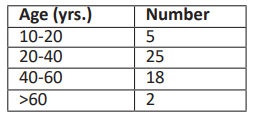
Table 2: Perforated Organs

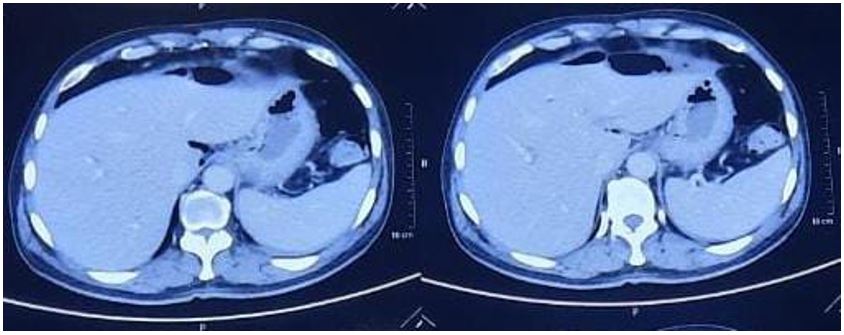
Figure 1A

Figure 1B

Figure 1C

Figure 2A,2B
Table 3: Causes of spontaneous pneumoperitoneum in tabular form. [22-23/12].

Table 4: Shows cases of Spontaneous pneumoperitoneum and its causes

Discussion
Pneumoperitoneum, or gas in the peritoneal cavity, is a surgical emergency in adults and children. In about >90% of cases, perforated intra-abdominal viscous,e.g. peptic ulcer, Meckel's diverticulum, toxic megacolon, necrotizing enterocolitis, Crohn's disease, and/or perforation of the bowel due to trauma or tumours, are responsible for pneumoperitoneum3. The entity of 'benign', 'spontaneous', 'nonsurgical', 'asymptomatic', or 'idiopathic' pneumoperitoneum is reported in the literature, which, when identified, needs conservative management only.
Surprisingly, not all hollow viscous perforations result in pneumoperitoneum, and about 69% of the cases of gut perforationare present with air under the diaphragm on X-Ray4. This can happen due to spontaneous perforation sealing with invisible minimal gas leakage. Similarly, all pneumoperitoneum is not due to perforated viscus. The decision to go for laparotomy cannot be made solely on the presence of pneumoperitoneum without signs of peritonitis.Such cases in the literature are explained as nonsurgical pneumoperitoneum or spontaneous pneumoperitoneum2,5,6.
Most nonsurgical (spontaneous) pneumoperitoneum cases may occur as a procedural complication or a complication of medical intervention. The most common abdominal aetiology of NSP can be retained postoperative air (prevalence 25% to 60%). NSP frequently occurs after peritoneal dialysis catheter placement (10% to 34%) and gastrointestinal endoscopic procedures (0.3% to 25%, varying by procedure)7.
Thepathophysiology of spontaneous pneumoperitoneum is unclear. Whenintra-thoracic pressure increases, air maydissect its way downwards along the oesophagus and aorta into the retroperitoneal tissue [12/8]. The air can alsodissect through the diaphragm defectsin the posterolateral region secondary to arrest in the closure of the pleuroperitonealcanal and diaphragmatic defects at the sternocostal andlumbo-coastal region[13/9]. Another suggested theory is that there are micro-perforations (2 to 4 mm)in the anterior wall of the stomach, which can cause pneumoperitoneum. [14/10]
The causes of spontaneous pneumoperitoneum can be divided into:
- Intrathoracic,
- Abdominal,
- Gynaecological and
- Idiopathic:-
Thoracic
Pneumothorax, pleuroperitoneal fistula, pneumomediastinum due to thoracic trauma, barotraumas, cardiopulmonary resuscitation and pneumonia.
Abdominal
Abdominal causes include pneumatosiscystoidesintestinalis. In this disease, gas-filled submucosal or sub-serosalcysts are mostly found in the terminal ileum and are the most important cause.
Upper gastrointestinal endoscopy, emphysematous cholecystitis and post-surgical pneumoperitoneum are other possible causes.
Gynecological
Forceful coitus, vaginal douching, pelvic inflammatory disease & postpartum knee-chest exercise are possible gynaecological causes [9,11/11].
Idiopathic
In the current era of increasing critical care, ventilator management and COVID cases, idiopathic pneumoperitoneum is no longer a diagnosis of exclusion. It should be kept in mind while evaluating critically ill patients in ICU with sepsis and ventilator support. If feasible, moving ahead with exploratory laparotomy must be planned after cross-sectional imaging with oral and IV contrast.
Reviewing the literature revealed that watchful waiting is important with favourable outcomes. It also helps decrease hospital stays and avoid unnecessary surgeries with related morbidity and mortality. Conservative treatment was successful in Idiopathic cases without signs of peritonitis. [8/13]
Review of literature for spontaneous pneumoperitoneum: Management
This condition is demanding as most cases are misdiagnosed as perforated viscus resulting in immediate laparotomy. The literature review advocates for conservative management if peritoneal signs of visceral perforation are absent. Whereas if peritoneal signs of perforation are present, then laparotomy is necessary. Avoid negative exploratory laparotomy in patients with spontaneous pneumoperitoneum and thus save the patients from unnecessary morbidity [10/22].
Diagnostic laparoscopy is a good diagnostic and therapeutic tool in a hemodynamically stable patient with pneumoperitoneum without obvious features of viscera perforation. It will prevent unnecessary exploratory laparotomy with morbidity in already sick patients, especially in the COVID era, when many patients need prolonged ICU stay and mechanical ventilation (both risk factors for spontaneous pneumoperitoneum).[21] However, the use of diagnostic laparoscopy in such cases is quite limited in the literature.
Conclusions
Spontaneous pneumoperitoneum means air under the diaphragm without hollow viscous perforation. It is an uncommon surgical entity and is a diagnostic dilemmain the patient without signs of peritonitis wherethe X-Ray shows gas under the diaphragm.The treating surgeon should maintain a high index of suspicion for nonsurgical causes of pneumoperitoneum and recognize that conservative management may be indicated in many cases.In stable patients with elements of pneumoperitoneum, diagnostic laparoscopy can be considered to rule out visceral perforations. In patients with features of peritonitis, laparotomy is justified.
References
- Ostrowski A, Williams R, Broderick G, Panagopoulos V, Kyriazis I, et al. Scientific program of 35th world congress of endourology program book andabstracts. J Endourol2017; 31: 1-474
- Mularski RA, Ciccolo ML, Rappaport WD. Nonsurgical causes ofpneumoperitoneum. West J Med 2000; 170: 41-46.3.
- Mann CM, Bhati CS, Gemmell D, Doyle P, Gupta V, et al. Spontaneouspneumoperitoneum: Diagnostic and management difficulties. Emerg Med Aust 2010;6: 568-570.4.
- Winek TG, Mosely HS, Grout G, Luallin D. Pneumoperitoneum and itsassociation with ruptured abdominal viscus. Arch Surg 1988;123: 709-712.5
- Pitiakoudis M, Zezos P, Oikonomou A, Kirmanidis M, Kouklakis G, et al. Spontaneous idiopathic pneumoperitoneum presenting as an acute abdomen:A case report. J Med Case Rep 2011; 5: 86.
- Estridge P, Akoh JA. Recurrent spontaneous pneumoperitoneum: A surgical dilemma. Int J Surg Case Rep. 2017;30:103-105. doi:10.1016/j.ijscr.2016.11.053.
- Mularski RA, Sippel JM, Osbourne ML. Pneumoperitoneum: A review ofnonsurgical causes. Crit Care Med 2000; 28: 2638-2644.
- Williams NM, Watkin DF. Spontaneous pneumoperitoneum and othernonsurgical causes of intraperitoneal free gas. Postgrad Med J 1997;73: 531-537.
- Hovelius L.Pneumocholecystitis: An uncommon cause ofpneumoperitoneum. Acta Chir Stand 1973;139: 410
- Tung-Lung W. Spontaneous pneumoperitoneum: Report of one case. JAcute Med 2013; 3: 20-22.
- Broekaert I, Keller T, Schulten D, Hünseler C, Kribs A, Dübbers M. Peri‑ toneal drainage in the pneumoperitoneum in extremely low birth weight infants. Eur J Pediatr. 2018;177(6):853–8.
- Gummalla P, Mundakel G, Agaronov M, Lee H. Pneumoperitoneum with‑out intestinal perforation in a neonate: case report and literature review. Case Rep Pediatr. 2017;2017:1–5 Available from: https://www.hindawi. com/journals/cripe/2017/6907329/
- He TZ, Xu C, Ji Y, Sun XY, Liu M. Idiopathic neonatal pneumoperitoneum with the favorable outcome: a case report and review. World J Gastroenterol. 2015;21(20):6417–21
- Wright AR. Spontaneous PneumoperitoneumAMA Arch Surg. 1959;78(3):500–502
- van Gelder HM, Allen KB, Renz B, Sherman R. Spontaneous pneumoperitoneum. A surgical dilemma. Am Surg. 1991 Mar;57(3):151-6.
- Kadkhodaie HR*, Vaziri M. Asymptomatic Spontaneous Pneumoperitoneum Shiraz E Medical Journal 2008; 9 (4): 2008
- Wang H, Batra V. Massive Pneumoperitoneum Presenting as an Incidental Finding.Cureus2018; 10(6): e2787. DOI 10.7759/cureus.2787
- Hannan E, Saad E, Hoashi S, Toomey D. The clinical dilemma of the persistent idiopathic pneumoperitoneum: A case report. Int J Surg Case Rep. 2019;63:10-12. doi: 10.1016/j.ijscr.2019.08.015. Epub 2019 Aug 17.
- Sidiqi MM, Fletcher D, Billah T. The enigma of asymptomatic idiopathic pneumoperitoneum: A dangerous trap for general surgeons. Int J Surg Case Rep. 2020;76:33-36.
- Sakaguchi T, Kotsuka M, Yamamichi K, Sekimoto M. Management of incidentally detected idiopathic pneumoperitoneum: A case report and literature review. Int J Surg Case Rep. 2021 Oct;87:106463.
- Gemio del Rey IA, de la Plaza Llamas R, Ramia JM, Medina Velasco AA, Dı´az Candelas DA. Neumoperitoneoesponta´neo no quiru´ rgicoenpaciente COVID-19 positivo con neumonı´a bilateral severa.
- Cir Esp. 2021;99:469–471.
- 12 Williams NM, Watkin DF. Spontaneous pneumoperitoneum and other nonsurgical causes of intraperitoneal free gas. Postgrad Med J. 1997;73(863):531-7