Heterotopic Intrauterine and Cervical Pregnancy: Case Report and Literature Review
Ka Wai Ng 1# , Bai-zhou Chen,1# , Kai-di Tao1# , En-de Ni2, Ting-ting Xiang3, Teng-fei Long3*
¹Zhongshan School of Medicine, Sun Yat-sen University, Yuexiu District, Zhongshan 2nd Road, No.74, Guangzhou, China
²Department of Pathology, Sun Yat-sen Memorial Hospital of Sun Yat-sen University, Yuexiu District, Yanjiang West Road, No.107, Guangzhou, China
³Department of Obstetrics and Gynecology, Sun Yat-sen Memorial Hospital of Sun Yat-sen University, Yuexiu District, Yanjiang West Road, No.107, Guangzhou, China
#The authors contributed equally to this work.
*Corresponding author
*Teng-fei Long, PhD, MD, Department of Obstetrics and Gynecology, Sun Yat-sen Memorial Hospital of Sun Yat-sen University, Yuexiu District, No.107 Yanjiang West Road, Guangzhou 510120, China.
DOI: 10.55920/JCRMHS.2023.06.001257
Table 1: Sonographic information of the three cases’ gestational sacs

Two days later, she developed vaginal bleeding without obvious cause. On speculum examination, a moderate amount of blood was found in the vagina, and a dilated externalos was visualized with a tissue about 1cm×2cm incarcerated inside. On laboratory examination, the serum β-hCG was 172621.88 IU/L, and the serum progesterone was more than 42.60 μg/L.
With the clinical manifestations, the β-hCG level and the ultrasound examination result, the heterotopic intrauterine and cervical pregnancy was considered as the diagnosis. Selective termination of the cervical pregnancy but preserving the concurrent intrauterine pregnancy was preferred. Manual forceps evacuation of the cervical pregnancy was performed, with the following histology showed the excision included decidua and chorionic villus (Fig. 3C,D). The serum β-hCG levels were 164164.06 IU/L and 172621.88 IU/L respectively 2 days before and 1 day after the evacuation. However, vaginal bleeding persisted and remained no signs of remission 1 week after the surgery, and an abnormal echo in the cervix was revealed by the transvaginal ultrasound examination, suggesting the possibility of the retained materials from the cervical pregnancy. Therefore, 8 days after the first manual forceps evacuation, a second manual forceps evacuation with the aim to remove the persistent trophoblastic materials was carried out. The operation went smoothly and the following histology showed the excision was the residue from the pregnancy (Fig.3E,F). On laboratory examination, the serum β-hCG levels were 179835 IU/L and 207773.98 IU/L respectively 9 hours before and 4 days after the second evacuation.
The patient had a well-off recovery. The cervical pregnancy was successfully removed with the preservation of the intrauterine embryo. Regular obstetric follow-ups were done for the intrauterine pregnancy, and a healthy male infantweighting 3350 g was delivered by cesarean sectionat the 39+3weeks of gestation. Her serum β-hCG had been monitored from 10 days after the ET to 4 days after the second manual forceps evacuation, the trend as shown in Fig. 4.
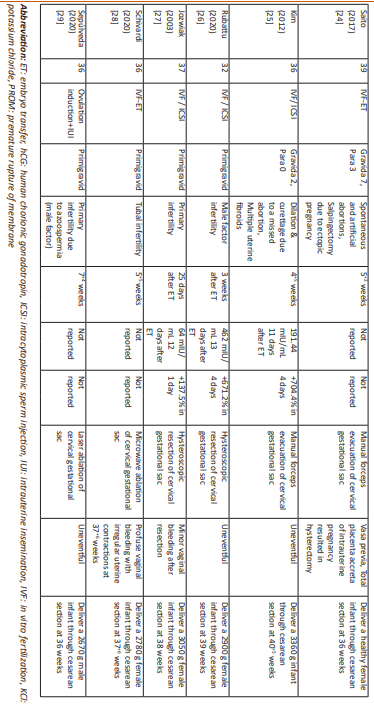
Table 2: Review of literature