
Representations violence at public university in central Mexico
Cruz García Lirios1, Oscar Coronado Rincón2
¹Autonomous University of Mexico City, Mexico.
²University of Sonora, Mexico.
*Corresponding author
*Cruz Garcia-Lirios, Autonomous Mexico State University, Mexico.
DOI: 10.55920/JCRMHS.2023.06.001256
Table 1: Centrality measures per variable
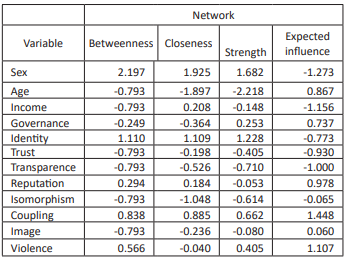
Table 2: Clustering measures per variable
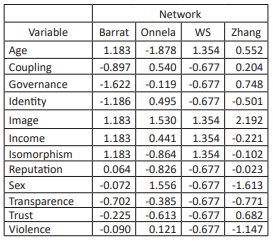
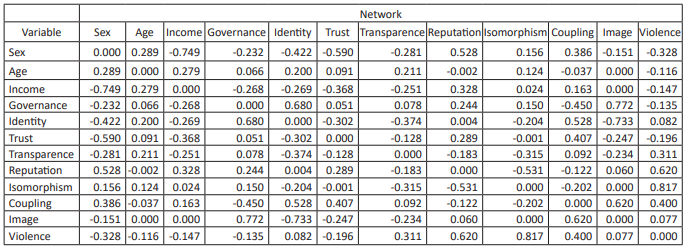
Table 3: Weights matrix
The media analysis of the Ayotzinapa case, centered on the journalistic agenda, highlights a parallelism between government actions and social mobilization. Both are oriented towards the demarcation of responsibilities from a trusted scientific source, although the Austrian Innsbruck Laboratory (LIA), the Independent Expert Investigators Group (GIEI) and the Argentine Forensic Anthropology Team (EAAF) do not always agree with the discourse of the government. The agenda established by the Excelsior newspaper of national circulation in the Ayotzinapa case focuses on the contradiction of the investigations, experiments and evidence regarding the murder and incineration of the 43 missing teacher training college students. It is noticeable that in the case of the Excelsior, the agenda of the disappearance of the 43 teacher training college students of Ayotzinapa is not centered on the victims except in the case of the last events related to the creation of the Specialized Prosecutor's Office for the Search of Disappeared (FEBD) and the Special Prosecutor's Office for the Search of Young People (FEBJ).
In other words, the social representation of the Ayotzinapa case focuses on the guilt attributed to the State, but not only because of the magnitude and impact of the event that, but also because each of the events seems to be related to the perceived authoritarianism of civil society with respect to its rulers. This event is qualified by experts as a crime against humanity and it would be up to the citizens to imagine the omnipresence of the State, Therefore, the category of responsibility of the State as a perpetrator of crimes against humanity, in the case of expert discourses, suggests a causal attribution bias to associate an event with a political actor that reflects its authoritarian historicity.
In contrast, the discursive positioning of non-experts towards the political actor consists rather in the identification of symbols that would be associated with their repression policy and that has not only been observed by the citizen, but also recognized as their hallmark with respect to other actors. Both discourses by experts and non-experts in human rights, those of an authoritarian State and those of a pervasive State, combine with the media discourse that frames the State in its security propaganda contrary to the propaganda of insecurity built by the GIEI and GAAF
These data indicate that the social representations of the Ayotzinapa case are centered on the absence of criticism towards the State and the expectations of justice, as is the case of the clarification of the kidnapping of the 43 teacher training college students.
However, the media have focused their agenda on the violence of the State, police corruption, political negligence, the demarcation of responsibilities, the promise of intensification of the search for the 43 teacher training college students, the confession of the perpetrators, the relevance of the expert evidence, the incineration evidence of 17 teacher training college students in the Cocula dump, the Human Rights approach, the victim care policy, the relevance of incineration experiments and the rotation policy of case officials Ayotzinapa
The framing of media has not focused on issues that allow the formation of a social representation aimed at a debate on the relationship between governors and the governed people with respect to the Ayotzinapa case. That is, citizens do not have enough information to engage in a discussion that allows reaching a negotiation and agreements with their authorities for the construction of a pacification pact at the local, state or federal level.
Consequently, the differences around the narratives and the discourses of experts and non-experts reflect the agenda of the media around the Ayotzinapa case and show significant differences that move away from a debate of co-responsibility between governed people and governors. While experts categorize the Ayotzinapa case as a crime against humanity and the citizenship creates an attribution of guilt to the State, the dialogue between political and social actors seems to be increasingly distant in the absence of points of agreement that are rather antagonistic.
The process that goes from the propaganda of the rectory of the State to the distrust of the citizenry towards its rulers reflects a scenario of symbolic violence rather than pacification. Therefore, not only the state's propaganda should be modified to include the citizenry as a victim of the Ayotzinapa case, but also the violation of human rights should be accompanied by an agenda to clarify the facts by recognized academic figures.
Such a measure would generate a social representation of the Ayotzinapa case centered on the search for a common good between public actors and social, but it would also have repercussions on the trust of civil society towards its authorities and institutions in charge of investigating the kidnapping of 43 teacher training college students.
In a scenario in which citizens have expectations of repression (27% of the total variance explained in the empirical study) instead of the perceived freedom (13% of the total variance explained), there is at least one symbolic conflict between the civil and the political. Such a scenario inhibits debate and agreements and encourages differences between rulers and governed people.
The repression that citizens expect from their authorities affects their perceived freedom and this is affected by an immorality that determines the criticism and this affects a decent behavior, also reducing the emergence of leadership and impacting perceived justice.
Therefore, the construction of a public peace from the propaganda, the agenda, the representations and the trust among the actors seems to be inhibited at least by factors that attempt against the negotiation between the rulers and the governed people, since if the first caused fear, fear and indignation in citizens and they generate opinion leaders based on rules and moral values far from a critical rationality. Then, we witness a scenario in which public peace would be the result of a non-aggression agreement among the actors, rather than being the product of a deliberate, planned and systematic system for the prosecution of crime, the prevention of violence, the delivery of justice and the defense of human rights.
From this scenario it is pertinent to review the proposals for intervention that, from Social Work have been generated with the purpose of promoting human relations free from violence, to inhibit crime and conflicts between citizens and authorities.
Since its inception Social Work has generated models to promote the rectory of the State, or promote civil self-management. The history of the discipline has influenced the development of intervention models. In the welfare stage, the State generated welfare policies that Social Work assumed as categorical imperatives of health, education and employment, following guidelines of coverage to groups and civil sectors, the discipline was led to produce models that contributed to the strengthening of corporatism.
This is how Social Work included in its intervention some economic and political models as well as social factors such as the dissemination of family planning campaigns, or in any case, the adherence to the treatment of diseases that, due to their degree of impact on society, were considered epidemics or pandemics, threatening the economic dynamics of the nation. In this historical period, the State sought territorial security and from that logic, it strengthened the family as the central axis of public services.
Both items, vaccination and planning were no more than synonyms of security and social welfare that legitimized the control of health and safety institutions by the State. As a new generation of politicians considered that processes and products of public service should be an exclusive patrimony of families of officials, the Welfare State allowed a patrimonialist state very close to the neoliberal or gendarme that, until then, had the rectory of security no longer territorial or national, but public.
In the scheme of territorial security, Social Work conceived models focused on the prevention of conflicts and national identity. Therefore, during the campaigns in favor of caudillos and revolutionary nationalism, the discipline generated models that focused on reproducing the differences between nationalism and foreignness represented by the United States. Although the migratory flows intensified, Social Work was not interested in guiding such flows towards a defense of human rights, not even towards the occupational health of migrants who were hired under working conditions unfavorable to their dignity.
Regarding national security policies that emphasized national identity, bypassing other foreign, indigenous or Afro-descendent identities, the discipline showed little interest in promoting the values of a post-civil war nation. Rather, the task was to promote adherence to a hegemonic party to the detriment of other political options. Thus, socialist models that emphasized solidarity and cooperation were eradicated from the national identity scenario to be replaced by corporatist models at the economic and political levels. The nascent chambers, groups and unions around the caudillos and the postrevolutionary state denied forms of social entrepreneurship and rather oriented the civil will to dependence, obedience and conformity to the presidential political system.
However, once the welfare state entered into economic crises that undermined its patrimony unexpectedly, the political class generated a patrimonialist ideology that consisted in preserving every emblem, process, function or resource used by a family of officials during the period of the postrevolutionary state (1920-1970). Patrimonialism generated new forms of relations between rulers and the governed people, fostering the reproduction of differences between political and social actors.
Through the intensive diffusion of a propaganda in favor of the rectory of the State in matter of well-being, Social Work is aligned with what Foucault (2002, 2004, 2005, 2007) calls positivity device, which consists of the use of academic, scientific and technological knowledge as instruments of legitimation of public policies of the State.
Thus, the welfare state acquired a patrimonial tinge in which important positions of public administration were discretionally determined by the president, but now they would be decided from the offices of intermediate officials with a preferential bias towards friends and family.
In terms of efficiency and effectiveness in public administration, the State dissociated itself from its social welfare objective and implemented targeted programs and strategies that would benefit groups of adherents and sympathizers of its political ideology.
The patrimonialist State, unlike the Welfare State, dissociated itself from social demands and needs, but focused on the expectations and requirements of the political class whose objective was to establish significant differences with respect to civil society.
Once the patrimonial model secured its goods and processes of public administration, a gradual transformation began until acquiring a neoliberal face that consisted in the dismantling of parastatal institutions, the reduction of social programs and the implementation of an institutional evaluation for those instances linked to the government budget.
The new neoliberal State, once again conducive to a Social Work oriented to the evaluation of the opportunities and capacities of sectors marginalized or excluded from civil society, as well as the brake on cooperative or socialist organization and development options.
If the Welfare State Social Work was advocated to promote national identity and in the patrimonial State the discipline promoted civil participation through adherence to political institutions sponsored by the State, now in the neoliberal State Social Work generated models and instruments of evaluation that allowed it to orient the budgets to sectors identified with the propaganda of the State.
However, the defense of human rights progressed towards an incidence in the policies of attention to victims that, in the case of citizen security, is an instrument of governmental performance. Unlike the territorial, national and public security policies that sought national unity for the prevention of crime and the construction of violence-free relations, citizen security considers the conservation of values and norms by promoting an ethical morality of cooperation and solidarity.
In the framework of citizen security, State management instruments allow civil self-management, but as technologies develop, civil security becomes a private security. In both cases, for citizens and private security, Social Work has generated intervention models focused on the individual rather than on groups, heritage, the nation or the territory.
Models centered on the individual deny the possibility that citizens get organized in groups of observation, management and action in favor of common security. As a consequence, the discipline faces the dilemma of returning to its origins in which it carried out diagnoses and promoted safety as a result of a social question and common interest before the possibility of reducing its models to the learning of self-care skills and knowledge and contact avoidance.
A device is a concept that explains a process of reproduction of the differences between governors and the governed people with respect to security, demands and resources, opportunities and the capacities of management and administration of security policies, prevention programs and strategies of promotion.
In the conception of Foucault (2002, 2004, 2005, 2007) the device has a high content of positivity, that is to say, knowledge about a phenomenon such as security.
Therefore, a security device is one in which a governing class takes advantage of all possible knowledge regarding a scenario, group or environment to be differentiated from the governed people.
If in the stage of social welfare, the device was implemented to distribute the resources among the different civil sectors. Now, in the neoliberal period, the device seeks differences among civil sectors to implement a specific control of their opportunities and capacities. The union that was previously promoted from Social Work is now seen as a problem of operation in the designation of resources, since these are increasingly scarce and in order to be distributed with equity some sectors must progressively pay higher rates, some other sectors will receive subsidies and other sectors will benefit from the cancellation of the payment of security services.
Therefore, since Social Work has developed models of intercession or mediation of conflicts when public policies generate differences among the actors that produce conflicts for the management of security.
An intervention model promotes differences or seeks to reduce them, correcting the asymmetries, but an intercession model intensifies the differences or similarities by engaging in negotiation among the parties in order to achieve a balance of risks, threats and benefits.
As a result, the intervention model of Social Work would consist of the reduction of citizen security and the increase of private security, since the principle that the State and the citizens form a co-government and reach an agreement of co-responsibility such that civil society no longer depends on police or military forces, but rather generates a civilian figure capable of protecting it. In this scenario, private security is hegemonic with respect to other forms of security and the intervention model seeks to select the talents that will make up the new security body.
In the model, the negotiation between civil networks and political institutions revolves around security such as values, beliefs, knowledge, intentions, dialogues, consensus and actions aimed at building public peace through crime prevention management and promotion of violence-free lifestyles, as well as the delivery of justice through a concerted decision-making system between political and social actors.
In contrast, an intercession model would rather focus on the transfer of virtues of the actors to a public or private security scenario.
In the case of the intercession model, the governance or governance of civil networks and political spheres is mediated by Social Work specialized in conflict resolution. The process is similar to that of the intervention device, but it is assumed that there is a co-responsibility independent of the needs and capacities of the political and social actors.