
Investigations on Medical Alcohol Detection on Vehicle Locking Ignition System
Dr. Bazani Shaik*, Dr. V. Srinivasa Rao
Department of Mechanical Engineering, Ramachandra College of Engineering, Eluru, Andhra Pradesh, India.
*Corresponding author
*Dr. Bazani Shaik, Department of Mechanical Engineering, Ramachandra College of Engineering, Eluru, Andhra Pradesh, India.
DOI: 10.55920/JCRMHS.2023.06.001245
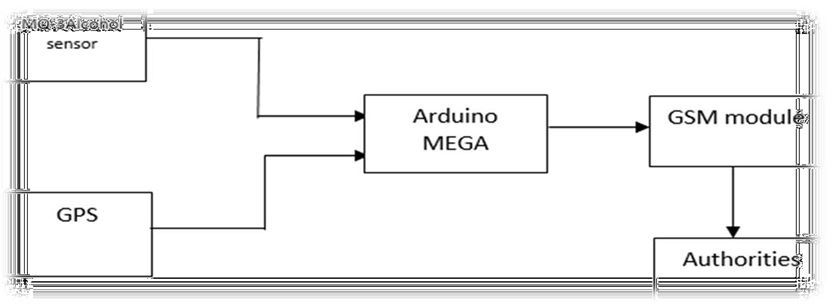
Figure 1: : Block diagram of entire system.

Figure 2: Program Process.
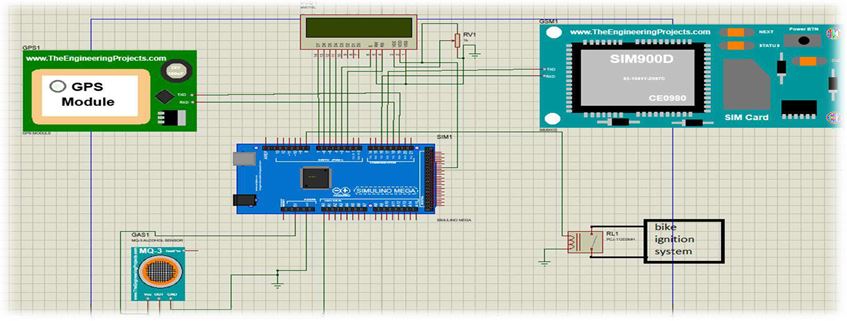
Figure 3: Circuit diagram.
vehicle engine will stop immediately. The Block diagram of entire system shows in Figure 1. This project is designed for the safety of the people seating inside/outside the vehicle.
Firstly, the alcohol sensor senses the alcohol level of the person, program process shown in Figure 2 and circuit diagram shown in Figure 3. This information is sent through Arduino MEGA. Now it compares with the value in the program if it is more than the threshold value the bike doesn’t start else the bike starts. Now while travelling the GPS continuously calculates the location and speed and sends it to Arduino MEGA and Arduino MEGA compares with threshold value and if it crosses the speed then the Arduino MEGA sends an instruction to GSM and now the GSM module sends the message to the respective authorities which includes the latitude, longitude and the speed.
- The MQ3 alcohol sensor detects the alcohol and outputs the value through A0 pin of the Arduino. (printing the value to keep a note of it).
- The L293D IC helps in controlling the DC motor and requires 9V input voltage.
- The enable and direction pin are being controlled by pin 9, pin 8 and pin 7 of the Arduino.
- Pin 8 and 7 will drive when they have different voltage level. Initially, we set pin 8 as HIGH and pin 7 as LOW. When both are LOW, the DC motor stops.
- Whenever the sensor detects alcohol above given threshold and the pin 8 and pin 7 are both set to LOW and hence DC motor stops.
- Eventually, we will generate sound through piezo buzzer by making use of pin 12 and passing a wave using tone()function.
Thus, we have proposed a method to sense the presence of alcohol from the breath of drivers and avoid the catastrophic effects it can have on people’s lives. The system will be designed and implemented successfully via the use of Arduino Uno ATMEGA328 microcontroller and MQ-3 sensor. Experimental evaluation of the system will show that the alcohol sensor was able to deliver fast response when alcohol is detected. Also, the ability of the alcohol sensor to operate over a long time is an important feature of the proposed system. The project thus gives a system that can detect a certain amount of alcohol present in the atmosphere inside the car and to a certain range and activates a microcontroller-controlled control system that controls the movement and the alarm can act as an indicator that enables a person to judge that person has taken alcohol and needs help or any assistance. The GSM modem sends a message to the close relative or the police in order to take necessary steps to prevent any accident or necessary aids after accident.
MQ3 Sensor
MQ3- Alcohol Gas Sensor is a low-cost semiconductor sensor which, used to detect the presence of alcohol vapour gas at concentrations from 0.05 mg/L to 10 mg/L. It has high sensitivity to alcohol and has a good resistance to disturbances due to smoke, vapour and gasoline The sensitive material used for this sensor is SnO2, whose conductivity is lower in clean air. Its conductivity increases as the concentration of alcohol vapour gas increases. This module provides both digital and analogue outputs. This alcohol sensor is suitable for detecting alcohol concentration on your breath. It has a high sensitivity and fast response time. The sensor provides an analogue resistive output based on alcohol concentration. The drive circuit is very simple; all it needs is a resistor. A simple interface could be a 0-3.3V ADC. The MQ3 alcohol sensor module can be easily interfaced with Microcontrollers, Raspberry Pi etc.
Microcontroller (AT89S52)
The AT89S52 Microcontroller is a low-power, highperformance CMOS 8-bit Microcontroller with 8K bytes of in-system programmable Flash memory. The device is manufactured BY Atmel, with the industry-standard 80C51 instruction set and Pinout. The on-chip Flash allows the program memory to be reprogrammed in-system or by a conventional nonvolatile memory programmer. By combining a versatile 8-bit CPU with in-system programmable Flash on a monolithic chip, the Atmel AT89S52 is a powerful Microcontroller which provides a highly-flexible and costeffective solution to many embedded control applications.
GSM
The Global System for Mobile Communications (GSM) is a standard developed by the European Telecommunications Standards Institute (ETSI) to describe the protocols for second-generation (2G) digital cellular networks used by mobile devices such as mobile phones and tablets. GSM is also a trade mark owned by the GSM Association. GSM may also refer to the Full Rate voice codec.
It was first implemented in Finland in December 1991. By the mid-2010s, it became a global standard for mobile communications achieving over 90% market share, and operating in over 193 countries and territories.
2G networks developed as a replacement for first generation (1G) analog cellular networks. The GSM standard originally described a digital, circuit-switched network optimized for full duplex voice telephony. This expanded over time to include data communications, first by circuit- switched transport, then by packet data transport via General Packet Radio Service (GPRS), and Enhanced Data Rates for GSM Evolution (EDGE).
GPS
The Global Positioning System (GPS) is a satellite-based navigation system made up of at least 24 satellites. GPS works in any weather conditions, anywhere in the world, 24 hours a day, with no subscription fees or setup charges.
GPS satellites circle the Earth twice a day in a precise orbit. Each satellite transmits a unique signal and orbital parameters that allow GPS devices to decode and compute the precise location of the satellite. GPS receivers use this information and trilateration to calculate a user's exact location. Essentially, the GPS receiver measures the distance to each satellite by the amount of time it takes to receive a transmitted signal. With distance measurements from a few more satellites, the receiver can determine a user's position and display it.
To calculate your 2-D position (latitude and longitude) and track movement, a GPS receiver must be locked on to the signal of at least 3 satellites. With 4 or more satellites in view, the receiver can determine your 3-D position (latitude, longitude and altitude). Generally, a GPS receiver will track 8 or more satellites, but that depends on the time of day and where you are on the earth.
Ardino UNO
Arduino is an open-source electronics platform based on easy-to-use hardware and software. Arduino boards are able to read inputs - light on a sensor, a finger on a button, or a Twitter message and turn it into an output -activating a motor, turning on an LED, publishing something online. You can tell your board what to do by sending a set of instructions to the microcontroller on the board. To do so you use the Arduino programming language (based on Wiring), and the Arduino Software (IDE), based on Processing.
Structure
The basic structure of Arduino programming language is simple and runs in two parts. These two parts, or functions, enclose blocks of statements.
Void setup ()
{
Statements:
}
Void loop
{
Statements;
}
Where setup is the preparation, loop() is the execution. Both functions are required for the program to work.
Setup
The setup function is called once when the program starts. We use it to initialize pin modes or to begin serial communication. It must be included in the program even if thereare no statements to run.
Syntax: Void setup()
{
Pin Mode (pin, OUTPUT); // sets the 'pin' as output
}
Loop
The loop () function does precisely what its name suggests and loops consecutively, allowing the program to change, respond, and control the Arduino board.
Syntax: Void loop ()
{
digital Write (pin. HIGH); //turns pin on delay (1000); //Pause for one second