
Towards a Clinically Useful AI Tool for Prostate Cancer Detection: Recommendations from a PANDA Dataset Analysis
T. J. Hart, Chloe Engler Hart, Aaryn S. Frewing, Dr. Paul M. Urie M.D./ Ph.D., Dr. Dennis Della Corte Dr. rer. nat.*
Department of Physics and Astronomy, Brigham Young University, Provo.
*Corresponding author
*Dr. Dennis Della Corte, Assistant Professor, Department of Physics & Astronomy Brigham Young University N361 ESC, BYU, Provo.
Email: Dennis.dellacorte@byu.edu
DOI: 10.55920/JCRMHS.2023.05.001216
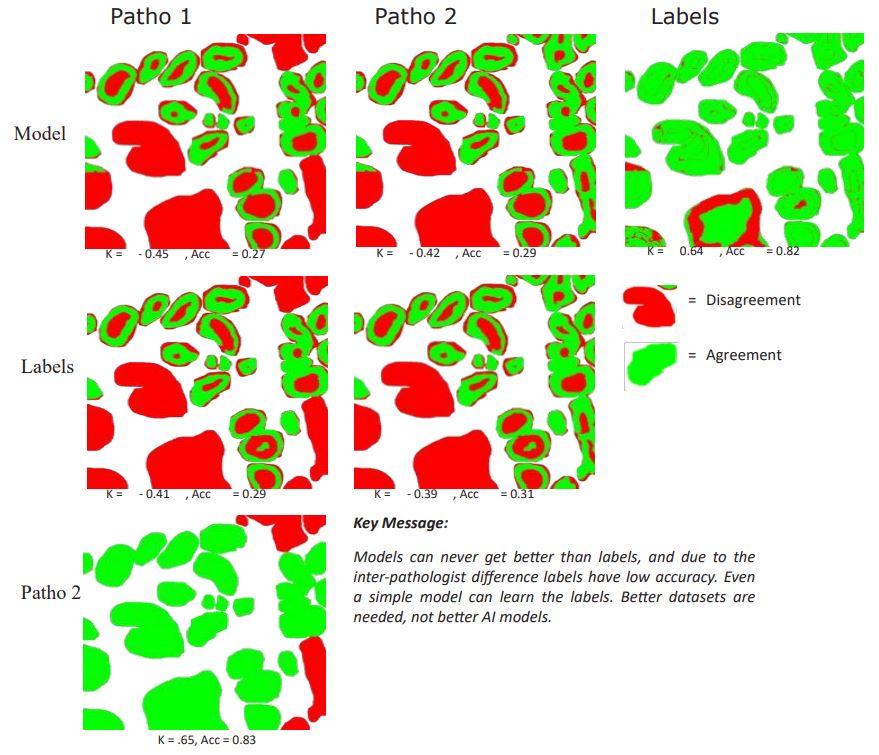
Figure 1: Binary comparison of regions of interest between pathologist annotation rounds (Patho 1 and Patho 2), annotation labels from PANDA test set (Labels), annotation from network inferences (Model). Agreement in green, disagreement in red. Kappa (K) - see methods for details – and accuracy (Acc) for all six combinations are shown below each panel.
The model yields an accuracy of 0.82 and kappa of 0.64 when evaluated on the test set labels from PANDA. Similar values are found between pathologist’s two sets of annotations (as depicted in Fig. 1). It is worth noting that the comparison between the pathologist’s first and second annotations was conducted using the same specified regions employed in the model’s evaluation on the test set. A low level of agreement between the model or labels and the pathologist annotations (all the combinations of comparisons provided similar accuracy/kappa values, refer to Fig. 1) can be seen.
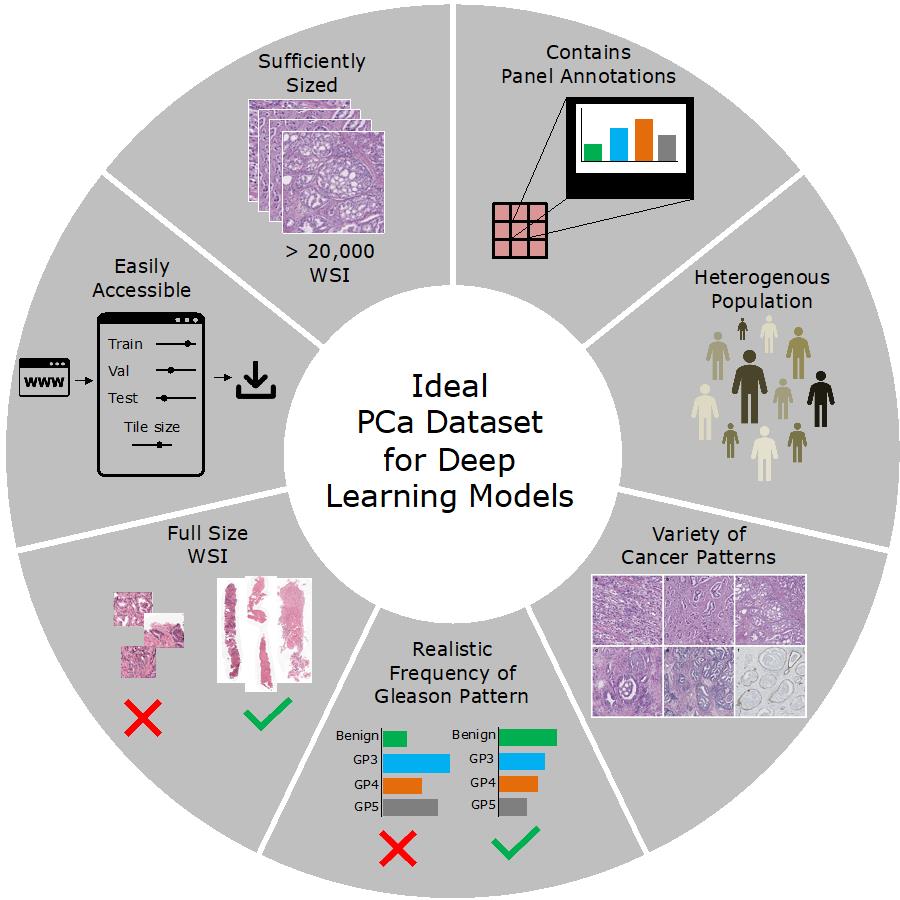
Figure 2: Provides an overview of the features expected in the ideal prostate adenocarcinoma dataset. Each feature is highlighted in the discussion section.
Based on our findings and previous research7 we put forth criteria for what would constitute the ideal high-quality prostate adenocarcinoma pathology dataset, as depicted in Figure 2. The dataset should be comprised of full-size WSIs, because they capture the entire tissue section at high resolution and allow analysis of tissue structures, cell morphology, and other relevant features, as opposed to patches or pixel clusters. The ideal dataset should be sufficiently sized for an algorithm to train on. We estimate this significant number to be 20,000 WSIs. Sufficient variation is necessary in the following three categories; patient demographics, prostate adenocarcinoma type; and adenocarcinoma severity.25 Finally, the dataset should be easily accessible to the public. It should be organized and stored in a consistent vendor agnostic format that allows researchers to retrieve and use the data efficiently. Providing open access or appropriate permissions for accessing the dataset encourages collaboration, accelerates research progress, and enables the development of innovative techniques for prostate adenocarcinoma diagnosis and treatment.