
Consideration of the gingival phenotype in a complete rehabilitation: A case report
Zineb IZI*, Asaad EL BAKKARI, Najwa AMSIGUINE, Soukaina ALLIOUI, Hatim ESSABER, Hounayda JERGUIGUE, Youssef OMOR, Rachida LATIB
Department of Prosthodontics; Autonomous University of Coahuila, Saltillo, Coahuila, México.
Ave. Dra. Cuquita Cepeda de Dávila Col. Adolfo López Mateos Saltillo, Coahuila CP 25125 México
*Corresponding author
Vargas-Segura A.I*, Department of Prosthodontics; Autonomous University of Coahuila, Saltillo, Coahuila, México.
DOI: 10.55920/JCRMHS.2023.04.001187

KT: KERATINIZED TISSUE
The diagnostic criteria to propose or design a successful rehabilitation, from a crown to a fixed prosthesis, must be conceived in a treatment protocol, so the periodontal probe must be used to make a periodontal probing (diagnosis) and a sling (surgical procedure) and predict the results to be obtained, especially when there is a critical condition regarding aesthetics. (Zeron, 2011). Furthermore, gum thickness, periodontal biotype, and gingival sulcus depth should be considered to understand the morphology of supra-crystal gingival tissue. One of the consequences of failing to diagnose the periodontal biotype properly is that the components of the periodontal organ can be injured.
When performing a rehabilitation, the margin of preparation should be considered, trying not to invade the biological thickness and the termination line so that dental preparation, sharpness, and gingival contour do not involve the interdental papilla, groove, or junction epithelium.
The margin of the preparation should be placed on the healthy dental structure to obtain a favorable prognosis since it could cause chronic inflammation of the periodontium, gingival recession, periodontal pockets, and bone resorption.
When carrying out a complete rehabilitation with a fixed prosthesis whose cause is generalized dental attrition, an occlusal determination is paramount. To determine the vertical dimension, alternatives are used, such as phonetic, aesthetic, anthropometric, and cephalometric methods, with instruments, among others.
A correct vertical dimension must have an adequate interocclusal distance between the resting position and the centric occlusion; mechanically healthy, aesthetically pleasing, and phonetically correct tooth length and cusp height; and comfort of the new facial profile.
Crown elongation: It consists of a surgical procedure to create a more extended clinical crown by removing gum and bone to displace the gingival margin apically.
When performing an elongation, the treatment is more aggressive in a thick periodontium since it is necessary to try to recontour its morphology. At the same time, the fine reacts to a recession. Thus, when we deal with a fine periodontium, we should wait six months; if we deal with a thick periodontium, we should wait about 12 months to place the definitive prosthesis (Zeron, 2011).
In patients with a thin periodontal biotype, minimally invasive or flapless surgery is more convenient, as it minimizes blood supply compromise and decreases the risk of marginal recession. Patients with these conditions (thin biotype) are advised to be informed of the aesthetic risk present, and it is advisable to recommend the increase of soft tissue (connective tissue grafting). On the other hand, patients with a thick gingival biotype have more resistance to surgical trauma and restorative procedures, less possibility of a marginal recession, and, therefore, less aesthetic compromise (Becerra Santos & Ramón Morales, 2009).
Case: A male patient of 62 years of age attends the postgraduate course in advanced prosthodontics in Saltillo, Coahuila, México, for a dental examination, referring to "I have tooth wear, and my bite hits the palate."
Anamnesis refers suffering two stents in the heart by an obstruction in the ascending branch of the left ventricle; currently taking anticoagulants (aspirin protect), Clopidogrel 75 mg, and Tyrox 75 mg for the treatment of hypothyroidism, Telmisartan 80 mg in the morning for treatment of hypertension and Lipitor 40 mg to reduce cholesterol and Prosgutt 160mg/120mg for the prostate.
In the clinical examination, generalized dental attrition was found, loss of vertical dimension and defective restorations, class 2 molar and canine, and middle line deviated 1 mm to the right.
The diagnosis was pathological migration, generalized wear, defective restorations, and carious lesions with a favorable prognosis.
The treatment was structured in phases to carry out a complete rehabilitation with the patient's consent.

Figure 1: Initial extraoral conditions of the patient. A) Frontal and smile view; B) Frontal close-up view C) Left view; D) Right view.
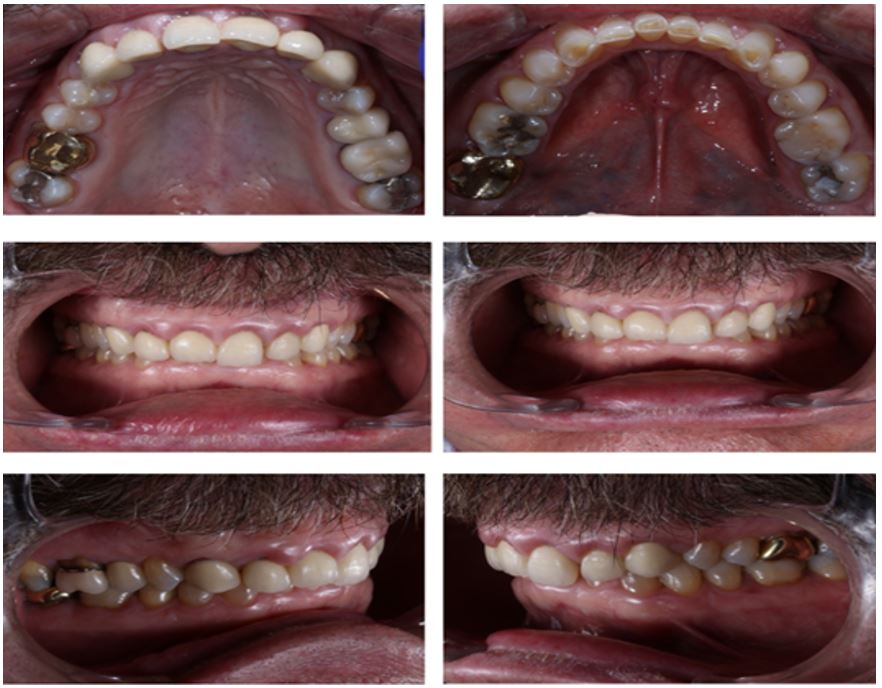
Figure 2: Initial intraoral conditions of the patient. A) Frontal view; B) Upper occlusal view; C) Lower occlusal view; D) Left lateral view; E) Right lateral view.

Figure 3: Panoramic X-Ray.
Anterior sector: In the initial phase, the removal of anterosuperior crowns was carried out, reviewing the dental substrate and the clinical evolution of the gingiva. The patient is referred to a periodontic specialist to treat gingivoplasty and root planing. Before the surgical phase, the patient discontinued the use of anticoagulants and decided to perform the gingivoplasty treatment (2 mm) with mockup guidance, root smoothing and thinning of the gingival tissue was performed, and suturing with nylon. After the postoperative phase, it is decided to start with the prosthodontic phase, which begins with the removal of the upper provisional and anterosuperior dental preparations made (1.3 - 2.3), leaving the equigingival termination line. In the following appointment, the dental preparations of anteroinferior veneers (4.3 - 3.3) were made, and the impression was taken for the working model with polyvinylsiloxane and bite record printing.
The patient went to the consultation for cementation of 12 units of EMAX, six anterosuperior crowns (1.3 - 2.3), and six anteroinferior veneers (3.3 - 4.3); restorations were prepared internally with hydrofluoric acid for 20 sec, previously with phosphoric acid for 20 sec and finally with silane for 3 minutes. Dental surfaces were prepared with pumice.
Crowns were cemented with RELYX U 2000 and veneers with RELYX VEENER.
Lateral sector: Posterosuperior preparations were made and an immediate dentinal sealant was placed to cement the provisional prosthetic tooth.
In the next appointment, the posteroinferior dental preparations were made, and immediate dentinal sealant was placed, as well as the provisionals. Final upper and lower impressions were made.
Sixteen posterior incrustations were cemented in the upper and lower jaw of EMAX in OD 17,16,15,14, 24,25,26,27. 45,44,46,47,36,35,34,37 and prepared with hydrofluoric acid for 20 sec, with phosphoric acid for 1 minute, and previously with silane for 3 minutes; the patient did not present discomfort and final photographs were taken.

Figure 4: Presurgical diagnostic photographs.

Figure 5: Surgical treatment. Crown elongation (2mm) and thinning of anterosuperior gingival thickness.

Figure 6: Photography is anterosuperior and anteroinferior dental preparations—bite log taking.

Figure 7: Preparation of dental surfaces with pumice.

Figure 8: Preparation of crowns with hydrofluoric acid, phosphoric acid, and silane.

Figure 9: Cementation of anterosuperior crowns and anteroinferior inlays.

Figure 10: Dental preparations, removal of cavities, and dental crowns.

Figure 11: Posterior cementation.

Figure 12: Final intraoral conditions of the patient. A) Frontal view; B) Right lateral view; C) Left lateral view; D) Upper occlusal view; E) Lower occlusal view.

Figure 13: Final extraoral conditions of the patient.
- Jepsen S, Caton JG, Albandar JM, Bissada NF, Bouchard P, Cortellini P, et al. Periodontal manifestations of systemic diseases and developmental and acquired conditions: consensus report of workgroup 3 of the 2017 world workshop on the classification of periodontal and peri-implant diseases and conditions. J Clin Periodontol. 2018;89 Suppl 1: S237-48. Doi: 10.1111/j.1600-051x.1993.tb00773.x
- Zerón, A. Periodontal phenotype and gingival recession. New classification. Revista ADM 2018; 75 (6): 304-305 305
- Dawson P. Oclusiòn funcional: diseño de la sonrisa a partir del ATM. Caracas: Amolca. 2009.
- Harper R. Indicaciones clínicas para modificar la dimensión vertical en oclusión, consideraciones funcionales y biológicas para la reconstrucción de la oclusión dentaria. Quintessence Internacional. 2000; 31 (4)
- Matta Valdivieso, E., Alarcon Palacios, M., & Matta Morales, C. (2012). Espacio Biológico y Prótesis fija: Del concepto clasico a la aplicación tecnológica. Revista Estomatológica Herediana, 22(2), 116-120.
- Navarrete, M., Godoy, I., Melo, P., & Nally, J. (2015). SciELO. Obtenido de Correlación entre biotipo gingival, ancho y grosor de encía adheria en zona estética del maxilar superior.: https://scielo.conicyt.cl/scielo.php?script=sci_arttext&pid=S0719- 01072015000300002
- Páez Cruz, J. F. (2015). DOCPLAYER. Obtenido de Consideraciones periodontales y protéticas para el tallado de piezas dentarias: https://docplayer.es/19701602-Consideraciones- periodontales-y-proteticas-para-eltallado-de-piezas-dentarias.html
- YH, C., Raffelt C, Pfeiffer H, Bizhang M, Saul G, Blunck U, y otros. (2010). Restoring strength of incisors with veneers and full ceramic crowns. J. Adhes. Dent.
- Jr, S. D. (2011). Adhesive Resin Cement for Bonding Esthetic Restorations: A Review. Quintessence.
- Alfaro, B. M., Anchelia Ramirez, S., & Quea Cahuana, E. (2015). Resistencia a la Compresión de Carillas Cerámicas de Disilicato de Litio Cementadas con Cemento Resinoso Dual y Cemento Resinoso Dual Autoadhesivo en Premolares Maxilares. Int. J. Odontostomat.