
Effect of conditioning activities of upper and lower limbs on the performance of the throttle drop
Jefferson de Souza Epifanio* and Joao Gabriel dos Santos Monteiro Nunes
Department of Physical Education, Pontifical Catholic University of Minas Gerais, Institute of Biological and Health Sciences, Brazil.
Advisor: Prof. José Mauro Vidigal
Co-advisor: Prof. Diego de Alcantara Borba
*Corresponding author
Jefferson de Souza Epifanio, Department of Physical Education, Pontifical Catholic University of Minas Gerais, Institute of Biological and Health Sciences, Brazil.
DOI: 10.55920/JCRMHS.2023.04.001181

Figure 1: Arm Flexion.
In the SV exercise, the volunteer must stand with feet parallel at shoulder width, hands resting on the hips and then perform vigorous flexion and extension of the hips and knees so that the hip angle is 90º during the flexion of the hips. hips and knees, (stretching-shortening cycle) performing the vertical jump, followed by landing with slight bending of the knees in order to cushion the fall.
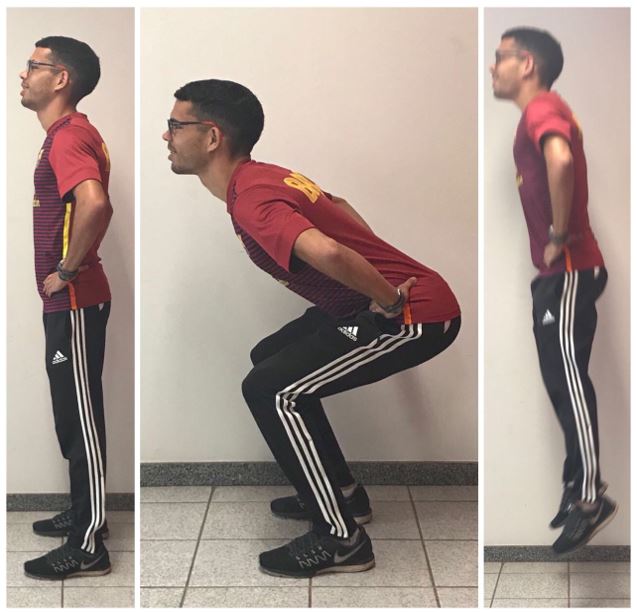
Figure 2: Vertical jump.
In the APE, the volunteers remained seated in a chair with a backrest, feet flat on the ground, holding the weight with both hands at chest height, resting their thumbs on the sternum, elbows high so as not to cause discomfort to the volunteer, and trunk resting on the chair. . Without removing the torso from the chair and without losing contact with the feet with the ground, they must throw the weight with both hands, extending the elbows, and throwing the weight as far as possible above the 45º angle marked on the slat with the stick.

Figure 3: Shot put.
This form of throw was chosen because it is an educational practice among beginner and advanced athletes to learn and improve the shot put technique. In addition, the APE presents a technique that is easy to assimilate and learn by beginners. And the number of repetitions was standardized by the fact that in the official test of the modality the athlete is entitled to six shot put attempts.
In the second, third and fourth meeting, the volunteers participated in the sessions randomly: A) Control (CON), in which there was no conditioning activity before the APE; B) FB followed by APE; C) SCM followed by APE. The interval between the conditioning activity and the main activity was three minutes. Two series of 10 seconds were performed for each type of conditioning activity with an interval of one minute between them and six attempts for the shot put, with an interval of 20 seconds between them.

Figure 4: Mean and standard deviation of throwing distance between situations. F=0.49; p=0.6.
Statistical analysis:
Data were presented as mean and standard deviation (SD). Data normality was guaranteed after performing the Shapiro-Wilk test. One-way ANOVA with repeated measures was used to compare the distance of the best shot between situations. The significance level adopted was less than 5%. In addition, the individual response of the volunteers to the interventions was evaluated using the typical error14,20. According to these authors, the average and SD of the performance of each volunteer were calculated, taking into account the six throws of the control session. The positive effect of AC was considered when the volunteer's performance was 1.5 x SD greater than the average. When the subject's performance was 1.5 x SD less than the mean, the effect of AC was considered negative. Finally, if the performance on pitches was within ± 1.5 x SD of the mean, he was considered non-responsive to AC.
In the second, third and fourth meeting, the volunteers participated in the sessions randomly: A) Control (CON), in which there was no conditioning activity before the APE; B) FB followed by APE; C) SCM followed by APE. The interval between the conditioning activity and the main activity was three minutes. Two series of 10 seconds were performed for each type of conditioning activity with an interval of one minute between them and six attempts for the shot put, with an interval of 20 seconds between them.
Table 1: Individual responses to conditioning activity protocols.
- BATISTA, Mauro A. B. et al. Potentiation: the influence of prior muscle contraction on rapid strength performance. R. Bras. Ci. and Mov., Brasilia, v. 11, no. 2, p. 07-12, Jun. 2003.
- BATISTA, Mauro Alexandre Benites et al. Post-activation potentiation: possible physiological mechanisms and their application in the warm-up of power sports athletes. Magazine of Physical Education/UEM, Maringá, v. 21, no. 1, p. 161-174, 1st trim. 2010.
- BEMFATO, Daniel Delzan. Effects of stretching-shortening muscle contraction on the development of post-activation potentiation in amateur wrestling athletes: Faculdade de Motricidade Humana, 2011. 139f. Thesis (Master's degree). Technical University of Lisbon. Available at: <https://www.repository.utl.pt/bitstream /10400.5/4438/1/thesis%20small.pdf>. Accessed on: Oct 23, 2017.
- BORBA, Diego de Alcantara; JUNIOR, João Batista Ferreira; COELHO, Leonardo Gomes Martins. Effect of post-activation potentiation in athletics: a systematic review. Rev. bras. kinanthropom. human performance. vol.19, n.1, p. 128-138. Available at: <http://www.scielo.br/scielo.php?pid=S198000372017000100128&script=sci_abstract&tlng=pt>. Accessed on: Oct 23, 2017.
- CHIU, Loren ZF. et al. Postactivation potentiation response in athletic and recreationally trained individuals. n. 17(4), p. 671-677, Nov. 2003. Available at: < https://www.ncbi. nlm.nih.gov/pubmed/14636093>. Accessed on: Oct 23, 2017.
- ESFORMES, Joseph; BAMPOURAS, Theodoros. Effect of back squat depth on lower body postactivation potentiation. Journal of Strength and Conditioning Research, v. 27 (11), p. 2997-3000, Feb. 2013.
- EVETOVICH, Tammy; CONLEY, Donovan S.; MCCAWLEY, Paul F.. Postactivation potentiation enhances upper and lower-body athletic performance in collegiate male and female athletes. Journal of Strength and Conditioning Research, v. 29 (2), p. 336-342, Feb. 2015.
- HEALY, Robin; COMYNS, Tom M.. The Application of Postactivation Potentiation Methods to Improve Sprint Speed. Available from: <http://journals.lww.com/nsca-scj/Abstract/2017/02000/The_Application_of_Postactivation_Potentiation.1.aspx>. Accessed on: 01 Oct. 2017.
- JASCHKEL, Cleiton; NAVARRO, Francis. Plyometrics and the increase in explosive muscle strength of the lower limbs in athletes of the most varied sports. Brazilian Journal of Exercise Prescription and Physiology, São Paulo, v. 2, no. 12, p. 653-662, Nov/Dec. 2008.
- MACINTOSH, BR, Robillard ME, Tomaras EK. Should postactivation potentiation be the goal of your warm-up? Journal of Applied Physiology Nutrition and Metabolism 2012;37:546–550.
- KÜMMEL, Jakob et al. Effects of conditioning hops on drop jump and sprint performance: a randomized crossover pilot study in elite athletes. BMC Sports Science, Medicine and Rehabilitation, v. 8, no. 1, Jan. 2016. Available at: < https://www.ncbi. nlm.nih.gov/pubmed/26835128 >. Accessed on: 01 Oct. 2017.
- SUCHOMEL TJ, LAMONT HS, MOIR GL. Understanding Vertical Jump Potentiation: a Deterministic Model Sports Medicine 2015: 1-12.
- KARAMPATSOS, BG, Terzis G, Polychroniou C, Georgiadis G. Acute effects of jumping and sprinting on hammer throwing performance. Journal of Physical Education and Sport 2013;13(1):3-5.
- TURNER, AP, Bellhouse S, Kilduff LP, Russell M. Postactivation potentiation of sprint acceleration performance using plyometric exercise. Journal of Strength and Conditioning Research 2015;29(2):343-350.
- SMITH, CE, Hannon JC, McGladrey B, Shultz B, Eisenman P. Lyons B. The effects of a postactivation potentiation warm-up on subsequent sprint performance. Human Movement 2014;15(1):36-44.
- HANCOCK, AP, Sparks KE, Kullman EL. Postactivation potentiation enhances swim performance in collegiate swimmers. Journal of Strength and Conditioning Research 2015;29(4):912-917.
- BISHOP, D. Warm Up I: Potential Mechanisms and the Effects of Passive Warm Up on Exercise Performance. Sports Medicine 2003;33(6): 439-454.
- YOUNG, WB, Jenner A, Griffiths K. Acute enhancement of power performance from heavy load squats. Journal of Strength and Conditioning Research 1998;12: 82-84.16
- HODGSON, MJ, Docherty D, Zehr EP. Postactivation Potentiation of Force Is Independent of H-Reflex Excitability. International Journal of Sports Physiology and Performance, 2008;3:219-231.
- RASSIER, DE, Macintosh BR. Coexistence of potentiation and fatigue in skeletal muscle. Brazilian Journal of Medicine and Biological Research 2000;33(5):499-508.
- KIDUFF, LP et al. Postactivation potentiation in professional rugby players: optimal recovery. Journal of Strength and Conditioning Research 2007;21(4):1134-1138.
- MACKALA, K, Fostiak M.; Kowalski, K. Selected Determinants of Acceleration in the 100m Sprint. Journal of Human Kinetics 2015;45:135-148.
- JUDGE, LW, Bellar D, Thrasher AB, Simon L, Hindawi OS, Wanless E. A pilot study exploring the quadratic nature of the relationship of strength to performance among shot putters. Technical Note. International Journal of Exercise Science 2013;6(2):171-179.
- TERZIS, G, Spengos K, Karampatsos G, Manta P, Georgiadis G. Acute effect of drop jumping on throwing performance Journal of Strength and Conditioning Research 2009;23(9):2592-2597.
- TERZIS, G, Karampatsos G, Kyriazis T, Kavouras SA, Georgiadis G. Acute effects of countermovement jumping and sprinting on shot put performance. Journal of Strength and Conditioning Research 2012;26(3):684-90.
- EVETOVICH, TK, Conley DS, McCawley PF. Postactivation potentiation enhances upper- and lower-body athletic performance in collegiate male and female athletes. Journal of Strength and Conditioning Research 2015;29(2):336-42.
- SANTOS, Natalia R. Post-activation pottencialization of upper and lower limbs on shot put performance: Institute of Biological and Health Sciences, 2017. 23 f. Article (Course Completion Work). Pontifical Catholic University of Minas Gerais.
- SEITZ, Laurent B.; HAFF G. Gregory. Factors Modulating Post-Activation Potentiation of Jump, Sprint, Throw, and Upper-Body Ballistic Performances: A Systematic Review with Meta-Analysis. Sports Med., v. 46, n. 2, p. 231-240, feb. 2016.
- SZMUCHROWSKI, L.A. et al. Determination of the minimum number of vertical jumps to monitor the responses to plyometric training. Motricity Magazine, v. 8, n. S2, p. 383-392, 2012.
- XENOFONDOS, Anthi et al. Post-activation potentiation: factors affecting it and the effect on performance. Journal of Physical Education and Sport, v. 28, n. 3, p. 32-38, sep. 2010.
- HEALY, R, Comyns T M. The application of postactivation potentiation ethods to mprove sprint speed. J Strength Cond Res 2017;39(1): 1-9.
- WHELAN, N, O’regan C, Harrison AJ. Resisted sprints do not acutely enhance sprinting performance. J Strength Cond Res 2014;28(7):1858-66.