Functional Outcome After Wide Resection, Ulna Translocation with Wrist Arthrodesis of Campanacci Grade 3 Of Giant Cell Tumor

Dr. Saleh Abumahara1, Dr. Nosiba Elhammal2, Dr. Mohmad Atboliy3, Dr. Amjad Alsohouli3

¹Consultant of Orthopedics surgery, Tripoli university hospital, Tripoli, Libya.
²Orthopedics surgeon, Tripoli university hospital, Tripoli, Libya.
³Orthopedics surgeon, Tripoli central hospital, Tripoli, Libya.

*Corresponding author

Dr. Saleh Abumahara, Consultant of Orthopedics surgery, Tripoli university hospital, Tripoli, Libya.
Email: Abumahara2018@gmail.com
Dr. Nosiba Elhammal, Orthopedics surgeon, Tripoli university hospital, Tripoli, Libya.
E-mail: Nosa89.1989@gmail.com

Abstract

Introduction: The Giant cell tumor (GCT) of bone is considered as benign tumor but with local aggressive behavior which require various surgical intervention either curettage or en bloc resection of the lesion with subsequent reconstructions. The distal radius is the third most common site predisposition for skeletal GCTs (10% cases) after distal femur and proximaltibia, which relatively difficult operation because presence of vital structures such as radial artery and median nerve in close proximity and location of epiphysis-metaphysis.

Method and result: This study was case report of distal radius giant cell tumor grade 3 campanacci presented on 12th November 2021 at orthopedics department in Tripoli university hospital, the patient experienced right wrist pain, swelling and reduce range of motion for five months duration, the physical examination revealed firm solitary non fluctuant lesion on both volar and dorsal sides of distal part of forearm measured about 4 cm x 6 cm in size and obvious dilated veins over the skin detected, the radiological images suggest giant cell tumor on the right distal section of radius which subsequently confirmed by histopathological biopsy. The patient managed successfully with wide resection, ulna translocation and wrist arthrodesis to preserve pronation and supination of forearm and hand function with excellent functional outcome.

Conclusion: management of campanacci grade 3 giant cell tumor using ulna transposition with wrist fusion is an effective procedure in the management of these difficult tumors with optimal functional outcome.  

Keywords: Giant cell tumor, Campanacci grade 3, Radiological images, Orthopedic  surgery, Libya.

List of abbreviations: GCT = Giant cell tumor

Introduction

The Giant cell tumor (GCT) of bone is considered as benign tumor but with local aggressive behavior which require various surgical intervention either curettage or en bloc resection of the lesion with subsequent reconstructions.14

The distal radius is the third most common site predisposition for skeletal GCTs (10% cases) after distal femur and proximaltibia.1,2

Which relatively difficult operation because of presence of vital structures such as radial artery and median nerve in close proximity and location of epiphyseal–metaphyseal.4

Method and Result

This study was case report of distal radius giant cell tumor grade 3 campanacci presented on 12th November 2021 at orthopedics department in Tripoli university hospital, the patient experienced right wrist pain, swelling and reduce range of motion for five months duration, the physical examination revealed firm solitary non fluctuant lesion on both volar and dorsal sides of distal part of forearm measured about 4 cm x 6 cm in size and obvious dilated veins over the skin detected, the radiological images suggest giant cell tumor on the right distal section of radius which subsequently confirmed by histopathological biopsy. The patient managed successfully with wide resection, ulna translocation and wrist arthrodesis to preserve pronation and supination of forearm and hand function with excellent functional outcome.

Case presentation of Giant cell tumor:

55 years old, Right hand dominant lady. Presented with pain, swelling and decrease range of motion of  her right wrist joint for 5 months ago.

The swelling was non tender, solitary, non fluctuant, firm at both volar and dorsal sides of distal part of her forearm about (4cm x6cm)in size with free of overlying skin and dilated veins.

There was no neurovascular deficit and hand function was normal.

The radiological finding:

X-ray revealed, aggressive, centric, expansile, well defined osteolytic lesion at epiphysis and metaphysis extending to diaphysis in the right distal area of radius, approximately measuring around 7x 4 cm ,with minimal periosteal reaction . The radiological features suggest of giant cell tumor of distal radius.

MRI scan: to assess the soft tissue involvement and medullary extension of the tumor, the scan showed distal radius articular margin involvement with aggressive soft tissue extension.

The incision biopsy, had take place longitudinally through dorsal aspect, where the definitive surgical incision had be done.

The histopathology result is Gaint cell tumor.

The Management plan: wide local resection, ulnar translocation and wrist joint arthrodesis.

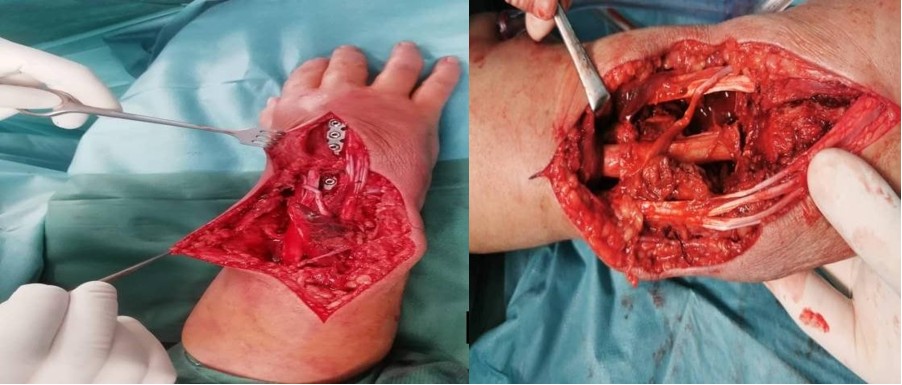
Through Dorsal and longitudinal incision where was the biopsy incision done, the incision had extended proximally and distally centering over the third metacarpal bone.

The Extensor muscles reflected. level of radius resection was planned according to MRI finding including 1cm of normal healthy non-involved bone, around 8cm of distal radius was excised along with pronator quadratus through radio-carbal and radio-ulnar joint capsule .

Wide local excision of the lesion had done with normal tissue margins of bone and soft tissues.

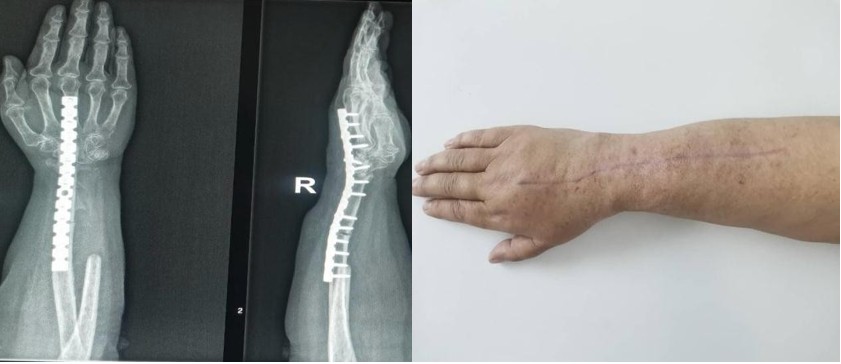
The tumor bed treated with hydrogen peroxide 3% solution to sanitize the wound for microscopic tumor cell spillage, around 8 cm of distal ulna was resected, keeping intact all soft tissue attachments and centralized between the lunate and radius cut end , articular surfaces of distal ulna and lunate were removed with burr for arthrodesis and it was stabilized with reconstructed pre-contoured 3.5mm plate across wrist ovar the 3rd metacarpal bone.

The wound closed in layered manner over the negative suction drain to prevent hematoma formation, which is removed after 24 hours.

Above elbow slab applied for two weeks. The incision healed with primary intention and stitches were removed after two weeks.

She was advised to wear removable wrist splint and do intermittent physiotherapy, the splint was discontinued after radiological signs of union. (Figure 1)

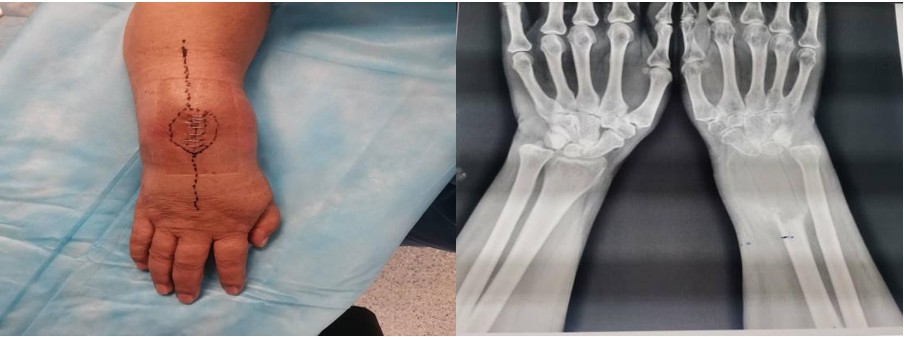
Figure 1: Pictures of pre-operative finding and X-ray of giant cell tumor in right wrist joint.

Figure 2: Pictures of intra-operative finding of giant cell tumor in right wrist joint.

Figure 3: Pictures of post-operative finding and X-ray of giant cell tumor in right wrist joint after 6 months.

Conclusions

Management of campanacci grade 3 giant cell tumor using ulna transposition with wrist fusion is an effective procedure in the management of these difficult tumors with optimal functional outcome.

Ethical approval: Patient consent obtained.

References

  1. Eckardt JJ, Grogan TJ. Giant cell tumour of bone. Clin Orthop 1986; 204: 45–58.
  2. Campanacci M, Baldini N, Boriani S, et al. Giant-cell tumor of bone. J Bone Joint Surg [Am] 1987; 69-A: 106–114.
  3. Liu YP, Li KH, Sun BH. Which treatment is the best for giant cell tumors of the distal radius? A meta-analysis. Clin Orthop Relat Res. 2012; 470(10): 2886–2894.
  4. Panchwagh Y, Puri A, Agarwal M, et al. Giant cell tumor—distal end radius: do we know the answer? Indian J Orthop 2007; 41: 139–145.
TOP