Multivessel Coronary Artery Disease and Coronary Calcification in Patients with Ischemic Heart Disease:An Interventional Cardiologist’s Perspective

Nagaeva G.A*, Mukhammedova M.G, Yarbekov R.R, Muradov M.M, Khaidarova N.U, Tashmirov Zh.B

Research Center for Military Medicine of the Military Medical Institute of the University of Military Security and Defense of the Republic of Uzbekistan.

*Corresponding author

Nagaeva G.A, Research Center for Military Medicine of the Military Medical Institute of the University of Military Security and Defense of the Republic of Uzbekistan.

Abstract

This study presents a retrospective assessment of the prevalence of multivessel coronary artery disease and coronary artery calcification in patients diagnosed with ischemic heart disease (IHD). A total of 120 patients were included in the analysis, among whom multivessel coronary lesions were identified in 43.3% of cases (n = 52). The highest prevalence was observed in patients older than 60 years, in whom multivessel disease was detected in 67.5% of cases. Coronary artery calcification was significantly more frequent in elderly patients (p < 0.0001), which is consistent with global epidemiological trends.

The findings confirm that multivessel coronary artery disease is associated with an increased risk of adverse clinical outcomes, while coronary calcification represents an important prognostic marker in the context of ischemic heart disease. These results highlight the need for improved diagnostic, preventive, and therapeutic strategies aimed at reducing cardiovascular risk and optimizing patient management.

Keywords: ischemic heart disease; multivessel coronary artery disease; coronary artery; coronary calcification.

Introduction

Cardiovascular diseases (CVDs) remain the leading cause of morbidity and mortality worldwide. Over recent decades, a steady increase in their prevalence has been observed, driven by the growing burden of cardiovascular risk factors and lifestyle changes. Ischemic heart disease (IHD), as a major component of CVDs, continues to account for a significant proportion of premature mortality, disability-adjusted life years, and healthcare expenditures. In the context of population aging, this issue has become increasingly relevant for healthcare systems globally [1].

Particular attention has been directed toward multivessel coronary artery disease, which is recognized as a critical prognostic determinant in patients with IHD. Multivessel involvement is associated with a higher risk of acute coronary events, increased procedural complexity during revascularization, and less favorable long-term outcomes. Patients with multivessel disease often require comprehensive treatment strategies and prolonged follow-up [2].

Coronary artery calcification represents another important marker of advanced atherosclerosis and has been shown to correlate with plaque burden, disease severity, and adverse cardiovascular outcomes. The presence of calcified lesions may complicate interventional procedures and is associated with an increased risk of restenosis and thrombosis [3].

The present study aims to evaluate the prevalence of multivessel coronary artery disease and coronary artery calcification in patients with ischemic heart disease, providing clinically relevant insights for risk stratification and optimization of therapeutic strategies.

Materials and Methods

A total of 120 patients who underwent coronary angiography (CAG) at a tertiary care medical center were included in the study. Ischemic heart disease was confirmed in 84 patients, including both stable and acute clinical presentations, while in 36 patients significant coronary artery disease was not detected on angiography.

The mean age of the study population was 55.3 ± 11.5 years. All participants provided written informed consent prior to enrollment. The study was conducted in accordance with the principles of the Declaration of Helsinki, with strict adherence to ethical standards and patient confidentiality.

Inclusion criteria consisted of clinically and instrumentally confirmed ischemic heart disease, documented history of IHD including previous myocardial infarction, and informed consent. Exclusion criteria included severe concomitant cardiovascular pathology, hypersensitivity to dual antiplatelet therapy, cardiogenic shock, and intermediate or high procedural risk according to the SYNTAX score.

Clinical evaluation included physical examination with measurement of blood pressure and heart rate, 12-lead electrocardiography, and transthoracic echocardiography with assessment of left ventricular volumes, systolic function, and valvular morphology. Laboratory investigations comprised complete blood count, biochemical analysis, serological screening, and coagulation profile.

All patients received guideline-directed medical therapy, including nitrates, beta-blockers, statins, and dual antiplatelet therapy. Additional pharmacological agents were prescribed as indicated for comorbid conditions such as arterial hypertension, diabetes mellitus, and arrhythmias. Premedication with sedative and antihistamine agents was administered prior to coronary angiography.

Based on angiographic findings, patients were managed with optimal medical therapy, percutaneous coronary intervention (PCI) with stent implantation, or coronary artery bypass grafting (CABG). Procedural success was assessed immediately following PCI. The primary endpoints included major adverse cardiac events (MACE): cardiac death, target vessel myocardial infarction, ischemia-driven target lesion revascularization, and stent thrombosis.

Statistical analysis was performed using standard methods. Continuous variables are presented as mean ± standard deviation. Group comparisons were conducted using Student’s t-test or the χ² test, as appropriate. A p-value < 0.05 was considered statistically significant.

Results

Analysis of clinical characteristics revealed that acute forms of ischemic heart disease (IHD), including acute myocardial infarction (AMI) and acute coronary syndrome (ACS), were more prevalent among younger patients (Group 1), accounting for 24.1% of cases. In contrast, older patients (Group 3) predominantly presented with chronic IHD, which was observed in 85% of cases. Patients of intermediate age (Group 2) showed a 62.7% prevalence of chronic IHD. The frequency of comorbid conditions, such as arterial hypertension (AH) and diabetes mellitus (DM), increased significantly with age. AH was recorded in 48.3% of younger patients, compared with 82.4% and 90.0% in the intermediate- and older-age groups, respectively.

Echocardiographic parameters also demonstrated age-dependent differences. Younger patients exhibited smaller left ventricular (LV) volumes and preserved left ventricular ejection fraction (LVEF). Older patients had increased LV volumes accompanied by reduced LVEF. Specifically, in the older group, a significant increase in left ventricular end-diastolic volume (LVEDV) and a more pronounced reduction in LVEF (by 4.1%) were observed, indicating an age-related decline in myocardial contractile function.

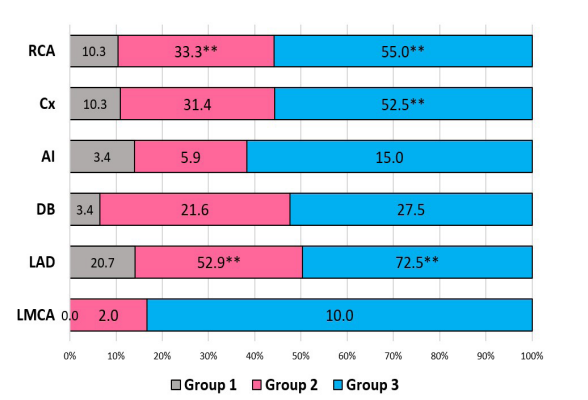
Coronary angiography (CAG) revealed marked age-related differences in coronary artery involvement. In younger patients (Group 1), the left anterior descending artery (LAD) was the most frequently affected vessel, occurring in 20.7% of cases, whereas lesions of the left main coronary artery (LMCA) were absent. Conversely, in older patients (Group 3), all major coronary arteries—including LAD, circumflex artery (Cx), and right coronary artery (RCA)—were affected more frequently, with LMCA lesions observed in 10% of cases. The frequency of involvement of the main coronary arteries is presented in Figure 1.

Figure 1: Comparative analysis of the incidence of major coronary artery lesions.

Notes: Data are presented as percentages; LMCA – left main coronary artery; LAD – anterior interventricular branch; DB – diagonal branch; AI – intermedia artery; Cx– circumflex artery; RCA – right coronary artery; ** – significant differences with Group 1 (control) at p<0.0001

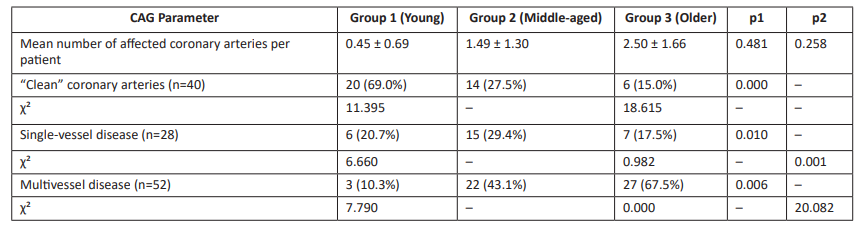
Table 1: Coronary Artery Involvement by Age Group
Coronary artery stenosis also exhibited age-related patterns. In younger patients (Group 1), the most pronounced stenoses were observed in the RCA and circumflex artery (Cx) territories, reaching 99.7% and 98.7%, respectively. In older patients, the mean stenosis across different coronary territories was 51.0 ± 32.8% for the left main coronary artery (LMCA), reflecting a high degree of atherosclerotic involvement in this age category.

Furthermore, the frequency of coronary artery occlusions was significantly higher in older patients, accounting for 51.6% of all occlusions in the study population. In the intermediate-age group, this proportion was 32.3%, and among younger patients, 16.1% of all occlusions were observed. These data indicate a trend toward more pronounced progression of atherosclerosis with increasing age.

As shown in Table 1, the proportion of “clean” coronary arteries (without significant stenosis) was highest among younger patients (69.0%) and lowest in older patients (15.0%). Multivessel disease was markedly more frequent in older individuals, affecting 67.5% of cases, compared with only 10.3% in younger patients. These findings confirm the higher burden of multivessel coronary involvement in the elderly population. Table 1.

Overall, age-related differences in clinical and coronary angiographic characteristics demonstrate a trend toward increased disease severity with advancing age. Younger patients more frequently presented with acute forms of ischemic heart disease (IHD), often accompanied by arrhythmias and microvascular angina. In contrast, older patients exhibited more pronounced chronic IHD and extensive multivessel coronary involvement, associated with a higher risk of coronary occlusions and arterial calcification.

Discussion

Cardiovascular diseases (CVD) remain a major global public health challenge. In 2017, CVD accounted for 17.8 million deaths and resulted in the loss of 35.6 million disability-adjusted life years [4]. The majority of this burden falls on low- and middle-income countries, as evidenced by higher incidence rates in regions such as South Asia, where urbanization and lifestyle changes significantly increase the risk of ischemic heart disease (IHD) [5]. It is important to note that the high prevalence of risk factors—including hypertension, obesity, physical inactivity, smoking, and diabetes—also substantially impacts CVD statistics [6]. Our findings are consistent with these trends. Specifically, 43.3% of patients with IHD in our study exhibited multivessel coronary artery involvement, which aligns with broader global data reporting multivessel disease in 44%–66% of patients presenting with acute myocardial infarction [7]. Multivessel disease is associated with higher mortality and increased risk of recurrent myocardial infarction, making it an important prognostic factor [8].

Another notable finding was the higher prevalence of coronary artery calcification among older patients, consistent with other studies demonstrating an age-related increase in vascular calcification. It is well established that atherosclerosis and vascular calcification progress with age, and calcified deposits may contribute to thrombosis, significantly increasing the risk of acute cardiovascular events [9]. According to the literature, coronary artery calcification occurs in 90% of men and 67% of women over 70 years of age, which corresponds with our observation of higher calcification rates in older patients with IHD [10].

In patients with multivessel coronary involvement, there was also a higher incidence of comorbidities such as hypertension and diabetes, consistent with previously published data [11]. Although our sample size was relatively limited, the overall results corroborate key observations reported in other populations. For example, our data are in agreement with a study from Saudi Arabia, in which the left anterior descending artery (LAD) was the most commonly affected vessel among patients with myocardial infarction [12]. In both studies, the LAD emerged as the primary target vessel, highlighting its clinical significance in interventional planning for patients with IHD.

Despite limitations related to sample size and population characteristics, our findings are consistent with global trends, confirming a high risk of multivessel disease and coronary artery calcification in older patients with IHD. These results underscore the importance of preventive strategies, early diagnosis, and ongoing research aimed at improving treatment outcomes and reducing the global burden of cardiovascular disease.

Conclusion

In this study, multivessel coronary artery disease was observed in 43.3% of patients, with a prevalence of 67.5% among those aged 60 years and older. The results demonstrated a strong association between age and both multivessel disease and coronary artery calcification (p<0.0001).

Coronary artery calcification was detected in a significant proportion of patients, particularly in the older age group. This phenomenon is likely related to the progression of atherosclerosis and age-related changes in the vascular system, which increase the risk of acute cardiovascular events.

Furthermore, multivessel coronary involvement was more frequently observed in patients with comorbidities such as hypertension and diabetes, highlighting the importance of a comprehensive approach to the management and prevention of ischemic heart disease in these patients.

Overall, the findings confirm the high prevalence of cardiovascular disease, particularly in older adults, and underscore the need for early diagnosis, risk factor management, and individualized treatment strategies.

References

  1. Mann DL, Zipes DP, Libby P, Bonow RO. Braunwald’s Heart Disease: A Textbook of Cardiovascular Medicine. 12th ed. Philadelphia, PA: Elsevier; 2019.
  2. Collet JP, Thiele H, Barbato E, et al. 2020 ESC Guidelines for the management of acute coronary syndromes in patients presenting without persistent ST‑segment elevation. Eur Heart J. 2020;41(3):349–452.
  3. Hao Y, Yang S, Yang Y, et al. Predictive factors for multivessel disease in patients with acute coronary syndrome: analysis from the CCC‑ACS project in China. BMC Cardiovasc Disord. 2024;24:617.
  4. Roth GA, Abate D, Abate KH, et al. Global, regional, and national age‑sex‑specific mortality for 282 causes of death in 195 countries and territories, 1980–2017: a systematic analysis for the Global Burden of Disease Study 2017. 2018;392:1736–1788.
  5. Gupta M, Singh N, Verma S. South Asians and cardiovascular risk: what clinicians should know. 2006;113:924–929.
  6. Kyu HH, Abate D, Abate KH, et al. Global, regional, and national disability‑adjusted life-years (DALYs) for 359 diseases and injuries and healthy life expectancy (HALE) for 195 countries and territories, 1990–2017: a systematic analysis for the Global Burden of Disease Study 2017. 2018;392:1859–1922.
  7. Savic L, Vukelic R, et al. Impact of multivessel coronary artery disease on long-term prognosis in patients with ST-segment elevation myocardial infarction. J Cardiovasc Emerg. 2019;5(2):66–71.
  8. Pande RL, et al. Long-term outcomes associated with multivessel coronary disease in patients undergoing percutaneous coronary intervention: implications for contemporary practice. J Am Coll Cardiol. 2016;67(16):1898–1907.
  9. McInerney A, O’Hynes S, Gonzalo N. Calcified coronary artery disease: pathology, prevalence, predictors and impact on outcomes. Interv Cardiol. 2025;20:e02.
  10. Budoff MJ, et al. Prognostic value of coronary artery calcification and its association with mortality and cardiovascular events: a systematic review and meta-analysis. J Am Heart Assoc. 2019;8(18):e013039.
  11. Criqui MH, et al. Coronary artery calcium and future cardiovascular disease risk: implications for risk stratification and prevention. JAMA Cardiol. 2018;3(5):503–511.
  12. Toma A, Stähli BE, Gick M, et al. Impact of multivessel versus single-vessel disease on outcomes after percutaneous coronary interventions for chronic total occlusions. Clin Res Cardiol. 2017;106:428–435.
TOP