M.Essouri*, S. Ben Ammar ,I.M. Abbassi, N.Toujani , Z. Teyeb N. Khammassi
Internal Medicine Department, RAZI Hospital, Faculty of Medicine of Tunis, Tunis Manar University, Tunisia
*Corresponding author
M.Essouri, Internal Medicine Department, RAZI Hospital, Faculty of Medicine of Tunis, Tunis Manar University, Tunisia
Email: mariem.essouri@fmt.utm.tn
Clinical Image
This is the cerebral MRI of a 24-year-old patient with no notable medical history, referred by ophthalmologists for an etiological assessment of bilateral retrobulbar optic neuropathy.
During the interview, the patient reported experiencing headaches and bilateral galactorrhea. Physical examination revealed no abnormalities.
Laboratory tests showed an initial moderate hyperprolactinemia which normalized after a few days.
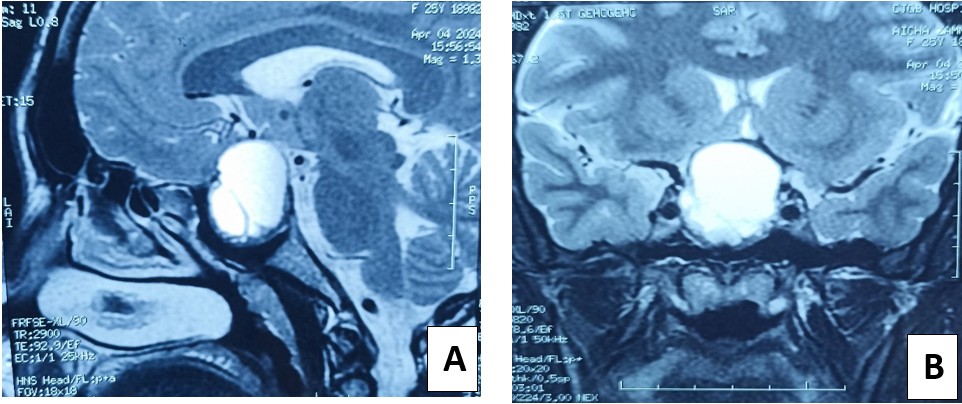
The cerebral MRI revealed a pituitary macroadenoma with suprasellar
extension compressing the optic chiasma.
The patient was referred to neurosurgery for decompression surgery.
Pituitary adenoma is indeed a benign tumor with no impact on life expectancy, but it can threaten visual prognosis (1-2).
Figure 1: T2-weighted MRI sagittal (A) and coronal (B) view showing the pituitary macroadenoma with suprasellar extension
References
- Mendes R, Vydalie, ELJ, Abdellaoui, T., Fiqhi, A., Mouzari, Y., & Oubaaz, A. (2022). Pituitary Adenoma Revealed by Optic Neuropathy: A Case Report and Literature Review. Sch J Med Case Rep, 11, 1131-1135.
- Monteiro, M. L., Zambon, B. K., & Cunha, L. P. (2010). Predictive factors for the development of visual loss in patients with pituitary macroadenomas and for visual recovery after optic pathway decompression. Canadian Journal of Ophthalmology, 45(4), 404- 408.