Traumatic Human Bite Wound on the Lower Lip: A Case Report

Dr Gabriel Mpundu1,3; Dr Emmanuel Muwowo1; Dr Mutinta Syalucha1; Mr Crecious Phiri2; Mr John Soko2

¹Levy Mwanawasa University Teaching Hospital, Oral Health and Maxillofacial Department
²Levy Mwanawasa Medical University, Public Health Department
³Levy Mwanawasa Medical University, School of Medical and Clinical Sciences

*Corresponding author

Gabriel Mpundu, Levy Mwanawasa University Teaching Hospital, Oral Health and Maxillofacial Department
Email: gmpundu3@gmail.com

Abstract

Introduction: Traumatic lip injuries present major challenges in terms of reconstructive options and the outcome of surgical management. The etiology of lip injuries includes human bite as interpersonal violence. Bite wounds are always considered to be complex injuries contaminated with unique polymicrobial inoculum. We have included a classification of facial bite injuries and the surgical management of these lesions has also been discussed. We report a rare bite injury on the lower lip.

Case presentation: A 35-year-old woman presented with a severe tissue defect on her lower lip to the Dental and Oral Department at Levy Mwanawasa University Teaching Hospital in Lusaka, Zambia.  She explained that she had been involved in a fight and someone had bitten her lower lip. An orofacial examination confirmed a serious loss of lip tissue that resembled a chronic ulcerative process. Accurate assessment of the lesion was made by a thorough evaluation of some parameters such as size, depth, presence of granulation tissue, fibrin coverage, wound edges, exudates and/or necrosis. A surgical debridement under local anaesthesia was carried out. Afterwards a layered suture was performed. Eventually the healing was complete and satisfactory.

Conclusions: A severe bite avulsive wound on the lower lip, despite the elapsed time before treatment, may have an excellent prognosis after a simple surgical procedure.

Keywords: Human Bite, Lip Injury, Orofacial Wound

Introduction

Traumatic lip injuries present major challenges in terms of reconstructive options and the outcome of surgical management. The aetiology of lip injuries varies, depending on socio-environmental factors1. These include road traffic accidents, human bite, animal bite, burns and electrical injuries, as well as interpersonal violence1,2,3. Commonly, human bites by an assailant occur extra-orally but, on a few occasions, they also occur intra-orally. The size and severity of the injuries vary, ranging from small lacerations, punctures or cuts to total avulsion and loss of relatively big chunks of tissue4. The location of human bites in the maxillofacial region compromises the function and aesthetics of the face; as a result, social and psychological effects are most likely5. The prevalence of human and animal bite injuries is around 1% of all emergency injuries. The frequency by affected areas, varies from cervicofacial region (36%), lower extremity (31%), upper extremity (19%) and chest (14%)5. Bite wounds are always considered to be complex injuries contaminated with unique polymicrobial inoculum5. Of note is that human bites are as serious as animal bites because they can induce a higher incidence of infectious complications. Human saliva is considered to be a virulent inoculum, with bacterial loads at the order of 108 per millimetre, which significantly increase in cases of periodontal disease and oral sepsis5. Bite wounds to the face, infectious complications can create more difficulties than the initial tissue damage itself for the task of restoring an aesthetic appearance. Therefore, management should aim to minimise or avoid this potential for infection and provide an infection-free environment for wound healing5. An atypical orofacial traumatic wound type IIIA, according to Lackmann’s facial bite injuries classification, is presented. The appearance of the lesion because of the elapsed time between the trauma and the patient’s attendance adds interest.

Case presentation

A 35-year-old woman presented to the Dental and Oral Department in Lusaka, Zambia, with a severe tissue defect on her lower lip (Figures 1 & 2). She had no significant past medical or dental history. She reported that, one day earlier, she had been involved in a fight during which another individual bit her lower lip. After initial self-administered first aid and medication, she sought care at a local clinic and was subsequently referred to the hospital.

On orofacial examination, there was a substantial loss of lip tissue resembling an acute ulcerative lesion. A thorough assessment of the wound was performed, evaluating its size, depth, presence of granulation tissue, fibrin coverage, wound edges, exudates, and necrosis.

Surgical management included debridement and copious irrigation with normal saline under local anaesthesia. A layered closure was performed using the materials available: catgut for muscular and subcutaneous tissues, and silk for the skin and oral mucosa. There was some over-tension around the vertical mattress sutures, but correct primary wound closure was achieved (Figure 3).

Figure 1: Pre Operative

Thoracic CT scan revealed the wide spread emphysema of the right buccal region, and the cervical spaces extending to the anterior and posterior mediastinum (Fig. 2).
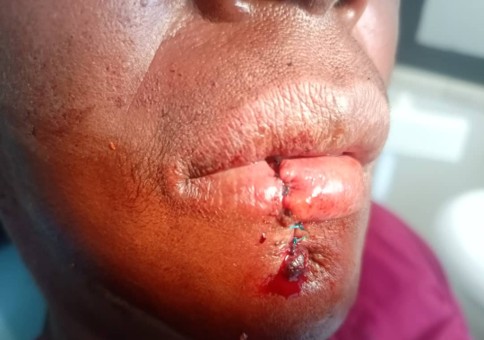
Figure 2: Post Operative

Conservative treatment included nonsteroidal anti-inflammatory drugs and preventive antibiotic therapy with ceftriaxone. The patient was prescribed bed rest. After nine days the swelling resolved, physical examination and control chest X-ray were normal. The patient was discharged and maintained follow-up in as a stomatology outpatient for extraction of teeth.

Figure 3: Post Operative

Postoperative management consisted of oral analgesics (ibuprofen 400 mg every 8 hours for 5 days) and broad-spectrum antibiotic coverage (amoxicillin 500 mg every 8 hours for 5 days combined with metronidazole 500 mg every 8 hours for 5 days). A stat dose of tetanus toxoid (0.5 mg) was also administered. To minimize cicatrization-related complications, silk sutures were removed after 2 weeks.

Although wound cultures were not performed due to limited resources, the patient was closely monitored for signs of infection. In addition, HIV screening and counselling were offered, and the patient was informed about the potential risk of viral transmission associated with human bite injuries.

At her 6-month follow-up, the patient had healed well, with good aesthetic and functional outcomes. She was able to speak, eat, and maintain lip competence without difficulty, and scarring was minimal.

From a public health perspective, this case underscores the burden of interpersonal violence as a cause of traumatic human bites in Zambia. Such injuries not only carry risks of infection and disfigurement but also highlight the importance of violence prevention, community education, and timely access to oral surgical care.

This case demonstrates that a simple surgical procedure, if performed promptly and appropriately, can result in excellent functional and aesthetic outcomes for human bite injuries of the lip.

Table 1: Lackmann’s classification of facial bite injuries

Discussion

Human bites account for approximately 1–3% of bite-related emergency presentations, with the face being the most frequently affected region due to its prominence in interpersonal violence1,2. Globally, maxillofacial bite injuries are often linked to assault, with women disproportionately affected3. Regional studies across Africa consistently report the lower lip as the most vulnerable site, particularly among female victims4,5. In Zambia, the prevalence of intimate partner violence is estimated at 21%, underscoring the sociocultural determinants driving such presentations6. This highlights how human bite injuries not only reflect surgical concerns but also broader public health and social justice issues.

The lesion in our case corresponds to Lackmann’s Type IIIA injury, characterized by deep soft tissue avulsion with a tissue defect. Such higher-grade injuries require meticulous reconstruction to restore oral competence, articulation, and acceptable aesthetics7. Our patient underwent layered primary closure following irrigation and conservative debridement, which remains the cornerstone of effective management. Copious irrigation reduces bacterial load and removes particulate matter, with normal saline being the irrigant of choice as it preserves tissue viability and avoids interference with wound healing, unlike most antiseptics8,9. Techniques may range from manual syringe irrigation (20–35 mL syringe, 18–20G needle) to pulsatile jet lavage at pressures of 50–70 psi9.

Although delayed wound closure was historically preferred because of the fear of infection, current evidence supports primary closure of well-prepared facial bite wounds due to the excellent vascularity of the region and favorable cosmetic outcomes2,10. Our case adds to this evidence, as the patient achieved good healing, intact lip function, and minimal scarring within three months of follow-up.

Human bite wounds are polymicrobial, typically involving Eikenella corrodens, Streptococcus spp., Staphylococcus aureus, and anaerobes11. The Infectious Diseases Society of America (IDSA) recommends empiric prophylaxis with amoxicillin–clavulanate or intravenous ampicillin–sulbactam; alternatives include quinolones plus metronidazole for penicillin-allergic patients12. Our use of amoxicillin plus metronidazole offered anaerobic coverage but lacked β-lactamase inhibition against Eikenella, reflecting a formulary limitation common in district hospitals across Africa. This underscores systemic gaps in antibiotic availability12.

Beyond infection control, prophylaxis against tetanus was correctly provided12. Rabies prophylaxis is not indicated for human bites in Zambia, given the negligible risk. However, HIV transmission, though rare, is biologically plausible when blood is exchanged through deep bites. Both WHO (2024) and CDC (2025) recommend risk-based HIV testing with immediate initiation of post-exposure prophylaxis (PEP) within 72 hours13,14. Our administration of PEP aligned with these guidelines and highlights best practice in resource-constrained environments where HIV prevalence remains significant.

Surgical reconstruction of human bite injuries in the lip should adhere to basic principles: preservation of viable tissue, restoration of oral competence, and re-establishment of normal anatomical relationships with acceptable aesthetics15. Over-aggressive debridement should be avoided in the face due to its rich vascularity, which allows even marginal tissues to survive16. Landmark structures such as the vermilion border, nasolabial fold, and philtrum must be preserved to maintain facial symmetry. In our case, layered closure with minimal subcutaneous sutures provided excellent functional recovery and cosmetic acceptability, consistent with the literature2,7,16.

This case highlights not only the surgical dimension of human bite injuries but also the public health context. In Zambia, where intimate partner violence remains a major driver of such trauma, clinical management must be integrated with violence-prevention strategies, psychosocial support, and medico-legal documentation6. Furthermore, common constraints in African district hospitals—including lack of wound cultures and limited antibiotic formularies—were evident in this case but did not prevent a favourable outcome.

Practice Points

Copious irrigation and conservative debridement are essential to infection prevention8,9.

Primary closure of facial bites is generally safe and cosmetically superior2,10.

Empiric antibiotics should ideally cover Eikenella and anaerobes; amoxicillin–clavulanate is first-line11,12.

Tetanus prophylaxis and timely HIV testing with PEP initiation remain critical13,14.

Management of human bite injuries must integrate violence-prevention measures and medico-legal reporting6.

Conclusions

This case reinforces that even in resource-limited country’s hospitals, favourable outcomes in severe human bite injuries can be achieved through thorough irrigation, conservative debridement, primary layered closure, and appropriate prophylaxis. Beyond surgical repair, such injuries must be recognized as both a clinical and social problem, demanding multisectoral collaboration between healthcare, law enforcement, and community support systems.

Consent: Written informed consent was obtained from the patient for publication of this case report and any accompanying images. A copy of the written consent is available for review by the Editor-in-Chief of this journal.

Competing interests: The authors declare that they have no competing interests.

Authorscontributions: GM was the consultant responsible for diagnosing and treating the patient in this case report. GM provided the information to JS who co-wrote the paper. All authors have read and approved the final version of this manuscript.

References

  1. "Human Bites Over Nose: Management and Reconstruction." J Plast Reconstr Aesthet Surg. 2023.
  2. Caruso G; Vuletic T; et al (2024). Antibiotic prophylaxis in traumatic craniomaxillofacial injuries: evidence review and recommendations. J Oral Maxillofac Surg. 82(4):245–258.
  3. Obimakinde OS; Olajuyin OA; Olajuyin O; Fasola AO (2018). Human bite injuries of the orofacial region in a Nigerian tertiary hospital. Niger J Clin Pract. 21(8):996–1001.
  4. Shubi FM; Hamza OJ; Kalyanyama BM; Simon EN (2008). Human bite injuries in the oro-facial region at Muhimbili National Hospital, Tanzania. BMC Oral Health. 8:12.
  5. Zambia Statistics Agency (ZamStats), Ministry of Health (MOH), and ICF. Zambia Demographic and Health Survey 2018. Lusaka, Zambia & Rockville, MD, USA: ZamStats, MOH & ICF; 2019.
  6. Lackmann GM; Draf W; Isselstein G; Töllner U (1992). Surgical treatment of facial human bite injuries: classification and management. J Craniomaxillofac Surg. 20(2):81–86.
  7. Singer AJ; Dagum A (2008). Current management of acute cutaneous wounds. N Engl J Med. 359(10):1037–1046.
  8. Hollander JE; Singer AJ (1999). Laceration management. Ann Emerg Med. 34(3):356–367.
  9. Medeiros I; Saconato H (2001). Antibiotic prophylaxis for mammalian bites. Cochrane Database Syst Rev. (2):CD001738.
  10. Talan DA; Abrahamian FM; Moran GJ; Citron DM; Tan JO; et al (2003). Clinical presentation and bacteriologic analysis of infected human bites presenting to emergency departments. Clin Infect Dis. 37(11):1481–1489.
  11. Stevens DL; Bisno AL; Chambers HF; et al (2014). Practice guidelines for the diagnosis and management of skin and soft tissue infections: 2014 update by the Infectious Diseases Society of America (IDSA). Clin Infect Dis. 59(2):147–159.
  12. World Health Organization. Updated guidelines on HIV post-exposure prophylaxis (PEP). Geneva: WHO; 2024.
  13. Centers for Disease Control and Prevention. Updated guidelines for nonoccupational antiretroviral postexposure prophylaxis (nPEP). MMWR Recomm Rep. 2025;74(RR-1):1–20.
  14. Ekenna O; et al (2021). Eikenella corrodens and other oral flora in human bite infections: implications for empiric therapy. Infect Dis Clin Pract. 29(3): e123–e130.
  15. Hurwitz DJ; Koblenz J; Koblenz A (2009). Principles of facial reconstruction after trauma. Oral Maxillofac Surg Clin North Am. 2009;21(1):29–37.
  16. Caruso G; et al (2023). Antibiotic prophylaxis and outcomes in facial bite injuries  recent systematic review. Facial Plast Surg Open J. 8(1):17–29.
TOP