Treatment of Toe-Tip Amputation in Children. Presentation of a New Technique with Occlusive Dressing and Review of the Literature

Johannes Wirmer1*, Jurek Schulz2

¹Department of Pediatric Surgery, Sana Klinikum Offenbach, Germany.
²Department of Pediatric Surgery, Universitätsklinikum Dresden, Fetscherstrasse 74, 01307 Dresden, Germany

*Corresponding author

Johannes Wirmer, Department of Pediatric Surgery, Sana Klinikum Offenbach, Germany.

Abstract

Introduction: Amputation injuries to the tip of the big toe offer various therapeutic options such as surgical stump formation using V-Y plastic or island flap covering. The here presented treatment with a semi-occlusive dressing has not yet been described

Case: A 1 ¾ year old boy was presented with a subtotal amputation of the distal phalanx of the big toe after a tabletop had fallen on to it. Exploration revealed an open fracture at the base of the distal phalanx with subtotal detachment. Replantation and K-wire fixation under perioperative antibiotic therapy were performed. In the further course, the replanted distal tip became increasingly necrotic, so that 17 days after the trauma it was removed. The resulting defect with exposed residual bone of the distal phalanx was then treated with a semi-occlusive bandage.

Result: The patient was recalled for a weekly dressing change with re-application of the semi-occlusive dressing. Already two weeks after the start of the occlusive treatment, a soft tissue covering of the bone could be seen with the skin defect still existing. The patient was allowed to step on the foot according to personal measure.

Further controls showed an increasing epithelialization of the defect with simultaneous regeneration of the distal phalanx. The semi-occlusive treatment was ended after 8 weeks.

The final check-up 4 months after the trauma showed a non-irritated, slightly shortened toe with an irregularly growing toenail. There was no discomfort

Summary: Semi-occlusive treatment for toe tip amputations is a good, conservative alternative to surgical stump formation.

Introduction

Injuries to the big toe account for 5-13% of all foot fractures in childhood, with the toe fracture being the most common of all foot fractures [1]. However, in contrast to finger fractures, there are significantly fewer descriptions in the literature. In particular with regard to the regeneration described in partial amputation of the distal phalanx with partially scar-free restoration of the fingertip under conservative therapy using a semi-occlusive bandage [2-4], no case has yet been described in the Pubmed research. On the other hand, various surgical options for coverage of toetip injuries are described, such as VY advancement flap coverage or island flap coverage [5,6], which are difficult to perform without anesthesia, especially in small children. The following case illustrates, that regeneration after partial amputation of the distal phalanx under treatment with a semi-occlusive bandage is also possible on the big toe.

Case

A 1 ¾ year old boy was presented to our emergency room after a table top had fallen on his left big toe at home. Since the family first went to another hospital, the injury was already more than three hours old when arriving at our clinic.

We saw an open fracture at the base of the distal phalanx of the big toe above the epiphyseal plate, with subtotal separation of the entire tip distally from the fracture, including the complete toenail, with the proximal nail wall still intact. Suitable vessels for microsurgical repair were not available.

The partially amputated distal phalanx was repositioned and fixed with a K-wire (see Fig. 1). In addition, the skin was adapted in a circular manner using single button sutures with Serapid 5-0. Perioperatively, the patient received antibiotic therapy with clindamycin.

In the following outpatient controls, the distal part of the toe presented increasingly livid, until it was fully necrotic, so that 17 days after the trauma it was removed.  The removal was possible without anesthesia and absolutely pain free, proving the complete necrosis.

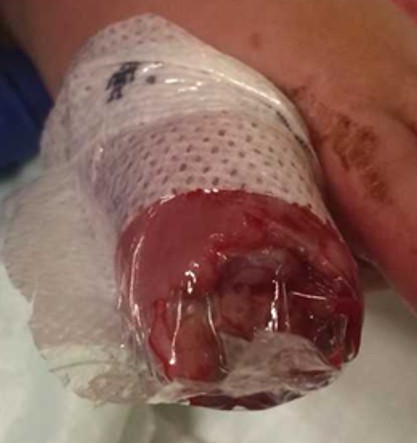
Subsequently, there was an open defect at the level of the basal nail wall with exposed bone of the remaining distal phalanx, which was treated with a semi-occlusive bandage, using Tegaderm TM Film transparent dressing (see Fig. 2-4).

The patient was then called back for a weekly dressing change. Already two weeks after the start of the occlusive treatment, the previously exposed bone was covered with granulation tissue, with the skin defect still presenting (Fig. 5 + 6).  In the absence of discomfort, the foot was released for careful loading according to the child's measures. The follwoing controls showed increasing regeneration of the tip with simultaneous epithelialization (see Fig. 7), so that the semi-occlusive treatment could be ended after 8 weeks.

The final check-up 4 months after the trauma showed a non-irritated, slightly shortened toe with an irregularly growing toenail (see Fig. 8). There was no discomfort, the patient and the parents were very content.

Discussion

Unlike the fingertip amputation, the toe-tip amputation is an injury that so far has been neglected in the literature. Although injuries to the big toe are described in childhood [1], unlike finger injuries, there is no established classification model for injuries of toetip. However, for orientation the most widespread Allen classification for fingertip injuries (Fig.9) [7] can be used. This classification distinguishes between type I (no involvement of the nail bed), type II (no bony involvement), type III (bony involvement distal to the lunula) and type IV (injury to the lunula and further proximal).

One reason for the neglect of toe tip injuries in the literature may be the lower functional and cosmetic importance of the toes compared to the fingers. Nevertheless, the big toe plays an important role in the function of the foot [8]. Furthermore, patients with posttraumatic reduced toe length are aware of and bothered by the deformity [6,9]]. In addition, the surgical covering of substance injuries on the toe tips is a surgical challenge [5].

Treatment with a semi-occlusive bandage has been described many times for partial amputation of the distal phalanx of the fingers [2-4]. The dressing protects the wound from drying out, so that epidermal cells use the moist wound exudate directly for migration, which leads to faster epithelialization. In addition, the bandage acts as protective wall to the outside world, preserving the pH value, immunoglobulin concentration, temperature and humidity and at the same time allowing an influx of oxygen. All of this leads to faster epithelialization of the wound. The indication for semi-occlusive treatment can be made up to Allen type IV injuries [2].

Applied to the big toe, the case described is a type III injury according to Allen. In retrospect, the initial attempt to fix the subtotally amputated tip of the toe under anesthesia led to an unnecessary delay in healing of 17 days. Anesthesia and antibiotic therapy could also have been avoided if conservative therapy had been carried out initially. It is possible, that an immediate start of therapy would have led to even faster healing.

Transferring the knowledge about the treatment of fingertip injuries to the toes, caution is advised.   The longer distance between the heart and toes, also noticeable in the significantly higher incidence of PAD on the lower extremities [10], as well as the higher mechanical stress to which the feet are exposed in everyday life compared to the hands, forbid a one on one transfer of treatmentalgorithms. The good end result achieved in this case should, however, give reason to consider semi-occlusive treatment for toe tip amputations up to the lunula as a therapeutic option.

Ethics statement: This case report is a retrospective report of the treatment of a single patient. An approval of an ethics committee was not required for the treatment and was not obtained afterwards.

Ethics approval: As this is a retrospective presentation of performed therapy in consent with the fully informed patients parents, the ethics committee advised that no ethical approval was needed.

TOP