Quantitative Deteemination of Sugar Content in Cola Drinks of Different Brands Via A Gragh Slope

Z.M Anka1, Abdul rauf I1*, Isiya I1, S.N Gimba2

¹Department of Chemistry, Zamfara State College of Education Maru, P.M.B. 1002 Maru, Zamfara State, Nigeria.
²Shehu Sule College of Nursing Science, Damaturu. Yobe state. Nigeria

*Corresponding author

Abdul rauf, Department of Chemistry, Zamfara State College of Education Maru, P.M.B. 1002 Maru, Zamfara State, Nigeria.

Abstract

Cola drink is a carbonated non-alcohol soft drink with complex mixtures, containing different chemical substances such as color combinations, flavoring agents, additives, preservatives, sweetener and caffeine. They are usually mixed with water (H2O) plus 1-3% liquid carbon dioxide (CO2), 3-5% liquid sugar, acidified to 2.4-4.0 pH, emulsifiers and flavors (Ashurst et al.1998). Sugar is one of the simplest forms of carbohydrate. It is made up the simple sugars, fructose and glucose. Simple sugar (glucose) was discovered independently by German and Russian chemist. The German, Wohler Kolbe, first gave the details description of some complex substance starch, fats and proteins in 1803. he described a complex substance were less easy to manipulate in his book, this substance can be broken down to relatively simple “building block” by heating them with dilute acid or base (Rels et al,1997). 100ml of distilled water and weighed 87.00g, then 5g,10g,15g,20g,25g and 30g of sugar crystals was transferred into the six (6) 100ml distilled water in different beakers respectively. The sugar crystal was allowed to dissolve completely. The sugar solutions were weighed and recorded; also, their densities were determined as in table1. A graph of mass of the sugar solutions obtained against the densities of the sugar solutions was plotted and gives a straight-line graph which was then to be use in to trace the densities of the sample solutions to get the masses of the sample solution on the graph. These cola soft drinks are indeed of low density. However, in some of the brands, sugar content from the experiment corresponded to the amount of sugar as claimed on their labels by their manufacturers that of Coca-cala, Pop-cola, Pepsi-cola while others shows significant difference in the values obtained from the experiment to that on their bottle label as claimed by their manufacturers.

Introduction

Cola drink is a carbonated non-alcohol soft drink with complex mixtures, containing different chemical substances such as color combinations, flavoring agents, additives, preservatives, sweeteners, and caffeine. They are usually mixed with water (H2O) plus 1-3% liquid carbon dioxide (CO2), 3-5% liquid sugar, acidified to 2.4-4.0 pH, emulsifiers and flavors (Ashurst et al.1998)

Cola drink became popular worldwide after the American Pharmacist named John Smith Pemberton invented the coca-cola trademark brand in1886, which was then imitated by other manufacturers. The name ‘Cola’ was originally due to the caffeine content from the kolanut (cola acuminata) (Rels et al,1997) . Cola drinks exist in various forms and brands which are marketed and distributed by different manufacturers and wholesalers all over the state,

The cola drink got accepted worldwide by people of almost all tribes, religious, social and community differences due to its non-alcoholic and sweet (sugar) taste. Due to the high rate of consumption of carbonated soft drinks especially the cola brand in Zamfara state makes it mandatory to investigate the chemical constituents present for health risk purpose. Some decades ago, most people of the rural areas believed every can and bottle drinks to be alcohol so, they can only be found in the main towns of the state. But presently no matter how remote a village is carbonated drinks are found

Sugar is one of the vital ingredients of carbonated soft drinks, has a role to play in the dietary and health issues. Sugar is the generic name for sweet, soluble class of food belonging to carbohydrate, it is an energy source in human diet (Jasmine et al,2012)

In 2015 Aloh and Obeagu at Michael Opara University of Agriculture, Umudike, Abia state, Nigeria made research on similar issue on estimation of different sugar content in soft drinks using a standard method to estimate the amount of glucose, fructose, glactose, sucrose, maltose and lactose in different soft drinks consumed in Nigeria.

Abbas and Blessing (2020), made a research study and set to ascertain the sugar content from different soft drinks sold in Nigeria. Ten (10) soft drinks registered and licensed in Nigeria by their respective companies. The sugar contents were assessed using standard methods. Result showed significant differences (p<0.05) in ranges of 0.36g/100ml (Limca) to 3.88g/100ml (Teem Bitter Lemon). Conclusively, the sugar contents were all below recommended value and it can be consumed by those who need low sugar in the body.

Hassan and Emiforiye, (2018) from the department of petroleum and natural gas, Petroleum Training Institute (PTI), Effurun Nigeria. They conducted research to quantitatively determine the type and quantity of sugar present in each of these brands of soft drinks. Two different batch samples of each brand selected at random shops located in different parts of the state were procured and their comprehensive documentation to show batch number, manufacturing dates, Expiry date and NAFDAC number. Preliminary quantitative investigation was done using alkaline copper is sulphate solution. The pH and densities were estimated by conventional methods, while the type of sugar present was determined by Knight and Alien EDTA methods. Results obtained showed that all the brands of soft drinks tested contained sucrose as the only sugar present and that the sugar level as well as the densities varied through the machine brands in the order. Pepsi>Coke>Gold Sport> Limca >Sprite>7up>Fanta>Miranda. The mean sugar concentration for soft drinks in Ebonyi State was 32.4856mg/ml. Though there were differences between the sugar values (Emmanuel, 2015).

Methodology

Experimental, Samples Collection, Identification And Pretreatment

Electronic digital weighing balance, Beakers, Conical flasks, Funnel, Measuring cylinder, Stirrer, and Graph sheet

Chemicals/Reagents

The chemicals or reagent required for this research are distilled water and sugar granules (crystals)

Research Samples

Seven (7) different cola brands such as; Coca-cola, Big-cola, Bigi-cola, Wow-cola, v-cool-cola, Pepsi-cola, Pop-cola, registered and licensed in Nigeria by their respective companies were purchased from different retail shops around new market, along Zamfara state radio and television services road, in Gusau metropolis, Zamfara State.

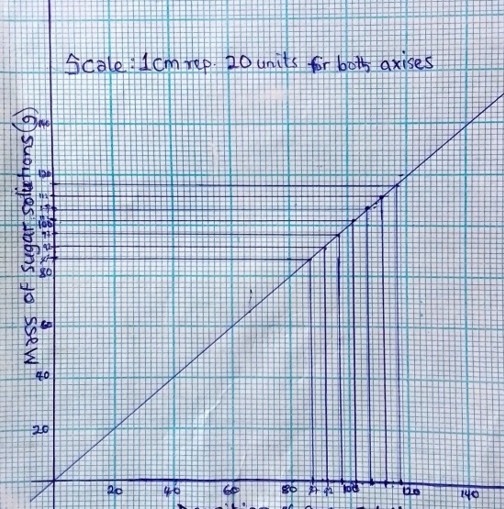
Graph 1: 

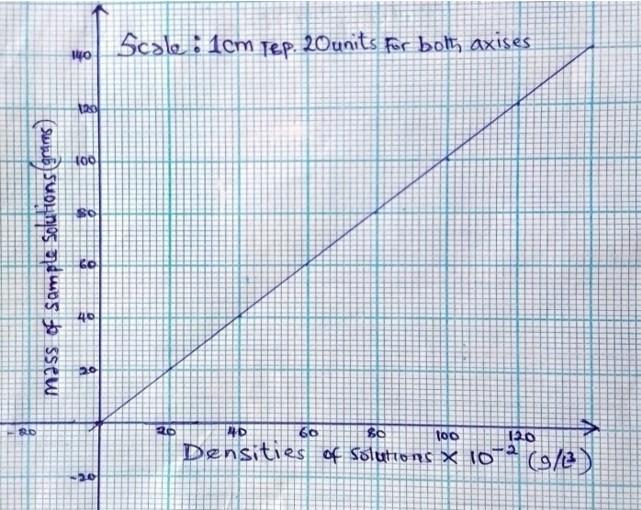
Graph 2: 

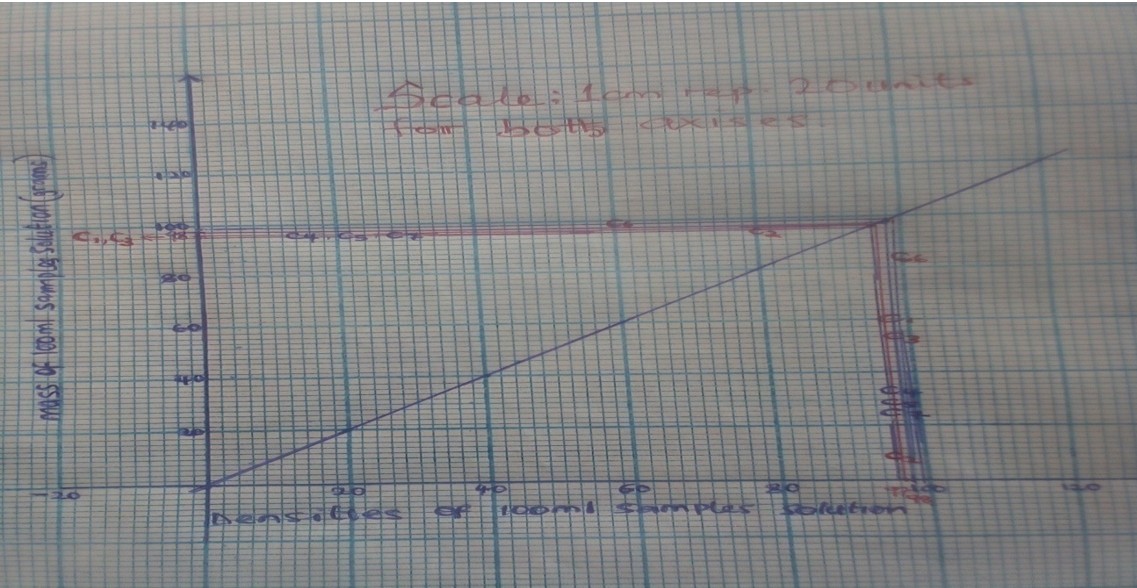
Graph 3: 

Preparation Of Sugar Solutions

The mass of 100ml of an empty beaker was weighed and recorded to be 56. 00g.Then seven (7) different beakers of the same size and volume was filled with 100ml of distilled water and weighed 87. 00g.Then 5g, 10g, 15g, 20g, 25g and 30g of sugar crystals was transferred into the six (6) 100ml distilled water in different beakers respectively. The sugar crystal was allowed to dissolve completely. The sugar solutions were weighed and recorded; also, their densities were determined as in Table1. A graph of mass of the sugar solutions obtained against the densities of the sugar solutions was plotted and gives a straight-line graph which was then to be use in to trace the densities of the sample solutions to get the masses of the sample solution on the graph.

After obtain the masses of the sugar solutions and also determining their densities as presented in the Table1, the graph of the mass of the sugar solutions over their densities was plotted and it gives a straight-line slope.

Sample Treatment

The cola brands samples were labeled for easy access and identification, seven (7) different beakers of the same volume and mass were also labeled according to the sample label.  The cola brands were labeled C1 to C7 respectively for the seven (7) brands of the cola .The sample brands were then poured into the seven labeled beaker in accordance to their label and allowed to degassed for about 2 hours. After making sure that the samples had degassed, the mass of 100ml of each sample was measured using the electronic digital weighing balance. The masses of the sample solutions were obtained and also their densities were determined as shown in the table 2.

Plotting the graph.

Before plotting the graph, an appropriate scale was used to get at least three-quarter (3/4) of the graph page.1cm represent 20units for both the mass of sugar solutions axis and that of the densities of the sugar solutions axis. It was also observed that the values of the masses of the sugar solutions were in whole number integer while that of their densities were in decimal (fraction) integer.  The values of the densities of the sugar solutions were then converted to negative whole number standard form integer to get the same unit that can give a straight-line graph.

Result

Table 1:

Table 2: 

Discussion

Table1 shows the results of the measurements carried out to the sugar solutions, starting with the mass of the empty beaker which is 56.00g, then the mass of 1000ml distilled water and the masses of sugar solutions by dissolving 5,10,15,20,25,30 grams of sugar crystals in 100ml of distilled water of six different beakers of the same size. It also contains the densities of the sugar solutions by dividing the masses over the volumes of the solutions. Likewise, the decimal values of the sugar solution were converted to negative whole numbers as in table 1 for easy scaling of graph 1.

Graph 1 and 2: Using the values of the mass of 100ml of the sugar solutions and the negative whole number of their densities in table1, a straight-line graph was plotted by using an appropriate scale which produced graph 1 and 2.

Table 2 contained the values of the masses of 100ml degassed solutions of the samples, their densities as calculated previously and the negative whole numbers of those densities of the various cola samples.

Graph 3: Tracing the values of densities negative whole numbers of the cola sample solutions on graph 2 gave us the values of the masses of sugar solution on the graph that result to the derivation of Table 3.

Table 3 contains all the vital information on this research that includes the masses of samples solutions, actual sugar content in the samples solutions by subtracting the mass of distilled water from the mass of 100ml sample solution obtained from the graph and the amount of sugar per 100ml as claimed by the manufacturer and the quantity of sugar per unit bottle.

Table 3

Coca- cola (C1) and Pop-cola (C2) had the same quantity of sugar per 100ml of solutions which was 11g determined from the graph after subtracting the mass of distilled water and that claimed by the manufacturer per 100ml was also 11g each. Though there are varieties of coca-cola soft drinks manufactured by the same company that includes; Bigger boy-coke, Diet-coke, Zero-sugar-coke, Original–coke. While the quantity per bottle (600ml) for both were 66g.The values of sugar content in both samples falls within the acceptable range 7.0 -14.0 g as specified by both NAFDAC and SON (Research Gate)

Pepsi (C3), V-cool (C4) and Big (C5) also fells within the same mass of sugar per 100ml of solutions from the graph which was 10g each by subtracting the mass of distilled water. The masses of sugar claimed by their respective manufacturers of each sample were 10.7g, 10.7g and 11g of sugar per 100ml for. While the masses of sugar per bottle 400ml,500ml and 360ml respectively were 40g,50g and 36g respectively. Though having a vase difference in sugar masses from their bottles, they all fells within the acceptable range specified by both NAFDAC and SON which is 7.0-14.0 (ResearchGate)

Wow-cola (C6) and Biggi-cola (C7)   falls within the same mass of sugar per 100ml of solutions from the graph which was also 12g sugar by subtracting the mass of distilled water. While the mass of sugar claimed by the manufacturer per 35ml of sample solution for Wow-cola was 19g and 10ml of sample solution for Biggi-cola was 12g according to the bottles labels each sample. While the masses of sugar per bottle 350ml and 350ml respectively were 42g each and their values also falls within the acceptable range specified by both NAFDAC and SON which is 7.0-14.0g (ResearchGate)

Conclusion

Although all effort was made to achieve a high degree of precisions and accuracy but error could be made due to uncontrollable environmental factors and influences from the results obtained in table 3, the following conclusion can be drawn;

Though the quantity of sugars in these soft drinks is within acceptable limits all falls within the acceptable range specified by both NAFDAC and SON which is 7.0-14.0 (ResearchGate), the quantity of sugar in relation to the standard is generally reduced.

These cola soft drinks are indeed of low density

Some of the brands sugar content from the experiment corresponded to the amount of sugar as claimed on their labels by their manufacturers like coca-cola, pop-cola, pepsi-cola while others show significant difference in the values obtained from the experiment to that on their bottle label as claimed by their manufacturer

References

  1. Agbazue VE ; Ibezim A & Ekere NR. (2014). Assessment of Sugar levels in Different Soft Drinks. International Journal of Chemical Sciences, 12(2), 327.
  2. Ashurst PR; Beal C; Davenport RP; Giles GA; Hammond DA & Lea RAW et.al (2010). The Chemistry and Technology of Soft Drinks and Fruit Juices. Sheffield Academic Press, United Kingdom. Pp. 25-31.8. Dharmasena, K.A.
  3. Agbazue VE; Ibezim A & Ekere NR. (2014). Assessment of Sugar levels in Different Soft Int. J. Chem. Sci. 12(2): 327 – 334
  4. Standard Organization of Nigeria, SON. (2007).Nigerian standards for drinking water quality.
  5. Akrokeokia P; Tubonimi JK  & Chinonso G. (2016). Determination of Glucose Concentrations and Acidity in Selected Soft Drinks Marketed in Port Harcourt Nigeria. Chemistry Research Journal,1(4), 100,104.
  6. Ashurst PR; Beal C; Davenport RP; Giles GA; Hammond DA & Lea RAW et.al (2010). The Chemistry and Technology of Soft Drinks and Fruit Juices. Sheffield Academic Press, United Kingdom. Pp. 25-31.8. Dharmasena, K.A.
  7. Davenport DD. (2005). Microbiology of soft drinks,In Chemistry and Technology of Soft Drinks and Fruit Juices, Academic Press, CRC, Sheffield, UK. 197–216
  8. Jasmine YS. (2012). Comparison of Sugar Content in Bottled 100% Fruit Juice Versus Extracted Juice of Fresh Fruit. Journal of food and Nutrition Sciences,3, 1509-1513.
  9. Rels CP; Kline K & Wea SO. (1997). Impact of Commercial  Eating on Nutrient Adequacy. Journal of the American Dietetic Association,87, 463-468. 11.
TOP