Jejunal Carcinoid Tumor Presenting with Bowel Obstruction: A Clinical Insight

Dr. Aun Ali1; Dr. Madeeha Shahid2,*; Dr. Pirhay Fatma3; Dr. Yousuf Ali Lakdawala4; Dr. Muhammad Ahmed5

¹MBBS, FCPS, MRCS, Professor of Surgery, Fazaia Ruth Pfau Medical College, Department of General Surgery, Pakistan
²MBBS, FCPS Surgery, Senior Registrar, Fazaia Ruth Pfau Medical College, Department of General Surgery, Pakistan
³MBBS, FCPS II Surgery Trainee, Fazaia Ruth Pfau Medical College,Department of General Surgery, Pakistan
⁴MBBS, FRCS, MRCGP, MCPS (Family Medicine), Professor of Surgery, Fazaia Ruth Pfau Medical College, Department of General Surgery, Pakistan
⁵MBBS, FCPS, Associate Professor of Surgery, Fazaia Ruth Pfau Medical College, Department of General Surgery, Pakistan

*Corresponding author

Dr. Madeeha Shahid, Senior Registrar, Fazaia Ruth Pfau Medical College ,Karachi, Pakistan.

Abstract

Bowel obstruction is a surgical emergency that remains a challenge, both diagnostic and management-wise. Post-operative adhesions, congenital or acquired bands, and obstructed hernia are common causes. In developing countries like Pakistan tuberculosis is another important cause. Intestinal tumors remain the rare cause of particularly small bowel obstruction as one can’t think of these initially. And the presentation of intestinal obstruction is also variable, cardinal features of abdominal pain, distension, vomiting and obstipation not seen in all cases. Here we present a rare case of intestinal obstruction secondary to carcinoid tumor of jejunum in middle age female who diagnosed on histopathology about exact nature of disease.

Key Words: Adhesion, Band, Carcinoid tumour, Small bowel obstruction, Tuberculosis.

Introduction

Carcinoid tumors are rare, well-differentiated neuroendocrine tumors with secretory components that arise from enterochromaffin cells of gastrointestinal and respiratory epithelium1. They arise from the appendix, ileum, jejunum, colon, rectum, and stomach. They don’t grow to a large size to cause intraluminal obstruction rather than local desmoplastic reaction hindering motility2. With a larger size of >1.5cm, there may be a potential for metastasis to visceral organs like liver, transforming the carcinoid tumour into carcinoid syndrome3. They progress slowly and remain indolent for many years in most of the cases. We are reporting a rare case of carcinoid tumour of the jejunum in a 58-year-old patient who presented with small bowel obstruction.

Case Report

A 58-year-old married female presented in the outpatient department with a one-month history of intermittent colicky central abdominal pain and non-projectile bilious 5-6 episodes of vomiting per day. There was no history of fever, night sweats, weight loss, and bleeding per rectum.

On examination, she was dehydrated, afebrile having tachycardia of 110 beats/min. The abdomen was soft, non-tender and had no palpable lump. Her bowel sounds were exaggerated. Digital rectal examination was also normal.

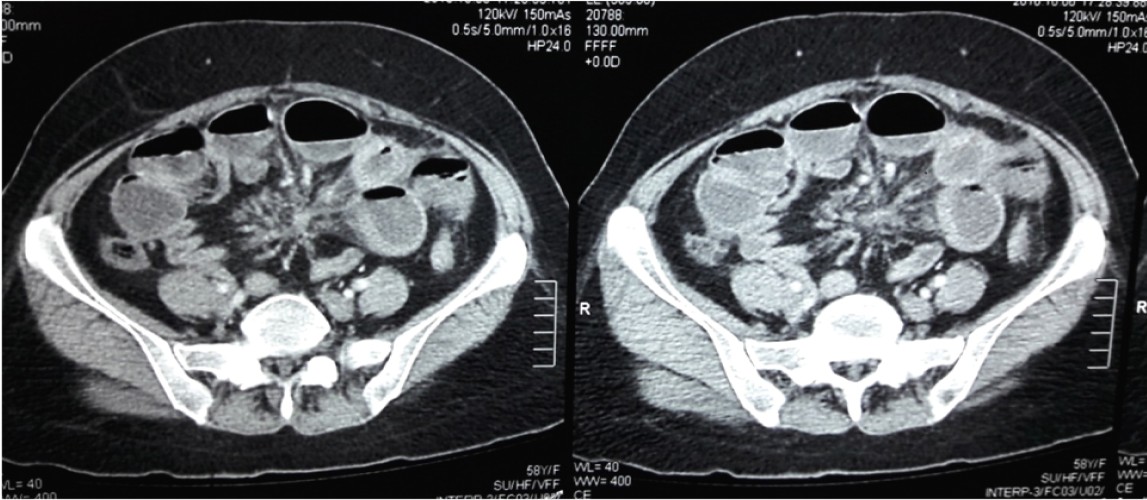
After admission, she was resuscitated with intravenous fluids. A nasogastric tube and Foley’s catheter were placed. Routine hematological investigation was normal. X-ray abdomen shows valvulae conniventes. CT scan of the abdomen with contrast demonstrated thickening and enhancement of jejunal loops with fat stranding of mesentery and enlarged mesenteric lymph node suggestive of inflammatory/ infective process (Figure 1, 2). Another possibility of carcinoid tumour was suggestive.

Figure 1: Transverse section of Contrast CT Abdomen shows thickening and enhancement of jejunal loops with fat stranding of mesentery
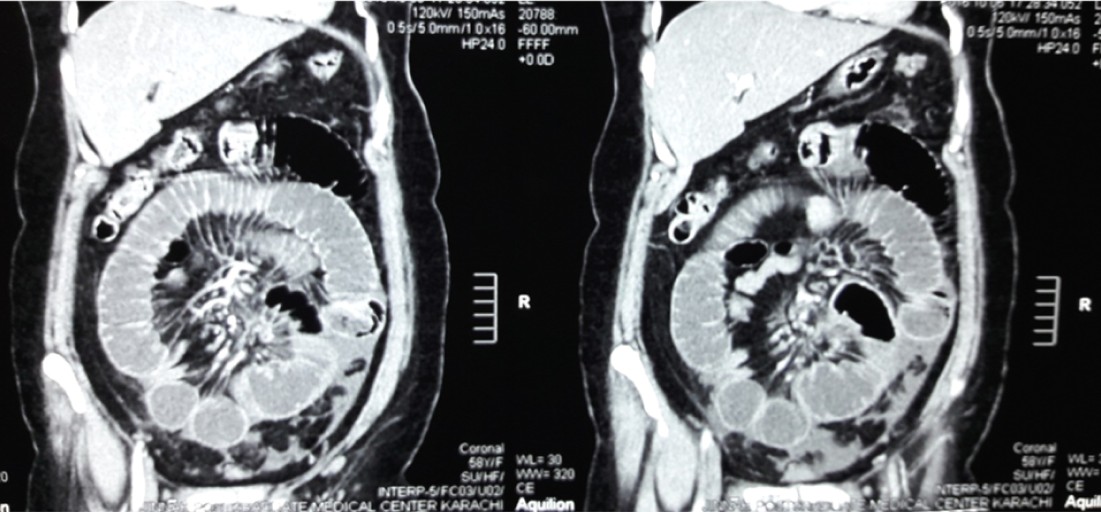
Figure 2: Contrast CT Abdomen shows thickening and enhancement of jejunal loops with fat stranding of mesentery and enlarged mesenteric lymphnodes

After resuscitation and workup, an exploratory laparotomy was performed. There was a long stricture at mid jejunum measuring about 15cm with few enlarged mesenteric lymph nodes. One and a half feet of jejunum were resected and end-to-end anastomosis was performed. Specimen along with lymph node was sent for histopathology. Postoperative recovery was smooth and the patient was discharged on 4th postoperative day. Later, histopathology report revealed the exact nature of pathology that was carcinoid tumor with clear resection margins. A total of 10 lymph nodes recovered, out of which one lymph node was found to be involved. We send our patient for oncologist opinion. And enroll him in surveillance program as advised by oncologist with 6 monthly triphasic CT scan of abdomen.

Discussion

Proximal small bowl obstruction usually presents with abdominal pain and vomiting. Constipation is a late feature while abdominal distention may not be seen.

Carcinoid tumors are the most common tumors of small bowel. They are neuroendocrine tumors having embryonic origin from endochromaffin cells of Kultchitsky which are neural crest cells situated at the base of crypts of Lieberkuhn. These neuroendocrine cells are mostly found in gastrointestinal tract (70%) and tracheobronchial tree (25%). Appendix is the most common site for carcinoid tumors following ileum, jejunum, colon, rectum and stomach in descending order 4, 5.

Majority of small intestinal carcinoids are asymptomatic. However when symptomatic they present as stricture from outside usually caused by desmoplastic reaction of tumour2. These tumors secrete serotonin, vasoactive intestinal peptide and other mediators which are metabolized in liver3. If metastasized to liver then these metabolites bypass liver metabolism and form carcinoid syndrome which manifest as flushing, diarrhea, abdominal cramps, wheezes etc.

Surgical resection is the main stay of management. Tumors <1cm size can be resected locally. And for lesions more than 1.5cm and nodal involvement, segmental resection with clearance of mesenteric lymph nodes is mandatory6. Prophylactic cholecystectomy should be considered in every patient undergoing surgery for carcinoids of the digestive tract7. This procedure mitigates the biliary toxicity of somatostatin analogues therapy and avoids chemical cholecystitis, should transcatheter chemoembolization be performed in the future. Fortunately, in our case patient already had cholecystectomy two years ago.

The management of metastatic carcinoid tumour or carcinoid syndrome is both medical and surgical. Surgical options are resection of primary tumour, debulking surgery, bypass procedure if tumor is not amenable to resection, Segmentectomy, wedge resection, lobectomy for liver metastases. Medical strategies include single agent or multiple agent based chemotherapy, somatostatin analogue etc8.

In our case we did resection of around one and half feet of small bowel along with mesenteric lymph nodes and end to end anastomoses. The patient recovered well, advised for regular follow-up for recurrence and till date no recurrence noted.

One might not think of small bowel malignancy as a cause of obstruction in the first instance and it is inaccessible to have a biopsy preoperatively by endoscopy. Hence while dealing with isolated strictures careful palpation of the entire length of small bowel is recommended and it can affect the prognosis of the patient.

References

  1. Seyyedmajidi M; Hosseini SA; Vafaeimanesh J; (2020). Anemia as the Only Clinical Presentation of Metastatic Jejunal Carcinoid Tumor: A Case Report with Radiological and Enteroscopic Findings. J Vessel Circ. Winter 2020; 1(1): 37-40.
  2. Moosavy SH; Andrabi Y; Esmaeeli S; Amini A; (2011). Small bowel obstruction by a terminal ileum carcinoid tumor: a case report. Medical Journal of The Islamic Republic of Iran (MJIRI). 2011 Nov 15;25(3):165-9.
  3. Ahmed M; (2020). Gastrointestinal neuroendocrine tumors in 2020. World J Gastrointest Oncol. 12(8): 791-807.
  4. Komborozos V.A; (2011). Carcinoid tumours of small bowel colon and rectum: Hellenic J Surg. 83: 12.
  5. Wilson HM; (2009). Chronic subacute bowel obstruction caused by carcinoid tumour misdiagnosed as irritable bowel syndrome: a case report. Cases journal. 22;2(1):1.
  6. Eriksson B; Klopel G; Krenning E; (2008). Consensus guidelines for the management of patients with digestive neuroendocrine tumors – well-differentiated jejuno-ileal tumor/carcinoma. Neuroendocrinology. 87:8-19.
  7. Howe JR; Cardona K; Fraker DL; Kebebew E; Untch BR; et al. (2017). The Surgical Management of Small Bowel Neuroendocrine Tumors. Pancreas. Jul;46(6):715–31.
  8. Eric KN; (2018). Challenges Staging Neuroendocrine Tumors of the Pancreas, Jejunum and Ileum, and Appendix. 25:591–593
TOP