Farhana Rahman, Rabeya Basri, Md. Naimur Rahaman, Md. Roki Hossen, Mahbuba Haque, Enamul, Md. Shakil Ahmed, and Md. Atiqur Rahman*
Department of Pharmacy, University of Development Alternative (UODA), Dhanmondi, Dhaka1209, Bangladesh
*Corresponding author
Dr. Md. Atiqur Rahman, Department of Pharmacy, University of Development Alternative (UODA), Dhanmondi, Dhaka1209, Bangladesh.
Abstract
Background: Women's health is a key driver of public health and national development. In 2023, over 700 women died daily from preventable pregnancy-related causes, with more than 90% occurring in low- and lower-middle-income countries. Maternal, neonatal, and adolescent health outcomes remain central to achieving the Sustainable Development Goals (SDG), particularly targets 3.1, 3.2, and 3.7.
Objective: To evaluate Bangladesh’s progress in key women’s health indicators from 2014 to 2023 and assess its alignment with SDG targets, while identifying existing gaps and policy priorities.
Methods:A retrospective analysis was conducted using secondary data from national and international sources including BBS, DHS, WHO, and UNFPA. Key indicators assessed include maternal mortality ratio (MMR), neonatal mortality rate (NMR), under-5 mortality rate (U5MR), adolescent fertility rate (AFR), contraceptive prevalence rate (CPR), and skilled birth attendance. Statistical analyses included trend analysis, Pearson correlation, and linear regression to assess relationships between indicators.
Results: Between 2014 and 2023, MMR declined from 193 to 136 (AARR = -3.44%), NMR from 25 to 18 (-3.23%), U5MR from 41 to 31 (-2.75%), and AFR from 92 to 73 (-2.28%). However, these rates remain insufficient to meet SDG targets by 2030. Regression analysis revealed AFR as a significant predictor of both MMR (r = 0.905, p< 0.001) and NMR (p = 0.002). Contraceptive use trends show increasing pill use, while use of injectables and condoms declined. Skilled birth attendance remains low at 59%, and 21.7% of children under five remain underweight.
Conclusion: Despite measurable progress, Bangladesh must significantly accelerate reductions in AFR, MMR, and NMR to meet SDG goals. For example, to reach the SDG 3.1 target of reducing MMR to 70 per 100,000 by 2030, the current annual reduction rate must more than double from -3.44% to -9.05%. Similarly, AFR must decline five times faster from -2.28% to -12.14% annuallyto fall below the benchmark of 20 per 1,000 girls. These gaps highlight the urgent need for investments in adolescent reproductive health, long-acting contraceptive options, rural maternal care, and equity-based policy reforms.
Key words: Adolescent Fertility, Bangladesh Health Trends, Maternal Mortality, Neonatal Mortality, Reproductive Health, Sustainable Development Goals (SDGs)
Introduction
Women’s health is a cornerstone of public health, significantly influencing a nation’s social and economic development. Improving women’s health outcomes not only enhances individual well-being but also fosters stronger families, more resilient communities, and national progress through healthier, more productive populations [1]. In 2023, the World Health Organization (WHO) reported that over 700 women died daily from preventable causes related to pregnancy and childbirth—equating to one maternal death every two minutes—with 90% of these deaths occurring in low- and lower-middle-income countries (LMICs) [2]. This alarming statistic underscores the persistent global burden of maternal mortality, particularly in regions like South Asia and Sub-Saharan Africa.
Over the past two decades, global health policies have been shaped by the Millennium Development Goals (MDGs) and their successor, the Sustainable Development Goals (SDGs), both prioritizing women’s and children’s health. MDG 4 aimed to reduce under-five mortality by two-thirds, while MDG 5 targeted a three-quarter reduction in the maternal mortality ratio (MMR) between 1990 and 2015 [3]. Although global MMR declined by 44% from 1990 to 2017 [4], many LMICs continue to report elevated maternal and child mortality rates[5]. The SDGs build on this framework, with SDG 3 aiming to "ensure healthy lives and promote well-being for all at all ages." Specifically, SDG Target 3.1 seeks to reduce global MMR to less than 70 per 100,000 live births by 2030, and Target 3.2 strives to eliminate preventable deaths of newborns and children under five, targeting an under-five mortality rate (U5MR) of 25 or fewer per 1,000 live births [6].
Maternal mortality, defined as the death of a woman during pregnancy or within 42 days post-termination due to pregnancy-related causes, remains a pressing public health issue [4]. Child mortality, encompassing neonatal and infant deaths under five, serves as a critical indicator of healthcare quality and socioeconomic conditions, measured per 1,000 live births [7]. In South Asia, countries like Bangladesh, Pakistan, and Afghanistan report elevated U5MRs, reflecting inequities in access to immunization, nutrition, and neonatal care [5]. Adolescent fertility poses additional challenges, particularly in developing regions where pregnancy complications are the leading cause of death among girls aged 15-19, with 12 million annual births to adolescent mothers under 20, predominantly in LMICs [8].
Contraceptive use, a key determinant of maternal and child health, reveals stark global disparities. In 2022, 63% of women of reproductive age worldwide used contraception, yet 164 million women in LMICs lacked access to modern methods due to cost, cultural norms, and policy barriers [9,10]. Increasing access to diverse contraceptive options has proven effective in reducing fertility rates, lowering maternal mortality, and delaying adolescent pregnancies [11].
Bangladesh, an LMIC in South Asia, has achieved considerable progress in women’s health over the past two decades through expanded immunization, improved family planning, and community-based maternal care [12]. However, challenges persist in rural areas, where maternal and neonatal mortality rates remain high, adolescent fertility threatens young women’s health and education, and limited access to modern contraceptives and menstrual hygiene products impedes gender equity. In contrast, developed nations like the United States and Japan maintain low mortality rates due to advanced healthcare systems and universal skilled birth attendance [5].
The study aims to assess trends in key women’s health indicators—MMR, NMR, U5MR, adolescent fertility rate (AFR), contraceptive prevalence rate (CPR), and skilled birth attendance—in Bangladesh compared to India, Pakistan, Afghanistan, Japan, and the USA, evaluate progress toward SDG 3, identify disparities, and provide evidence-based recommendations to support national and global health objectives. It provides the first decade-long regression analysis linking adolescent fertility to MMR and neonatal mortality rate (NMR) in Bangladesh, offering new policy insights.
Material and Methods
Data Source: This study utilized a secondary data analysis method to investigate women’s health indicators in Bangladesh, drawing comparisons with 10 developing, developed, and neighboring countries. Data were obtained from reputable national and international sources, including the Bangladesh Demographic and Health Surveys (BDHS) [13], Bangladesh Bureau of Statistics (BBS) [14], World Health Organization (WHO) [2], United Nations Population Fund (UNFPA) [9], Save the Children [8], and UNICEF [5]. Comparative countries were chosen based on regional proximity (India, Pakistan, Afghanistan,) and global benchmarks, encompassing developed nations (Japan, USA), developing nations (Indonesia, Iran, Kenya), and underdeveloped nations (Uganda). Data consistency was maintained by cross-verifying BDHS with WHO estimates, resolving discrepancies using the most recent data source.
Study Design and Time Frame: The analysis spans a 10-year period from 2014 to 2023 and focuses on key indicators of women's and child health. These include the Maternal Mortality Ratio (MMR), Neonatal Mortality Rate (NMR), Under-5 Mortality Rate (U5MR), Adolescent Fertility Rate (AFR), Contraceptive Prevalence Rate (CPR), Contraceptive method usage patterns, Skilled Birth Attendance, and the percentage of underweight children under age five (weight-for-age).
Statistical Tools and Techniques
Descriptive analysis: To evaluate trends in mortality and fertility indicators, a descriptive analysis was employed, following the approach outlined by Fowler (2013) [15], which emphasizes the use of visual and statistical methods to identify patterns and changes over time in health-related metrics
Trends were assessed using line charts to plot annual values of mortality and fertility indicators from 2014 to 2023, following Cleveland (1994)[16] for identifying temporal patterns. Linear regression models were fitted to quantify trends, with time as the independent variable and the indicator as the dependent variable. The regression equation (y=mx+b, where y is the indicator, m is the slope, x is the year, and b is the intercept) estimated the rate of change, as per Draper and Smith (1998) [17]. Trend lines were added to visualize direction and magnitude, with goodness of fit assessed via the coefficient of determination (R2), as per Montgomery et al. (2012) [18]. Higher R2value indicates stronger linear relationships, while lower values suggest variability. Sensitivity analyses ensured robustness by addressing outliers and data gaps, following Rothman et al. (2012)[19]. Analyses were conducted using Excel[15,20], with a significance level of p<0.05 [15,20].
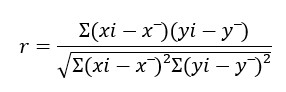
Pearson correlation analysis: To examine relationships between Adolescent Fertility Rate (AFR) and mortality indicators Maternal Mortality Ratio (MMR) and Neonatal Mortality Rate (NMR), Pearson correlation analysis was applied. This method measures the strength and direction of linear associations between two continuous variables, producing a correlation coefficient (r) ranging from -1 to 1, where values closer to 1 or -1 indicate stronger positive or negative relationships, respectively, and values near 0 suggest weak or no linear association [21]. The Pearson correlation coefficient was calculated using the formula:
where and are the individual data points for AFR and MMR/NMR, and and are their respective means. Significance was assessed at p<0.05.
linear regression: Simple linear regression was conducted to quantify the strength and direction of associations between indicators (e.g., AFR as the independent variable and MMR/NMR as dependent variables). This method models the relationship as a straight line, y=β0+β1x where y is the dependent variable, xis the independent variable, β0 is the intercept, and β1is the slope, indicating the change in y per unit change in x. The coefficient of determination (R2) was used to assess the proportion of variance explained by the model, with significance of the slope tested at p<0.05[21].
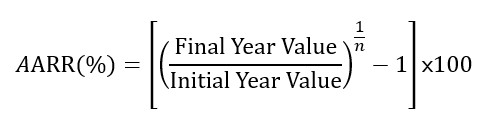
To evaluate progress toward Sustainable Development Goals (SDG) 3.1 (MMR reduction), 3.2 (NMR and Under-5 Child Mortality Rate [U5MR] reduction), and 3.7 (universal access to reproductive health, linked to AFR), the Annual Average Reduction Rate (AARR) was calculated using standard epidemiological formulas.
Where Start Value and End Value are the indicator values at the beginning and end of the period, and Number of Years is the time span[22,23].
Results and Discussion
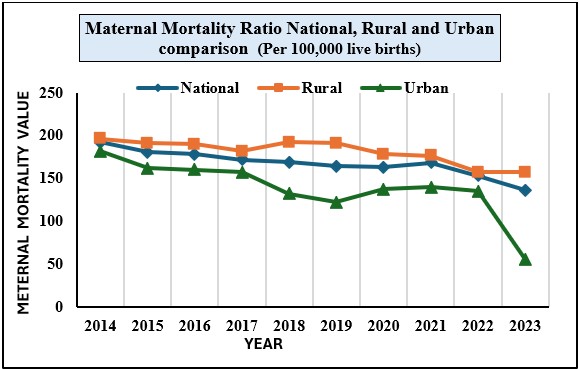
Maternal Mortality Ratio: The graph illustrates the Maternal Mortality Ratio (MMR) in Bangladesh from 2014 to 2023, revealing consistently higher rates in rural areas compared to national and urban averages. The national MMR declined steadily from 193 to 136 per 100,000 live births, while urban MMR dropped sharply after 2021, suggesting significant improvements in urban maternal health services or potential underreporting. Rural MMR remained elevated, underscoring a persistent rural-urban disparity.
Figure 1: Maternal Mortality Ratio in National, Urban, and Rural Settings (Per 100,000 Live Births)
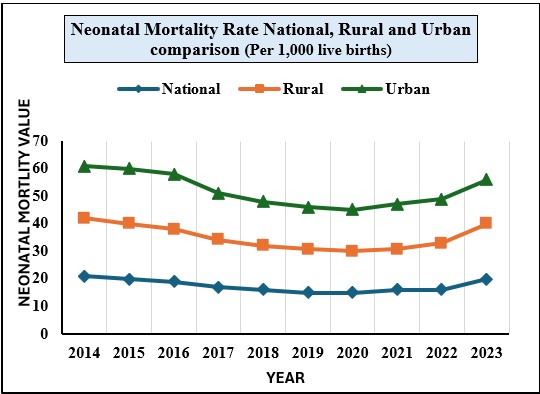
Neonatal Mortality Rate: The graph shows a consistent decline in neonatal mortality rates across all categories from 2014 to 2023. National rates fell from 21 to 20 per 1,000 live births, urban areas achieved the lowest rates (19 in 2014 to 16 in 2023), and rural areas lagged behind (21 to 17). The rural-urban gap persisted, with rural rates typically 3–5 points higher.
Figure 2: Neonatal Mortality Rate in National, Urban, and Rural Settings (Per 1000 Live Births)
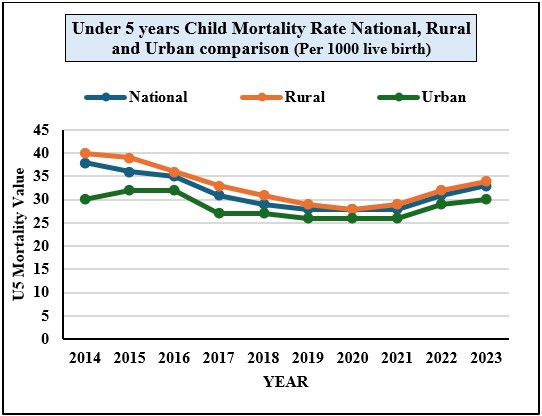
Under Five Child Mortality Rate: The under-5 mortality rate (U5MR) declined steadily from 38 to 28 deaths per 1,000 live births between 2014 and 2021. However, an uptick to 31 in 2022 and 33 in 2023 raises concerns, potentially linked to pandemic-related healthcare disruptions, infectious disease outbreaks, or gaps in postnatal care continuity.
Figure 3: Under Five Child Mortality Rate in National, Urban, and Rural Settings (Per 1000 Live Births)
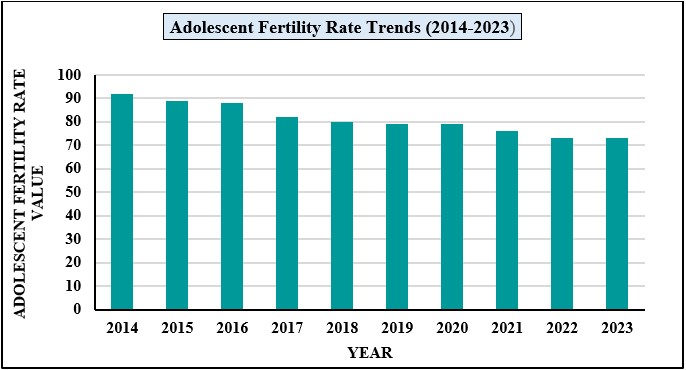
Adolescent Fertility Rate: The Adolescent Fertility Rate (AFR) decreased from 92 to 73 births per 1,000 women aged 15-19 between 2014 and 2023, marking a 20.6% reduction over the decade, driven by expanded access to sex education, contraception, policies promoting girls’ education, delayed marriage, and awareness campaigns on teen pregnancy risks.
Figure 4: Trends in Adolescent Fertility Rate for Women Aged 15-19 in Bangladesh (2014-2023)
Trends in MMR, AFR, U5MR, and NMR In Bangladesh with Linear Regression
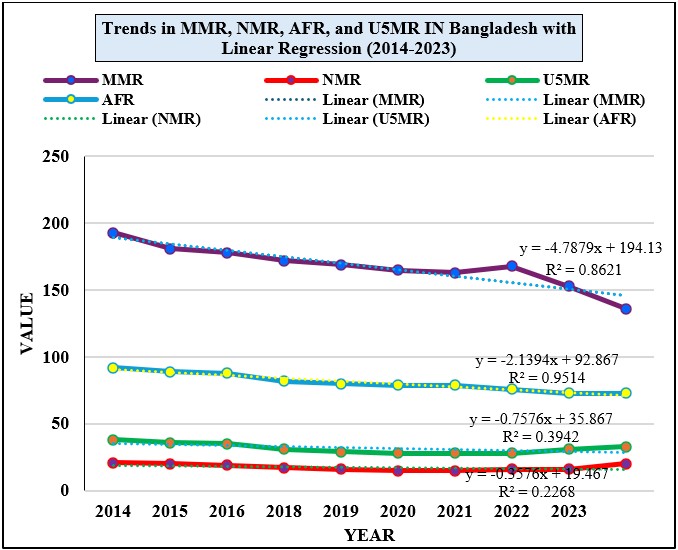
Maternal Mortality Ratio (MMR): Bangladesh’s MMR declined from 193 to 136 per 100,000 live births from 2014 to 2023. The linear regression equation is y=−4.7879x+194.13 with R2=0.8621, indicating a strong downward trend and an average reduction of 4.79 deaths per 100,000 live births annually.
Adolescent Fertility Rate (AFR): AFR decreased from 92 to 73 per 1,000 women aged 15-19 from 2014 to 2023. The linear regression equation is y=−2.1394x+92.867 withR2 =0.9514, showing a strong decline of 2.14 births per year.
Under-5 Mortality Rate (U5MR): U5MR declined from 38 to 33 per 1,000 live births from 2014 to 2023. The linear regression equation is y=−0.7576x+35.867 with R2 =0.3942, indicating a slow and inconsistent reduction of 0.76 deaths per year.
Neonatal Mortality Rate (NMR): NMR fluctuated between 18-20 per 1,000 live births from 2014 to 2023. The linear regression equation is y=−0.3576x+19.467 with R2=0.2268, showing a weak decline of 0.36 deaths per year.
Figure 5: Trends in MMR, NMR, AFR, and U5MR In Bangladesh with Linear Regression (2014-2023)
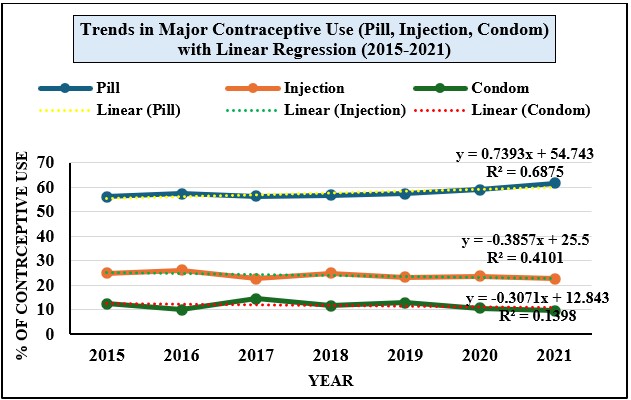
Major Contraceptive Use (Pill, Injection, Condom): Pill use increased by 0.74% annually (y=0.7393x+54.743), R2=0.6875, injectable use declined by 0.39% annually (y=−0.3857x+25.5), R2=0.4101), and condom use decreased inconsistently by 0.31% annually (y=−0.3071x+12.843, R2=0.1398)
Figure 6: Trends in Major Contraceptive Use (Pill, Injection, Condom) with Linear Regression (2015-2021)
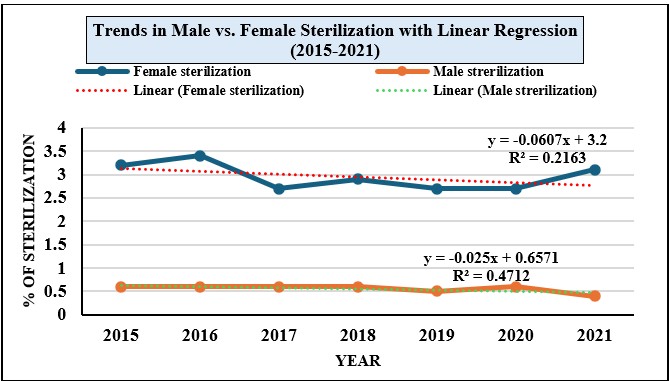
Figure 7: Trends in Male and Female sterilization percentage with Linear Regression (2015-2021)
Trends in Male and Female Sterilization: Female sterilization remained stable (2.7%-3.4%) from 2015 to 2021 (y=−0.0607x+3.2, R2 =0.2163), while male sterilization stayed below 1% (peaking at 0.6%) (y=−0.025x+0.6571, R2=0.4712).
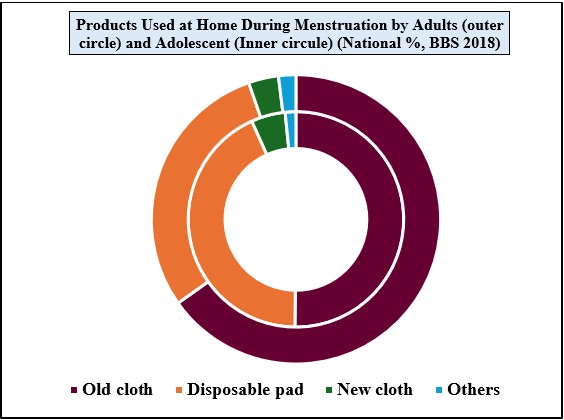
Products Used at Home During Menstruation by Age Group: The 2018 Bangladesh National Hygiene Survey showed 64% of adults and 50% of adolescents using old clothes, while 43% of adolescents and 29% of adults used disposable pads, with low use of new cloth and other alternatives.
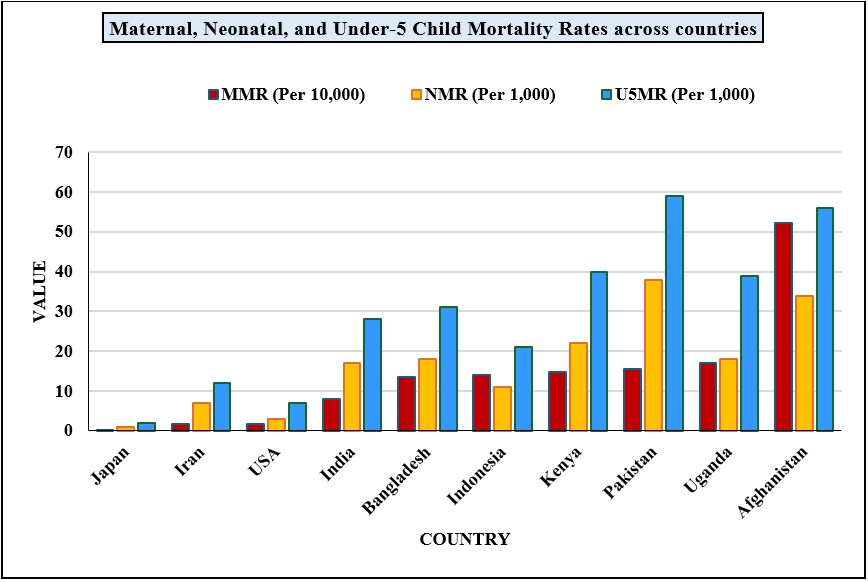
Footnote: To facilitate the combined visualization of three health parameters in a single bar chart, MMR values were scaled to a denominator of 10,000 instead of 100,000. This adjustment ensured proportional representation, preventing disproportionately elongated MMR bars relative to the other parameters.
Figure 8: Products Used at Home During Menstruation by Adults and Adolescent (National %, BBS 2018)
Comparative Analysis among different countries
Comparative Analysis of Maternal, Neonatal, and Under-5 Child Mortality: Bangladesh’s MMR (13.6 per 10,000), NMR (18 per 1,000), and U5MR (31 per 1,000) outperform Pakistan, Kenya, and Afghanistan but lag behind Japan and the USA.
Figure 9: Comparative Analysis of Maternal, Neonatal, and Under-5 Child Mortality Rates in Selected Countries
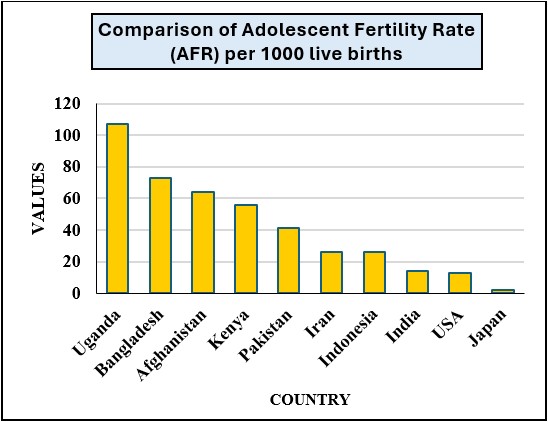
Comparative Analysis of Adolescent Fertility Rate: Bangladesh’s AFR (73) improved from 92 (2014) but remains high compared to India (14) and the USA (13).
Figure 10: Comparative Analysis of Adolescent Fertility Rate (AFR) per 1000 in Selected Countries
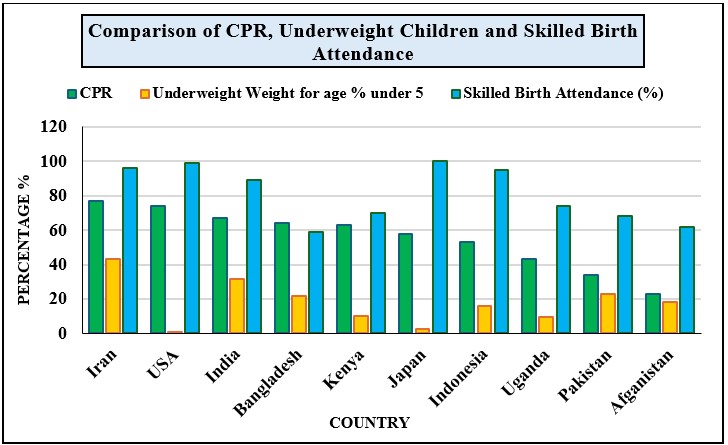
Figure 11: Comparison of CPR, Underweight Children and Skilled Birth Attendance.
Comparison of CPR, Underweight Children and Skilled Birth Attendance
Bangladesh exhibits a CPR of 64%, surpassing Pakistan (34%) and Uganda (43%), yet it falls short of Iran (77%) and India (67%). In terms of skilled birth attendance, Bangladesh’s rate of 59% is lower than that of India (89%), Iran (96%), Japan (100%), the USA (99%), and even Afghanistan (62%). Regarding underweight children under five, Bangladesh’s rate of 21.7% is more favorable than India’s (31.5%) but less so than Afghanistan’s (18.4%), and significantly higher than the USA (0.4%) and Japan (2.5%).
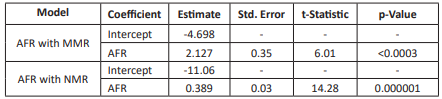
Pearson Correlation Coeficient: The Pearson correlation coefficient between adolescent fertility rate (AFR) and maternal mortality ratio (MMR) is r = 0.905, p = 0.0003, indicating a strong and statistically significant positive correlation. In contrast, the correlation between AFR and neonatal mortality rate (NMR) is r = 0.585, p = 0.076, reflecting a moderate positive correlation with marginal statistical significance.
Regression Analysis: The regression analysis revealed that AFR is a significant predictor of maternal and neonatal mortality. For maternal mortality, the regression equation is MMR = 3.62 + 2.03 × AFR (p< 0.001), indicating that each unit increase in AFR is associated with an approximate 2.03-unit increase in MMR. Similarly, for neonatal mortality, the equation is NMR = –2.54 + 0.261 × AFR (p = 0.002), suggesting that AFR also significantly predicts NMR, with each additional adolescent birth per 1,000 girls linked to a 0.261 increase in neonatal mortality per 1,000 live births. Both models demonstrate statistically significant relationships.3.12 Annual Average
Table 1: Regression Analysis Coefficients and Statistical Significance for Adolescent Fertility Rate (AFR) Relationships with Maternal Mortality Ratio (MMR) and Neonatal Mortality Rate (NMR)
Table 2: Progress and Required Efforts for Key Health Metrics in Achieving SDG Targets (2014–2030)
Footnote: MMR is per 100,000 live births; NMR and U5MR are per 1,000 live births; AFR is per 1,000 women aged 15-19. AARR is calculated using the compound annual reduction formula. Status definitions: 'On track' (required AARR ≤ current AARR), 'Need acceleration' (required AARR 0-2% higher), 'At risk' (2-5% higher), 'Off track' (>5% higher).
Reduction Rates (AARR) and Progress: Table 2 shows AARR for 2014-2023: MMR (-3.44%), NMR (-3.23%), U5MR (-2.75%), AFR (-2.28%). The required AARR for 2023-2030 are MMR (-9.05%), NMR (-5.63%), U5MR (-3.03%), AFR (-16.89%), with statuses: MMR (At risk), NMR (Need acceleration), U5MR (On track), AFR (Off track).
Discussion
The findings from this study highlight significant progress in Bangladesh’s women’s and children’s health from 2014 to 2023, yet substantial gaps remain in achieving SDG targets by 2030. The steady decline in Maternal Mortality Ratio (MMR) from 193 to 136 per 100,000 live births, with a strong linear trend (R2 = 0.8621), reflects the impact of improved access to skilled birth attendants and emergency obstetric care [1]. However, the rural-urban disparity and the required Annual Average Reduction Rate (AARR) of -9.05% nearly triple the current -3.44% indicate that current efforts are insufficient to meet SDG 3.1 [3]. The sharp urban MMR decline post-2021 suggests targeted urban interventions, but potential underreporting in urban areas warrants further validation [12].
Neonatal Mortality Rate (NMR) improvements, with a decline from 21 to 20 nationally and 19 to 16 in urban areas, are encouraging, yet the persistent rural gap (3–5 points higher) and weak linear trend (R2 = 0.2268) highlight inequities in neonatal care access [5]. The required AARR of -5.63% compared to -3.23% underscores the need for accelerated rural interventions, such as enhanced skilled delivery and newborn care. The Under-5 Mortality Rate (U5MR) decline from 38 to 33 per 1,000 live births, despite a concerning uptick in 2022-2023, reflects the success of immunization and nutrition programs [23]. R2 = 0.3942 and required AARR of -3.03% suggest that while progress is on track, resilience against disruptions like the COVID-19 pandemic is critical [1].
The Adolescent Fertility Rate (AFR) reduction from 92 to 73 per 1,000 women aged 15-19, with a strong linear trend (R2 = 0.9514), indicates effective reproductive health interventions, including education and contraception access [24]. However, the vast gap between the current AARR of -2.28% and the required -16.89% to reach the SDG target of 20 highlights a significant challenge.
The strong Pearson correlation (0.905, p = 0.0003) and regression coefficient (2.03, p < 0.001) between AFR and MMR, alongside a moderate NMR correlation (0.585, p = 0.076), confirm that adolescent fertility is a key predictor of maternal and neonatal outcomes [25]. This supports global evidence linking early pregnancies to increased mortality risks [1].
Contraceptive use trends reveal a preference for pills (AARR +0.74%), while declines in injectables (-0.39%) and condoms (-0.31%) suggest shifting preferences or access issues [11]. The stable female sterilization rate (2.7%-3.4%) and negligible male rate (<1%) reflect gender disparities, likely due to social stigma and limited male engagement [25]. Menstrual hygiene data showing 64% of adults and 50% of adolescents using old clothes underscore persistent hygiene gaps, though adolescent pad use (43%) indicates growing awareness [14] Expanding affordable options is vital for health and education outcomes [5,26].
Comparatively, Bangladesh outperforms Pakistan, Kenya, and Afghanistan in MMR, NMR, and U5MR but lags behind India, Japan, and the USA, reflecting infrastructure and equity gaps [3]. Its AFR (73) and CPR (64%) trail India (14, 67%) and the USA (13, high CPR), suggesting a need for youth-focused services and diverse contraceptive methods. The low skilled birth attendance (59%) and high underweight rate (21.7%) further highlight systemic challenges requiring rural investment and nutrition programs [1].
To bridge these gaps, Bangladesh should prioritize adolescent reproductive health, rural healthcare infrastructure, and equitable access to long-acting contraceptives and skilled birth attendance. Strengthening health systems against disruptions and promoting male involvement in family planning are essential to achieve SDG 3 targets by 2030 [25].
Conclusion
Between 2014 and 2023, Bangladesh achieved progress in maternal, neonatal, and adolescent health, yet current reduction rates remain insufficient to meet SDG 3 targets. Addressing adolescent fertility, rural-urban disparities, and limited male involvement in family planning is essential to accelerate equitable, sustainable improvements by 2030.
Recommendations
Accelerate adolescent reproductive health efforts: Expand access to youth-friendly services, including contraception and sexual health education. Enforce laws against early marriage and support school-based programs targeting adolescent girls (SDG 3.7, 5.3).
Strengthening maternal and neonatal health systems: Increase skilled birth attendance, especially in rural areas. Improve facility-based deliveries and postnatal care to reduce NMR and MMR.
Address contraceptive method mix and gender gaps: Promote long-acting reversible contraceptives (LARCs) alongside short-term methods. Engage men through awareness campaigns to increase male sterilization and condom use.
Enhance data systems and equity-based planning: Invest in disaggregated health data to monitor rural-urban gaps and ensure services reach underserved populations.
Improve menstrual hygiene and school retention: Provide affordable sanitary products and ensure menstrual education in schools to reduce adolescent fertility and school dropouts (SDG 4.7, 5.6).
Limitations: The study is constrained by multiple limitations, such as its reliance on secondary data, which limits oversight of variable quality and uniformity. Data for specific indicators, like contraceptive use, were insufficient for the years 2014 and 2022-2023. Moreover, indicators such as Contraceptive Prevalence Rate (CPR), Skilled Birth Attendance, and the proportion of underweight children under 5 (weight-for-age) lacked consistency in availability across countries for the same years. The lack of access to real-time or primary data further impedes the ability to reflect current trends or validate historical data accuracy. Finally, missing data for certain time periods could distort comparative evaluations and undermine the reliability of the results.
Conflict of Interest: The authors declare that there is no conflict of interest regarding the publication of this research.
Funding Statement: This research received no external funding. It was self-funded entirely by the authors.
Prior Publication/Presentation: This case report has not been previously published or presented in any form.
References
- World Health Organization. Women’s health. Geneva: WHO; 2023.
- World Health Organization. Millennium Development Goals (MDGs): Goal 5: Improve maternal health. Geneva: WHO; 2015.
- United Nations. Transforming our world: the 2030 agenda for sustainable development. New York: United Nations; 2015.
- World Health Organization. Trends in maternal mortality 2000 to 2017: estimates by WHO, UNICEF, UNFPA, World Bank Group and the United Nations Population Division. Geneva: WHO; 2019.
- United Nations Children’s Fund. State of the World’s Children 2023: For every child, vaccination. New York: UNICEF; 2023.
- United Nations. Sustainable development goals. New York: United Nations; 2016.
- World Health Organization. Child mortality (under 5 years). Geneva: WHO; 2022.
- Save the Children. State of the world's mothers: surviving the first day. London: Save the Children; 2013.
- United Nations Population Fund (UNFPA). State of world population 2022: seeing the unseen—The case for action in the neglected crisis of unintended pregnancy. New York: UNFPA; 2022.
- Guttmacher Institute. Adding it up: costs and benefits of contraceptive services. New York: Guttmacher Institute; 2012.
- Singh S, Darroch JE (2017). Adding it up: investing in contraception and maternal and newborn health. New York: Guttmacher Institute.
- National Institute of Population Research and Training (NIPORT), ICF. Bangladesh Demographic and Health Survey 2017–18. Dhaka (BD) and Rockville (MD): NIPORT and ICF; 2020.
- National Institute of Population Research and Training (NIPORT), Mitra and Associates, and ICF International. Bangladesh Demographic and Health Survey 2022 [Internet]. Dhaka, Bangladesh, and Rockville, Maryland, USA: NIPORT and ICF; 2023.
- Bangladesh Bureau of Statistics (BBS). Statistical Year Book Bangladesh. Dhaka: Statistics and Informatics Division, Ministry of Planning; 2014–2023.
- Fowler FJ (2013). Survey research methods. 5th ed. Thousand Oaks (CA): SAGE Publications.
- Cleveland WS. The elements of graphing data. Belmont (CA): Wadsworth Advanced Books and Software; 1994.
- Draper NR, Smith H (1998). Applied regression analysis. 3rd ed. New York: Wiley.
- Montgomery DC, Peck EA, Vining GG (2012). Introduction to linear regression analysis. 5th ed. Hoboken (NJ): Wiley.
- Rothman KJ, Greenland S, Lash TL (2012). Modern Epidemiology. 3rd ed. Philadelphia: Lippincott Williams & Wilkins.
- Walkenbach J (2015). Excel 2016 Bible: the comprehensive tutorial resource. Indianapolis (IN): Wiley.
- Healey JF (2014). Statistics: a tool for social research. 10th ed. Boston (MA): Cengage Learning;.
- Mukaka MM (2012). A guide to appropriate use of correlation coefficient in medical research. Malawi Med J;24(3):69–71.
- UN Inter-agency Group for Child Mortality Estimation (UN IGME). Levels and trends in child mortality: report 2020. New York: UNICEF; 2020.
- United Nations Population Fund, Ministry of Health and Family Welfare (Bangladesh). Family Planning in Bangladesh: Progress and Challenges 2022. Dhaka: UNFPA and MoHFW; 2022.
- United Nations Population Fund. State of World Population 2023: 8 Billion Lives, Infinite Possibilities: The Case for Rights and Choices. New York: UNFPA; 2023.
- Bhutta ZA, Das JK, Bahl R, Lawn JE, Salam RA, Paul VK, et al (2014). Can available interventions end preventable deaths in mothers, newborn babies, and stillbirths, and at what cost? Lancet;384(9940):347–70.