The Tip of the Iceberg: Cerebellar Stroke in a Young Patient with Dyspnoea

Bazo Medina Jessica M*, Castaño Guerra Rodolfo de Jesus, Ayala Hernández Eduardo, Alvarado Ávila J. Cesar, Muñoz Reyes Pamela M

Hospital General de México “Dr. Eduardo Liceaga”, México City.

*Corresponding author

Bazo Medina Jessica M, Hospital General de México “Dr. Eduardo Liceaga”, México City

Abstract

A stroke is an ischemic injury of brain tissue, usually secondary to the occlusion of blood flow in any branch, collateral or main, of the central nervous system circulation. The signs and symptoms of a stroke depend on the affected territory. Beyond anti-ischemic treatment, the care of a stroke patient requires a thorough analysis of the various possible causes, with laboratory and imaging studies aimed at an etiological diagnosis based on each patient's characteristics and clinical history. Cerebrovascular events in a young, healthy patient are rare, and given their morbidity at early age, identifying their origin is essential.

Clinical case

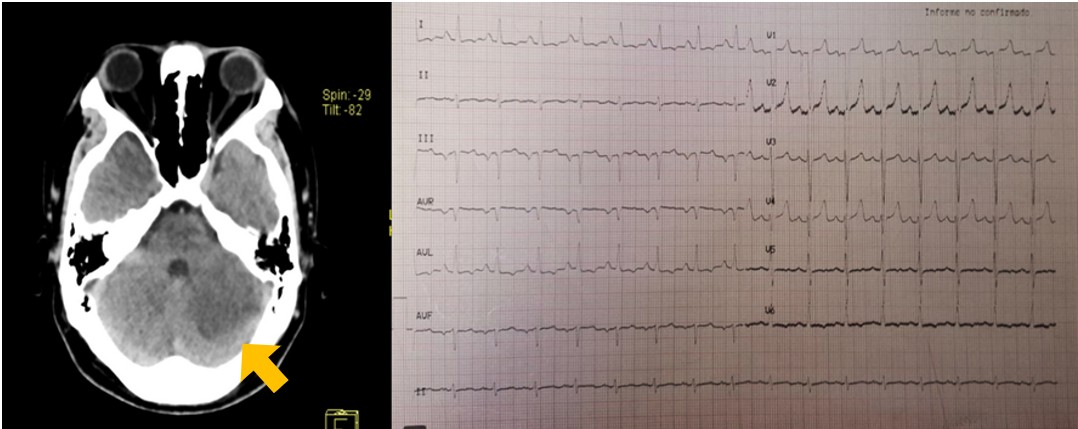
We present the case of a 28 year old male with no personal history of illness that developed sudden dyspnoea, paplpitations and lypothymia so he attended the Emergency Room. At initial evaluation pulse oximetry was normal and blood pressure was slightely high, so antihipertensive drug was prescribed and sent home. Upon awakening the following morning, the patient presented with vertigo, ataxia that limited gait, nausea, and vomiting, as well as a feeling of unsteadiness while sitting and dysarthria reported by a family member. He was admitted with uncontrolled hypertension and suspected cerebrovascular accident. A cranial CT scan revealed a left superior cerebellar infarction (Figure 1). He was hospitalized in the Neurology Department for further management.

Due to the patient's history of dyspnoea and impairment of functional class for 6 months, the physicians decided to call Cardiology for evaluation.

Figure 1: Left side: CT brain scan, an arrow shows the site of ictus at cerebellar hemisphere. Right side: 12-lead electrocardiogram of the patient, with sinus rhythm, axis deviated up to -30°, atrial enlargement and left ventricle hypertrophy, QRS measures 80ms.
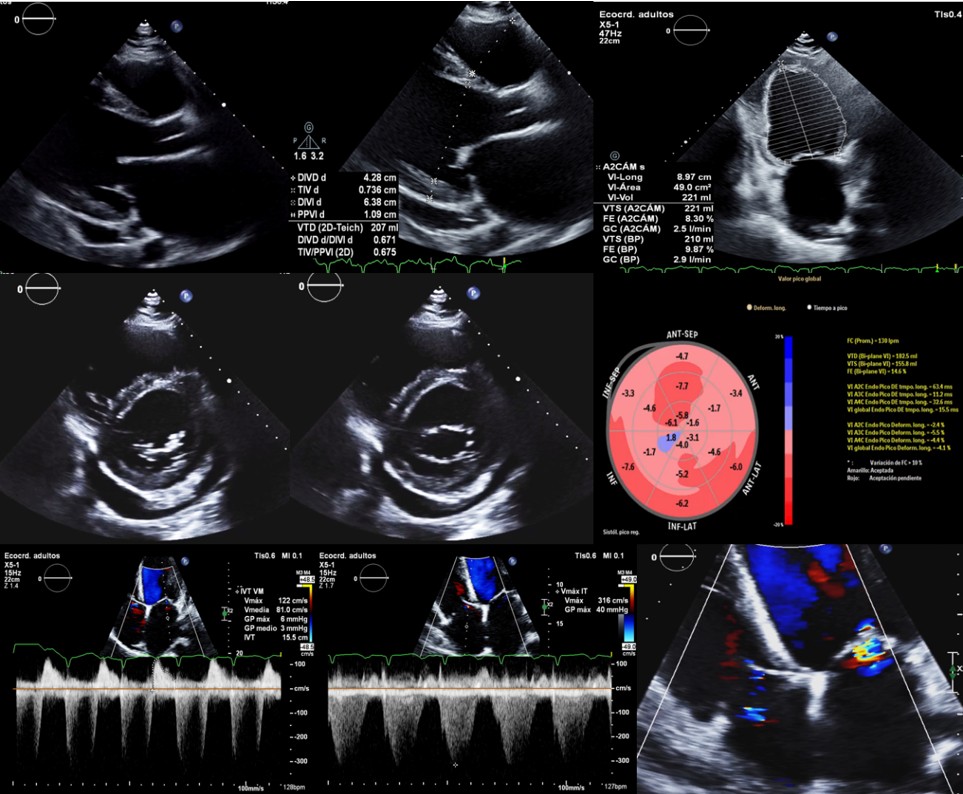
Figure 2: Transthoracic echocardiogram. Frozen images on PLAX, PSAX, and A2 showed significant enlargement of the left atrium, left ventricle, and right ventricle. The global longitudinal strain was -4.1% and the LVEF was 9%, with significant remodelling. Mitral and tricuspid regurgitation were observed in the context of dilated cardiomyopathy.
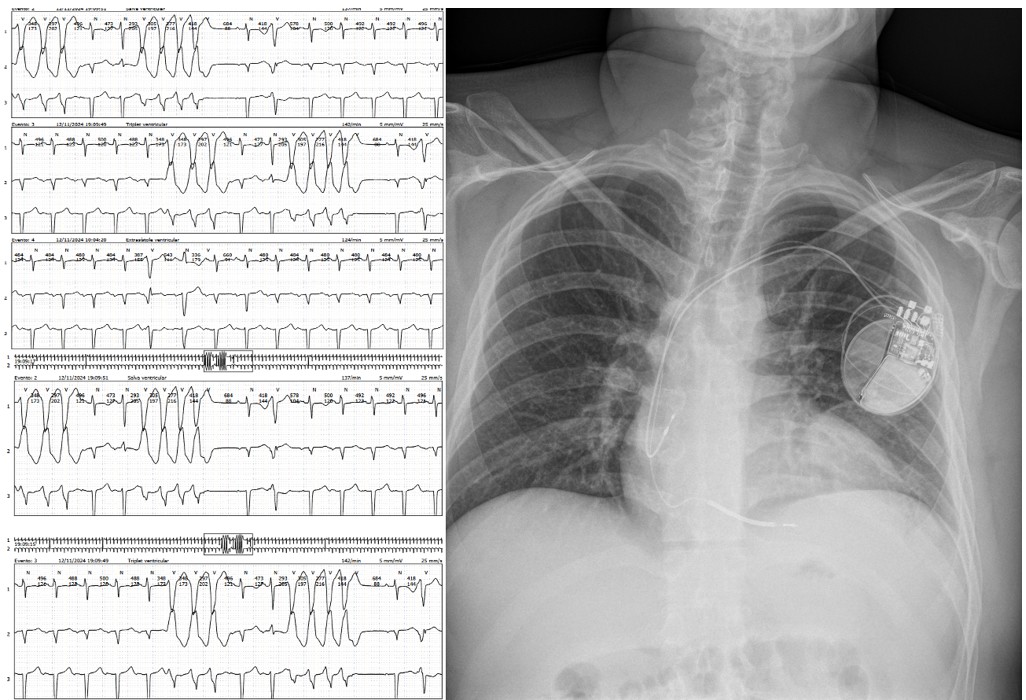
Figure 3: Non-sustained ventricular tachycardia was detected on Holter monitoring, and an implantable cardioverter-defibrillator was used to prevent sudden cardiac death.

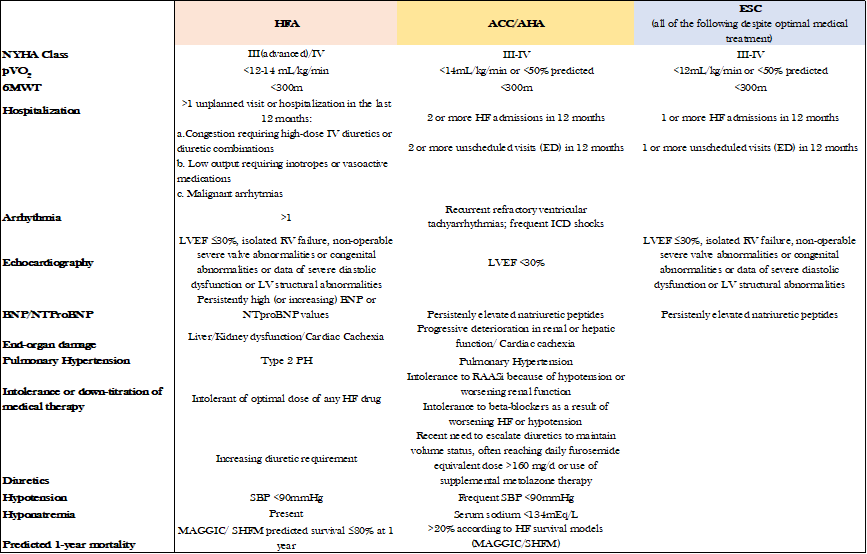
Table 1: Taken and modified from “Advanced heart failure: from definitions to therapeutic options”, by Garascia et al. (2023).
The physical examination most relevant findings were an irregular pulse, systemic venous congestion, an arrhythmic precordium with regurgitant mitral and tricuspid murmurs. However, the electrocardiogram showed sinus rhythm with evidence of left ventricular enlargement (Figure 1). A transthoracic echocardiogram was performed as a diagnostic approach, in which it was reported biventricular dilation, diastolic dysfunction, severely reduced systolic function (LVEF of 9% by biplane Simpson, GLS -4.1%, TAPSE of 12 mm, and CAF of 22%), in addition to a severely dilated left atrium, moderate functional mitral regurgitation, moderate tricuspid regurgitation, and mild aortic and pulmonary regurgitation (Figure 2). Also a Holter monitoring was ordered finding periods of sustained ventricular tachycardia.

Advanced heart failure, and in addition to statin treatment, he was started on guided medical therapy optimized to his tolerance. In the context of severely depressed EF and the arrhythmia identified during monitoring, an ICD was implanted (Figure 3). Also laboratory and imaging studies were performed in the etiological approach to dilated cardiomyopathy and as a heart transplant protocol.

Discussion

Although ischemic stroke has traditionally been considered a disease of older patients with vascular risk factors, approximately 1 in 10 adults with ischemic stroke is younger than 50 years old, with a greater incidence in females specially in pregnant and post-partum women with a 3 times bigger risk.1

About 10–20% of strokes in the young are the result of a large vessel occlusion yet secondary to atrial fibrillation or due to other pathologies including patent foramen ovale, endocarditis, cardiac tumors, or cardiomyopathies resulting in intracardiac thrombus. On the other hand, different causes from a cardiac origin may be, in order of frequency, vasculopathies such as cerebral artery dissection (25%) and reversible cerebral vasoconstriction syndrome (RCVS) (< 5%), genetic disorders, systemic cancer or infectious diseases.1

Since cerebellar functions are broadly known for participating in balance, coordination and gait, motor abnormalities caused by the diseased cerebellum are mainly ataxia and dysmetria, just like the patient in our case.

Regarding cerebellar infarcts, it has been described that due to the smaller caliber of arteries supplying the cerebellum, embolism is less common than in the cerebral hemisphere. Bland cerebellar infarctions cause cystic necrosis of the tissue, and the lesion is restricted to the supply territory of the involved artery. Necrosis affects the entire thickness of the cerebellar cortex though Golgi epithelial cells and their processes, the Bergmann glia, show some resistance to the necrotic process. 2

When a stroke is suspected based on impaired consciousness or neurologic findings, beyond the initial evaluation at emergency consisting of brain and vascular imaging, electrocardiogram, and basic blood tests including coagulation status, during inpatient management serology, echocardiography, ultrasound, and other studies should be completed to identify a possible etiology according to the TOAST classification system.1,3

Anyway young adults with stroke, even when matched for vascular risk factors, have a higher long-term risk of mortality, stroke, and myocardial infarction, than others their age1, and also risk of malignant ventricular arrhythmias is increased after a stroke and is associated with sudden cardiac death (SCD).4

Therefore, it is necessary to determine whether there is a causal relationship between the abnormal ECGs, arrhythmias, and acute stroke, or whether they are simply coincidences5. In our patient, the diagnosis of heart failure was made in a different way than usual, with the first noticeable sign being an electrical complication resulting from severely damaged myocardium.

Advanced heart failure is defined as a chronic and irreversible disease in which severely reduced contractile function is unable to maintain the body's economy, resulting in multiple compensatory mechanisms and systemic hypoperfusion due to low cardiac output. Diagnostic criteria can be review on Table 16,7,8,9. In this scenario, patients become refractory to traditional therapies, but even if there is still some degree of response, some specialized interventions and treatments should be considered individually for each patient.6

As mentioned, patients with heart failure and reduced ejection fraction (LVEF < 35%) are at an increased risk of sudden cardiac death due to ventricular arrhythmias. Trial as SCD-HEFT and DANISH study have shown benefit in reducing SCD risk in patients with non-ischaemic cardiomyopathy who have a LVEF ≤35% with NYHA functional classe II-III, even when compared against amiodarone as in the SCD-HFT7. Hence, implantable cardioverter defibrillators (ICDs) represent the only available option proven to prevent arrhythmic SCD, with a greatest risk in those who already suffered from previous ventricular arrhythmic events. According to ESC and AHA guidelines, in these patients an ICD is recommended with a class IA indication when a survival >1 year is expected7,8. But also, imaging findings and markers of increased arrhythmia risk can potentially be incorporated in the ICD decision making process such as genetic testing, circulating biomarkers, non-invasive electrophysiological testing between others.9

Conclusion

In the diagnostic approach to stroke, it is essential to rule out a cardiac origin. In patients with typical cardiovascular risk factors, the detection of a rhythm disturbance or structural defects that justify atherothrombosis in the nervous system is usually expected.

Nevertheless, in young patients, suspicion usually points primarily to congenital or acquired vascular disorders, autoimmune, haematological, or neoplastic diseases. However, an individualized patient assessment allows, as in this case, precise identification of the underlying cause, appropriate treatment, and the prevention of complications, such as the onset of new events. Our patient with advanced heart failure presented clinical manifestations suggestive of an arrhythmia before the cerebellar infarction, which was only the tip of the iceberg in the discovery of his pathology. He is currently on a heart transplant candidate protocol and has not experienced any additional complications.

Acknowledgement

Conflict of interest statement: The authors declare that they have no conflict of interest in the publication of this case report.

Funding: This case report was not funded by a grant or public or non-profit sources.

Prior Publication/Presentation: This case report has not been previously published or presented in any form.

IRB: IRB approval was not required for this case report. Data has been de-identified. Written consent was obtained from the patient for the use of health information including images.

Data Availability: Data from this case report may be made available upon reasonable request.

TOP