
Mild Encephalopathy With Reversible Splenial Lesion (Mers) In An Adult Patient With Atypical Presentation
De Sampaio Mauricio Emanuel, MD1*, Ziegler Gabriela Cecilia, MD2 , Grecco Martin Pablo, MD, Prof3, Povedano Guillermo Pablo, MD4
¹SHO - Neurology department -Churruca-Visca Medical Police Hospital, Buenos Aires, Argentina Teaching assistant in Neurosurgery in University of Buenos Aires
²Consultant - Movement disorders unit - Neurology department -ChurrucaVisca Medical Police Hospital, Buenos Aires, Argentina
³Consultant - Neurology department -Churruca-Visca Medical Police Hospital, Buenos Aires, Argentina
⁴Head of Neurology department -Churruca-Visca Medical Police Hospital, Buenos Aires, Argentina
*Corresponding author
De Sampaio Mauricio Emanuel, SHO - Neurology department -Churruca-Visca Medical Police Hospital, Buenos Aires, Argentina .Teaching assistant in Neurosurgery in University of Buenos Aires
DOI: 10.55920/JCRMHS.2025.10.001450

Figure 1: Brain MRI 1.5 Tesla showing a focal lesion with restriction on DWI (A) and signal drop on ADC (B), hyperintense on FLAIR sequence (C), involving the splenium of the corpus callosum at the midline.
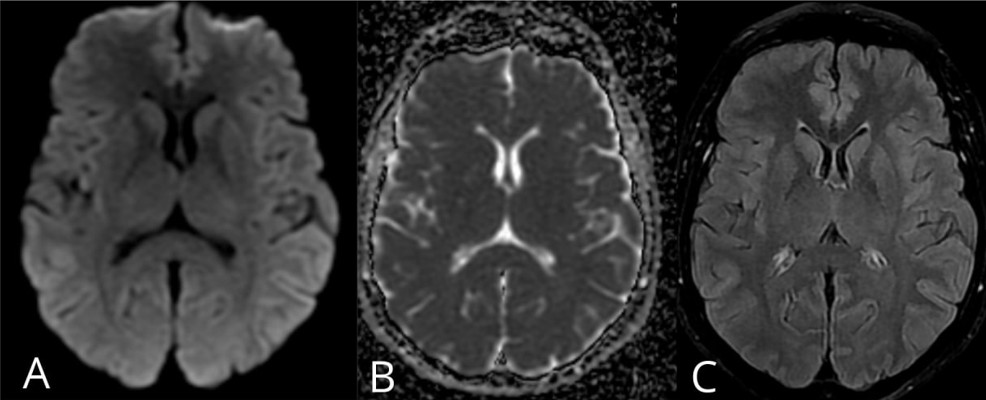
Figure 2: Brain MRI 1.5 Tesla, with previously illustrated sequences DWI (A), ADC (B), and FLAIR (C), where the mentioned lesion in the splenium of the corpus callosum is no longer evident.
Table 1: Diagnostic criteria for mild encephalopathy with reversible splenial lesion

A lumbar puncture was performed, showing crystal-clear cerebrospinal fluid with a protein level of 40.8 mg/dL, glucose 57 mg/dL (paired serum glucose of 94 mg/dL) and a white blood cell count of 0/mm³. Opening pressure was 12 cmH2O; cytological studies, cultures, flow cytometry, and PCR panels (viral, bacterial, and fungal - FilmArray© CSF) were normal. An EEG did not show any epileptiform activity.
A brain MRI spectroscopy revealed normal concentrations of evaluated metabolites. Additionally, a full-body PET-CT scan showed a small, non-specific 10 mm left pulmonary opacity without pathological uptake. The clinical and radiological presentation was interpreted as compatible with MERS. To confirm this diagnosis, a follow-up brain MRI was performed 30 days later, which showed no evidence of the previously described lesion. During further follow-up the patient did not experience any new symptoms (Image 2).