¹Former Prof of Neurology, Senior Consultant, Medicover Hospitals, Venkojipalem, Visakhapatnam, Andhrapradesh, India.
²Junior Resident Neurology
Prof. Dr. K. Satya Rao M. D; DM, 1Former Prof of Neurology, Senior Consultant, Medicover Hospitals, Venkojipalem, Visakhapatnam, Andhrapradesh, India.
Abstract
CSVT is a rare manifestation in sickle disease. It effects 5 people in 1 million each year and the risk is more in new born and takes up to 3 out of 3 lakh children up to the age of 18 yrs (1). Sickle cell disease children are more amenable than sickle cell traits. Increased clotting mechanism is responsible for this manifestation. We present here two cases who have presented with different clinical manifestations. Both of them are known cases of sickle cell disease with different presentation and here we discussed the mechanism and management. we lost one case with haemorrhagic infarct and gross midline shift and the other one recovered well and discharged with complete recovery.
Introduction
Sickle cell disease (SCD) is a rare entity commonly seen in south Africa, Saudi Arabia and India. It can be sickle cell disease or a trait. Sickle cell disease is the one which produces various manifestations and life span is less when compared to sickle cell trait. Various thrombo embolic manifestations are seen in SCD. Arterial strokes are more commonly seen along with the so called Moya Moya disease in the Brain. Venous sinus thrombosis is rarely seen.
We present here such a rare CSVT in SCD
(CSVT: Cerebral Sinus Venous Thrombosis, SCD: Sickle Cell Disease)
Case Vignette: A 15 yrs old girl a know case of SCD presented to E R with history of head ache, vomitings inability to speak and move the limbs. History of altered sensorium present for the past 2 days.
- Clinical examination showed
- Patient is Not following verbal commands.
- Dolls eye movement present
- Pupils Normal in size and reacting to light.
- No movement of limbs on painful stimuli
- No meningeal signs
- Evaluation of the patient showed:
- Routine haematological examination was normal
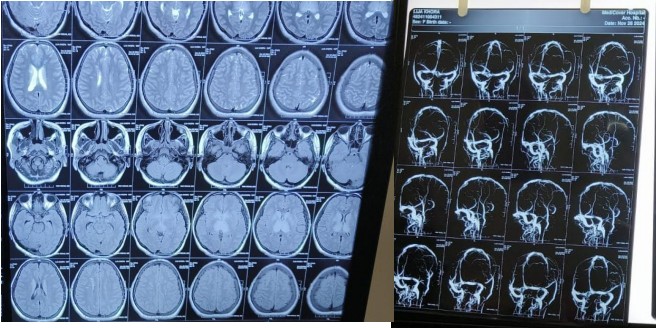
- MRI Brain showed: Hyper intense lesions in bil thalami, caudate nuclei, and Globus pallidi.
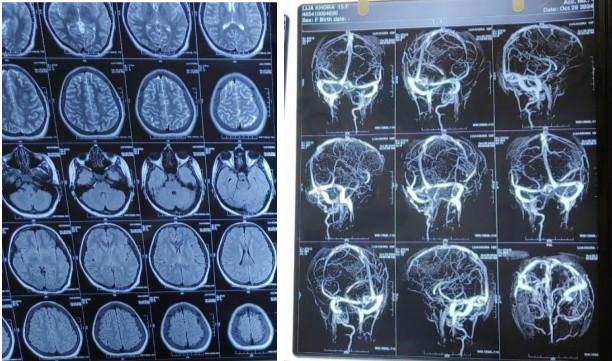
We suspected the possibility of CSVT of deep sinuses and Cerebral Venogram was done which showed sinus venous thrombosis of bilateral thalamo striate, internal cerebral and inferior saggital veins, where as superficial venous system was well seen.
Figure 1: At the time of Admission
Figure 2: After 1 month of treatment
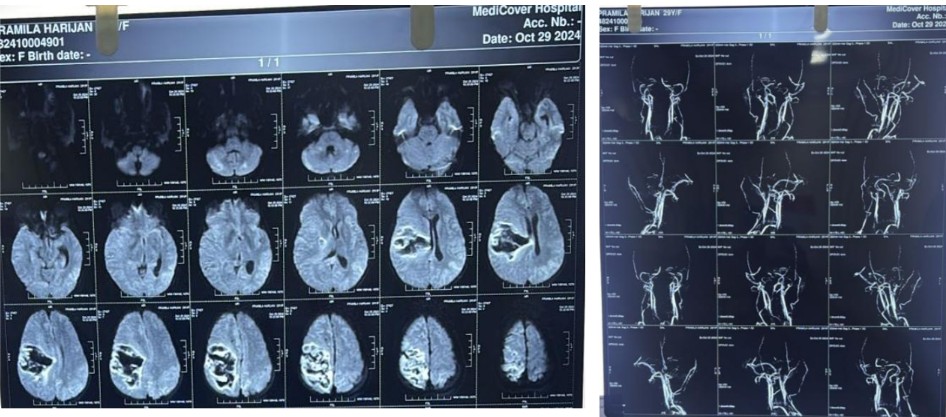
Figure 3: At the time of Presentation.
Her Hb electro phoresis was done which showed Sickle sell disease.
Thrombotic profile was done which showed normal result. No evidence of factor V laiden mutation in the report.
Other parameters were normal.
Treatment: Patient was started on Anticoagulants Inj Enoxaparin 0.4 mg twice daily.
- Anti epileptic drug Levetarscetam5 gms stat followed by 500 mg twice daily
- Inj Dexamethasone short course to reduce the cerebral oedema 8 mg thrice daily
- Folic acid 5 MG per day and Antibiotics.
- Review after regaining sensorium showed
- Aphasic
- Quadriplegic
- With bil extensor plantar response.
Over a period of 10 days the patient showed remarkable improvement.
She regained consciousness. Power improved to grade 4 and able to walk with support.
We could discharge the patient in walking condition at end of 2 weeks.
Follow up after 3 weeks showed complete resolution of the hyper intense lesions and reestablishment of circulation.
Case 2: Here is a 29 yrs old female who has delivered 3 days back by LSCS.
Presented with head ache, vomiting, Seizures and altered sensorium. She is a know case of SCD.
We suspected the possibility of CSVT and evaluated the case.
- Her clinical examination showed: Patient was in stupor.
- Pupils Normal in size and reacting to light
- Dolls eye movement present.
Left hemiplegia 0/5 with bil extensor plantar response and no meningeal signs.
Her MRI brain showed right fronto Parieto temporal region haemorrhagic infarct of size 8×5.5 × 5.1 cm with effacement of lateral ventricle prrilesionsl edema and mid line shift ..
Cerebral venogram showed superior saggital sinus and inferior saggital sinus thrombosis.
The prognosis was explained to the attendants and they left against medical advise.
We could not evaluate further. But the possible cause might be the SCD and the postpartum State.
Discussion
CSVT IS one of the rare manifestations of SCD.
Cerebral arterial thrombosis was well described particularly Middle cerebral anterior cerebral and internal carotid artery throbosis.
MOYA MOYA disease is one important presentation of SCD.
ARTERIAL thrombo embolic manifestations are described up to 7 to 33%percent.
Other manifestations like intra cerebral haemorrhage which is common in adults and sub arachnoid haemorrhage is also well described where as CSVT is rarely described.
The association of thrombophilia particularly facto V laden mutation is commonly seen.
The important factors which are responsible for thromboembolic manifestations in SCD are
- sickle cell itself which has increased adherence capability [2]
- The RBC in SCD patients have abnormal adhesive and procoagulant properties which produce Endothelial damage, secondary intimal proliferation and thrombosis.
- Liesner et al reported SCD patients have reduction of protein C and protein S and increased Thrombin grneration which results in thrombotic manifestation [3].
- There are studies which show association of facto V laden mutation and other prothrombituc factors which may increase thrombo embolic manifestations.
All these factors added together manifests various manifestations of vascular pathologies.
- CSVT was reported in 2 yrs to 25 yrs people.
- Management: Coming to the management view
- Continuous Folic acid therapy
- Hydroxy urea and
- Frequent Blood transfusions
- Reduce the stroke recurrence markedly.
Prevention of the Life Threatening Situations:
1) Frequent Trans cranial Doppler (TCD) study every 6 months in the age group of 2 to 16 yrs to identify any abnormality in the arterial system.
2) Frequent blood transfusion to prevent Vascular damage and Thrombo embolic manifestations.
Take home message: SCD Patients needs monitoring by the above investigations and if the TCD abnormality is identified the patient can be managed well and prevent life threatening situation.