
Traumatic Open Forearm Crush Injury in a Military Member Following an ATV accident
Emmanuel Tito1,2*, Richard Harrison1,3, Jason Moore1,4, Donald Anderson1,5 and Joseph McSherry1,6, Alejandro Stella1,7, and Aleksei Belousov1,8
¹United States Army Task Force Medical 396, Erbil, Iraq
²Johns Hopkins School of Medicine, Internal Medicine, Baltimore, Maryland
³Orlando Health Jewett Orthopedic Institute, Melbourne, FL
⁴Sentara Healthcare Systems, Harrisonburg, VA
⁵Central Illinois Radiological Associates, East Peoria, IL
⁶Marian University School of Anesthesia, Indianapolis, IN
⁷Saint Anthony Hospital, Denver, CO
⁸Florida State University College of Medicine, Tallahassee, FL
*Corresponding author
*Emmanuel Tito, United States Army Task Force Medical 396, Erbil, Iraq.
DOI: 10.55920/JCRMHS.2025.10.001438
Open and crushed forearm injuries represent a complex and relatively uncommon form of upper extremity trauma. Typically resulting from significant compressive forces generated by high-energy mechanisms, such as motor vehicle collisions, these injuries lead to extensive damage across multiple tissue types, including skin, soft tissues, vasculature, nerves, and bone [1]. Crush injuries stemming from traumatic events present substantial challenges within military medicine, frequently demanding swift and comprehensive management to optimize patient outcomes [2].
This report details the case of a 41-year-old active-duty service member who presented to a Role 3 hospital following an all-terrain vehicle (ATV) incident. The patient was working within a shipping container adjacent to an ATV secured by chains. When the chains failed, the ATV rolled over his left upper extremity (LUE), resulting in an obvious deformity noted at the scene. A contractor present at the scene moved the patient and transported him in a personal vehicle to the Role 3 hospital (field hospital) for further management.
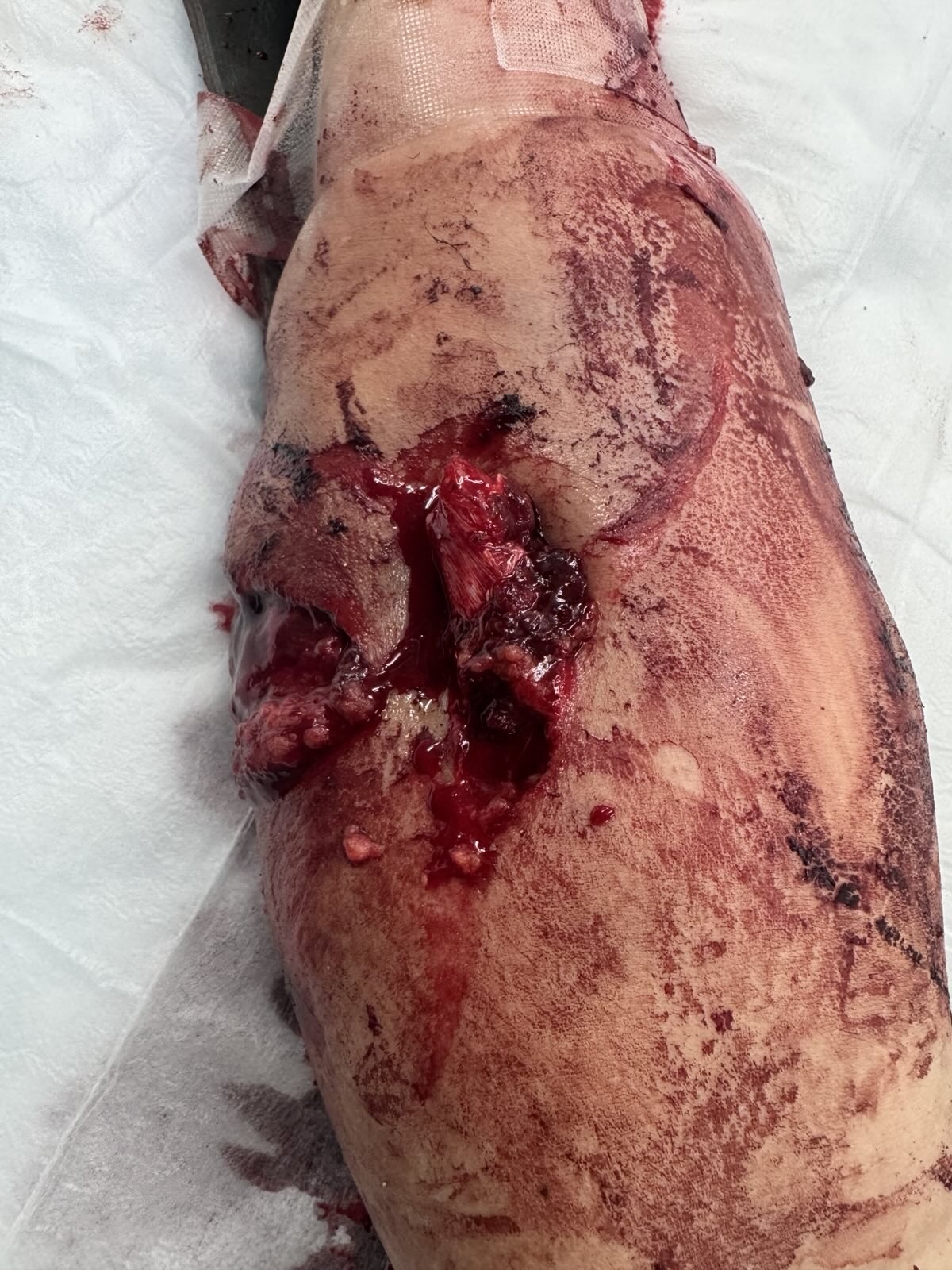
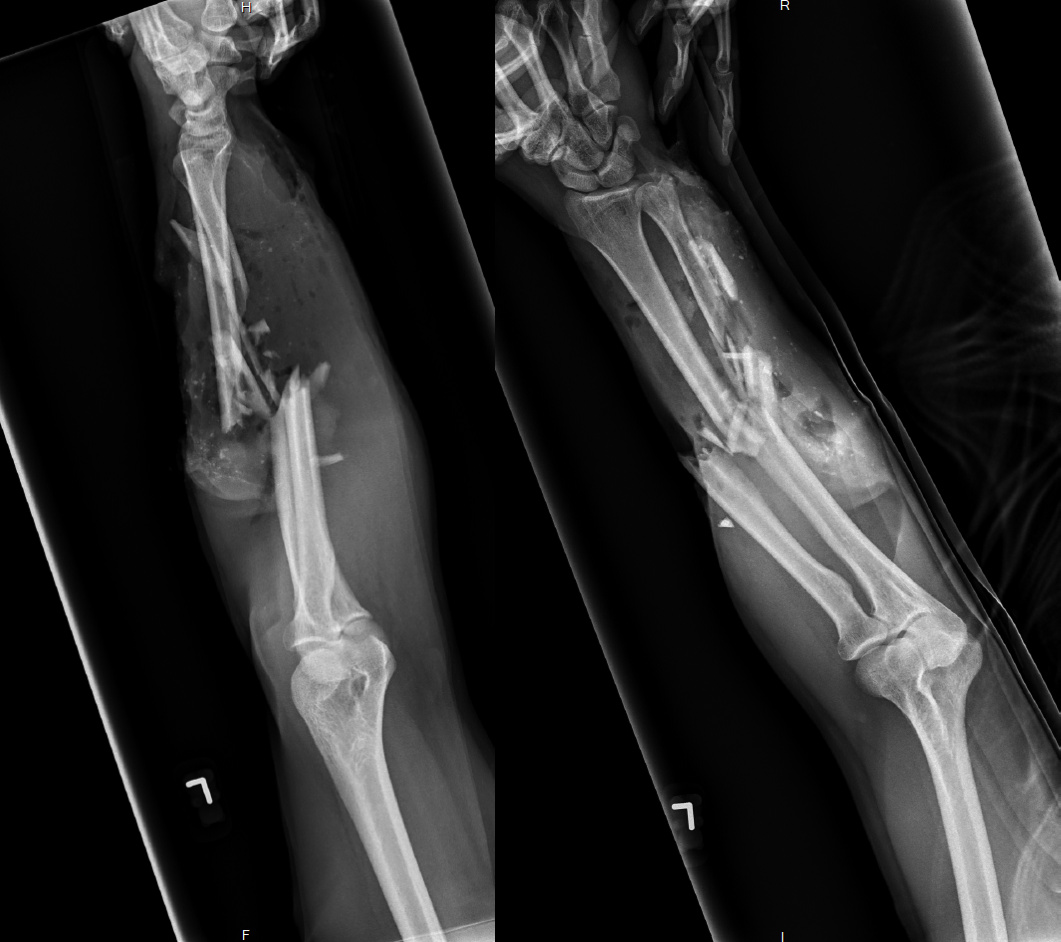
Upon presentation, Role 3 medic immediately applied a tourniquet in accordance with Tactical Combat Casualty Care guidelines. Initial vital signs were within normal limits, with the exception of an elevated blood pressure of 168/65 mmHg. Physical examination revealed a significant forearm wound with volar and dorsal degloving. An obvious deformity was noted with exposed fracture fragments (Figure 1). The hand was cool and pale. Radial and ulnar artery pulses were detectable via point-of-care Doppler evaluation. Initial laboratory studies, including complete blood count and comprehensive metabolic panel, were unremarkable upon admission. Radiographs revealed markedly comminuted and displaced mid-shaft fractures of the left radius and ulna, with bony fragments and debris in the adjacent soft tissue (Figure 2). Following the administration of intravenous cefazolin, the patient was emergently taken to the operating room (OR) for thorough debridement of skin, soft tissue, fascia, and bone associated with the fractures. Forearm volar and dorsal fasciotomies and a carpal tunnel release were performed. At the end of the case, an external fixator and wound vacuum-assisted closure (wound VAC) device were applied. The patient was subsequently admitted to the Mixed Care Unit for monitoring and was urgently evacuated to a Role 4 hospital (tertiary care center) the following day for definitive operative management.
Upon admission to the Role 4 hospital, the patient underwent further debridement of the LUE and open reduction internal fixation of the radius and ulna, followed by wound VAC dressing changes. Two weeks post-injury, a free anterolateral thigh flap reconstruction with Integra coverage was performed on the LUE. The patient tolerated these surgeries without complications. At the 1-month follow-up, he began strength training and, while not yet returned to duty, has recently initiated physical and occupational therapy.
In summary, this patient sustained a severe open forearm crush injury; however, limb preservation was achieved through prompt and coordinated surgical interventions. Definite fracture fixation with osteosynthesis plates was not performed at the Role 3 hospital due to limited resource availability and to mitigate the risks of nonunion and osteomyelitis in the setting of severe open injury. In the U.S military health system, fasciotomies are crucial in cases with increased compartment syndrome risk, particularly given the potential for prolonged transit times to higher echelon care facilities like Role 4 hospitals [3].
- Contributors ET, RH, JM, DA, JM, AS and AB drafted the manuscript. ET supervised and critically revised the manuscript. All authors were involved in the care of the patient mentioned in this report and approved the final version of the manuscript.
- Funding The authors have not declared a specific grant for this research from any funding agency in the public, commercial or not-for-profit sectors.
- Competing interests None declared.
- Provenance and peer review Not commissioned; internally peer reviewed.