
Paget’s Disease of the Nipple: A Case Report and Review of the Literature
El hachami.FZ ¹, Laaliaoui A ¹, EL karouani.D ¹, , Sakim.M ¹, Boufettal.H ², Mahdaoui. S², Samouh.N²
¹Gynecology obstetrics residents at CHU IBN ROCHD Casablanca, Morocco
²Professors of Gynecology obstetrics at : Gynecology Department C, CHU Ibn Rochd Casablanca, Morocco
*Corresponding author
*Laaliaoui A, Gynecology obstetrics residents at CHU IBN ROCHD Casablanca, Morocco
DOI: 10.55920/JCRMHS.2025.10.001433

Figure 1: On the right breast, there was an inflammatory placard on the nipple, ulcerated in places and topped with a crust.

Figure 2: Surcroît d’opacité pseudo-nodulaire, de tonalité hydrique rétro-mamelonnaire à limites imprécises comportant des microcalcifications segmentaires. Mammographie [(A) – incidence de profil; (B) – incidence de face].

Figure 3: Poorly limited, hypoechoic, heterogeneous pseudo nodule, with posterior attenuation, measuring 27 mm in long axis.
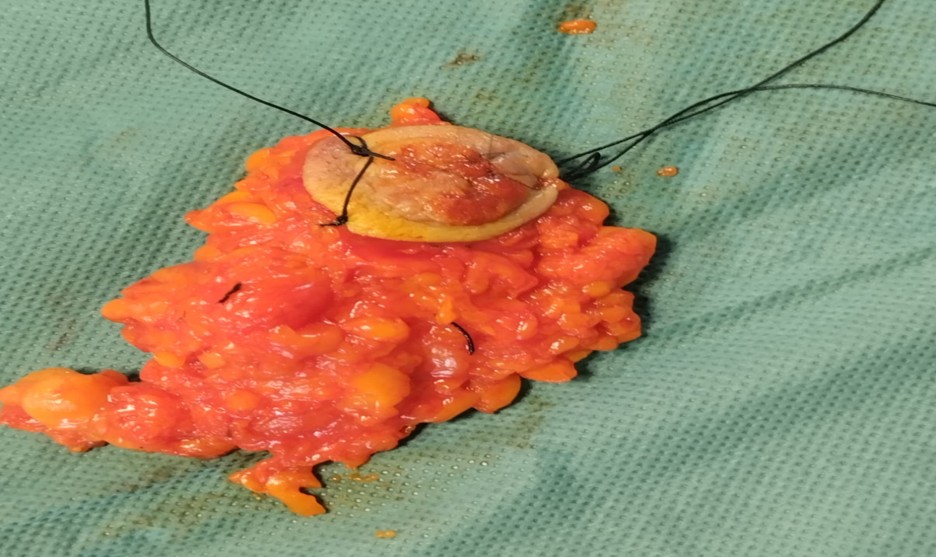
Figure 4: Surgical specimen of the right lumpectomy with removal of the areola-mammelon plate.

Figure 5: Intraepithelial tumour proliferation arranged in clusters within orthokeratotic squamous epithelium (under standard staining, x200).

Figure 6: Tumour cells [orange arrows] have abundant pale cytoplasm and large, irregularly outlined nuclei with a single nucleolus (under standard staining, x400).
The echomammographic examination was classified as BIRADS 5 on the right and 1 on the left (Figure 2 ,3).
A biopsy was performed after ultrasound detection, as well as a nipple biopsy. The results showed a high-grade intracanal carcinoma with the presence of a microfocus measuring less than 0.1 cm long of an infiltrating carcinoma of type NOS grade II of SBR, with Paget's disease of the nipple, Immunohistochemistry was not performed.
The extension work-up included abdominal ultrasound, chest X-ray, bone scan and CA15-3 assay, all of which were negative.
The patient underwent lumpectomy with removal of the nipple-areolar plate (pamectomy) and a sentinel lymph node (figure 4 ).
The final anatomopathological examination revealed the presence on the oriented pamectomy specimen of a cutaneous-mammary tumour, measuring 3.5 cm in length and occupying the entire mammelon. It was located 5 mm from the nearest internal excision site and corresponded to a pure intracanal carcinoma, of solid and cystic type, associated with significant carcinomatous pagetoid migration with excision sites in healthy areas, with no invasive component on the specimen ( figure (5 ,6) .
The patient was referred to the oncology department for further management.