
A Novel Application of Fish Skin Grafts in Pilonidal Wounds: Technical Description and Retrospective Case Series
Camryn FDBS1, Naved BS1, Leslie SMSN2, Ahsan Raza MD2
¹Research, Edward Via College of Osteopathic Medicine, Monroe, USA
²Department of Pharmaceutical Sciences, COMSATS Institute of Information Technology, Abbottabad 22060, Pakistan
*Corresponding author
*Camryn F. Daidone, Research, Edward Via College of Osteopathic Medicine, Monroe, USA
DOI: 10.55920/JCRMHS.2025.10.001422
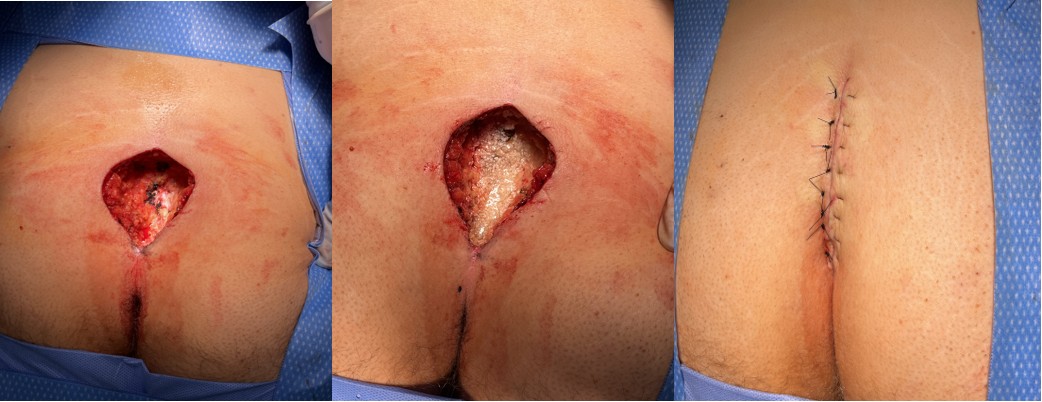
Figure 1: Intraoperative images of a pilonidal cyst removal. The images show the wound following dissection down to subcutaneous tissue and extraction of cyst (a), irrigation with saline and hydrogen peroxide and application of the Kerecis xenograft granules (b), and multi-layer closure with Karydakis flap to the right of midline (c)

Figure 2: Intraoperative images of a patient whose extensive disease required closure with a rotational Y flap. Once effectively debrided and irrigated, the wound was 12cm x 6cm x 3cm in dimension (a). The wound was tension-free and closed using a rotational Y flap and nylon sutures in a mattress fashion (b).

Figure 3: Images of wound healing and suture removal 21-28 days postoperatively. These images were of all of patients who underwent closure with a Karydakis flap. All patients had appropriate wound healing with no signs of infection or wound dehiscence. 3a and 3b show wounds prior to suture removal and 3c and 3d are images taken following removal of sutures.
Technical Description: After induction of anesthesia, administration of perioperative antibiotics, and a proper time-out was performed, the presacral perianal area was prepped and draped in the usual fashion. An elliptical incision was made around the area of pilonidal disease. We dissected down subcutaneous tissue and excised the disease in its entirety (Figure 1a). No contamination was made during the excision. Once all the disease was excised, the area was irrigated. Hemostasis was achieved and the wound was irrigated with normal saline and hydrogen peroxide. The deep tissue Kerecis™ xenograft granules were placed (Figure 1b). Note that there must be some blood in the wound to activate the granules. Once hemostasis was achieved the wound was closed in multiple layers with nylon sutures in a mattress fashion on the skin using a Karydakis flap (Figure 1c). Bacitracin and dressing were applied. The patient was awakened from anesthesia and taken to the post anesthesia in stable condition. Following the operation, patients were sent home with wound dressing and bacitracin ointment and scheduled for a follow up and suture removal 21 days postoperatively. Prior to discharge, patients were educated on proper wound dressing and were instructed to keep pressure off the wound.
Six out of seven of these patients underwent primary closure with Karydakis flaps slightly lateral to midline to reduce tension and improve blood flow to the healing wound. One patient had extensive disease that led to a large wound and a rotational Y flap was required to decrease tension. No tension was present once the flap was applied. Three layers of deep sutures were applied, and the wound was closed with sutures in a mattress fashion (Figure 2). All the patients followed 21-28 days postoperatively for assessment of wound healing and removal of the sutures (Figure 3).