A Questionnaire-based Study on the Knowledge of Lebanese Women Concerning Thrombophilia in Pregnant Women

Isabelle Basbouss-Serhal*Fatima Fayad

Department of Pathology and Molecular Laboratory, Siblin Governmental Hospital, Lebanon

*Corresponding author

*Isabelle Basbouss-Serhal, Department of Pathology and Molecular Laboratory, Siblin Governmental Hospital, Lebanon

Abstract

Thrombophilia disorders are linked to an increased risk of venous thromboembolism (VTE) during pregnancy. Antiphospholipid syndrome and factor V Leiden are examples of thrombophilia diseases that can be acquired or inherited. Both are related to VTE, although acquired diseases can raise the risk of arterial events. In Lebanon, this disease is rarely addressed in the field of research. A cross-sectional study on Lebanese women aged 18-40 found that hereditary thrombophilia increases the risk of venous thromboembolism and adverse pregnancy outcomes. The study, which included 1000 participants, aimed to highlight the association between thrombophilia and maternal venous thromboembolism and adverse pregnancy outcomes. The research, which took place between March and September 2024, highlighted a significant lack of information about this condition, with most women in Lebanon believing miscarriage is due to age. The study aims to provide recommendations for thrombophilia evaluation and encourage gynecologists to address this issue from the first pregnancy.

Keywords: Thrombophilia, Lebanon. Pregnant women, gynecologists, Awareness, diagnostic.

Introduction

Thrombophilia refers to inherited or acquired disorders that are known to be linked to coagulation system hyperactivity and/or the occurrence of thromboembolic events ( ‎1 ). Patients with thrombophilia are more likely to clot readily because they produce more coagulation factors (proteins) or fewer anticoagulants. Venous thromboembolism (VTE) is the third most common cardiovascular illness in Western nations and a serious global health concern ( ‎2 ). The hemostatic system becomes hypercoagulable during pregnancy, a condition that intensifies during the pregnancy and reaches its peak around term. Above all, there is a notable alteration in coagulation, with notable elevations in fibrinogen ( ‎3 ). There is also a rise in thrombin- antithrombin (TAT) complexes and prothrombin F1 and 2, which are indicators of thrombin production ( ‎4 ). Increases in placentally-derived plasminogen activator inhibitor type 2 (PAI-2) and plasminogen activator inhibitor type 1 (PAI-1) levels by five times, especially during the third trimester, also decrease fibrinolytic action ( ‎5 ). Venous thromboembolism (VTE), which is linked to an elevated risk of disease during pregnancy, continues to be a significant contributor to maternal morbidity and mortality ( ‎6 , ‎7 ). According to recent research, there may be a connection between thrombophilia and both VTE and unfavorable pregnancy outcomes such as fetal loss ( ‎7 , ‎8 ). An individual's family history of thromboembolic events, obesity, or surgery is necessary to identify pregnancies with an elevated risk of thromboembolic disease ( ‎10 ). Due to the lack of symptoms, the majority of thrombophilia individuals are unaware that they have the condition. The mechanism of thrombosis is the inability to control thrombin production or inactivate thrombin.

Many studies show an increased risk of thrombosis in Lebanon patients ( ‎8 , ‎9 , ‎10‎, 11 ). Some of these studies show that women are at high risk of being affected by thrombophilia ( ‎12 ). Today, many pregnant women in Lebanon suffer from increased maternal morbidity and mortality due to thrombophilia ( ‎12 ). Our study focuses on understanding the reasons why the percentage of high maternal morbidity due to thrombophilia among pregnant women has increased in Lebanon. The answer to this question lies in various major risk factors. One of the main factors may be the education of doctors on the indications and limitations of genetic tests, as well as genetic counselors, who are necessary to evaluate each clinical condition and interpret genetic and environmental risk factors. In our article, we will discuss the lack of education among Lebanese people regarding thrombophilia.

Methods

Participants: A cross-section study containing actionable information on the knowledge of Lebanese women aged 18 to 40 regarding thrombophilia during pregnancy. This study was carried out in March 2024 and September 2024 and involved 1000 patients. Our sample size is restricted to 1000 since it is already saturated; we recruited women from various districts of Lebanon. The questionnaire was introduced through advertising on the Google website. The study contained information on married or unmarried women, their knowledge about thrombophilia, and the importance of genetic testing to determine the presence of this condition. The document was included if the definition of the lack of education among Lebanese regarding thrombophilia during pregnancy increases maternal morbidity. After reading the study information sheet, every participant provided a signed (written) ICF. The confidentiality of all the participants was maintained throughout the study.

Data Collection: Data was collected using the answers of participants in this study. The study guide consisted of 18 main questions. This questionnaire is in the supplementary data. The first part of the questionnaire consisted of queries to collect socio-data about the participants. These included marital status, age, and educational level. A self-reported questionnaire “A questionnaire-based study on the knowledge of Lebanese women concerning thrombophilia in pregnant women” was included in the second part of the document and used to assess the participants’ level of adherence to the disease awareness. The knowledge of thrombophilia is composed of eleven questions about, “types” “symptoms”, “diagnostic tests” and “the importance of preventive tests of morbidity”. Study subjects indicated the frequency as (“always”, “sometimes”, “rarely “Yes” or “No”) for each question. The third part included the importance of raising awareness about the disease of thrombophilia in women. The Ministry of Health and Gynecology is responsible for this well-validated tool. This questionnaire was translated from English to Arabic; the back-translations technique validated the translations and involved three qualified independent translators.

Statistics: Google designed a database, and the participants' data were pseudo-anonymized. All women aged 18-40 were invited to participate, so no formal sample size calculation was performed.

Results

Demographic characteristics of the participants: After reading our study summary, 1000 patients fulfilled the inclusion requirements and consented to sign the permission form during the study period. 80% of the women were aged between 30 and 40 (Table 1). More than half of the women were married, and most had children. Of all the participants, 83% had obtained a bachelor's, master's, or Ph.D. degree ((Table 1). 64% percent of pregnant women did not have an abortion and 36% had an abortion without knowing the reason. The majority of participants concluded that the cause of abortion is a maternal age over 35 years (Table 1).

Table 1: Presents the different demographic characteristics of the participants.

Knowledge participant in thrombophilia in pregnancy

Of 1000 participants, 58% were concerned about thrombophilia, whereas 42% were aware of the disorder. The majority of women (51%) learn about thrombophilia followed by family, social media (41%), and the environment (8%). Lebanese women (59%) believe that the primary cause of thrombophilia is inherited. 23% is acquired, while a few women (18%) both reason. 48% of participants classified thrombophilia in women as a clinical illness, 23% as asymptomatic, and 29% as both. To assess women's knowledge of thrombophilia during pregnancy. We inquired about the most common symptoms of thrombophilia. Only 570 women out of 1,000 participants answered. The primary reaction is shown in graph (A).

Circular diagram A: A represents what respondents thought about the symptoms of thrombophilia illness in pregnant women.

Circular diagram A represents what respondents thought about the symptoms of thrombophilia illness in pregnant women. According to our study, only 9% of participants know pregnant women have thrombophilia. While 9% of women affirm that the diagnosis of this disease has little impact on outcome, 91% of women believe that early diagnosis improves maternal and neonatal outcomes. Forty percent of participants believe that the risk of thrombophilia is the same for the first and second pregnancies, 38 % sometimes, and 23% rarely think that the disease's effects are different.

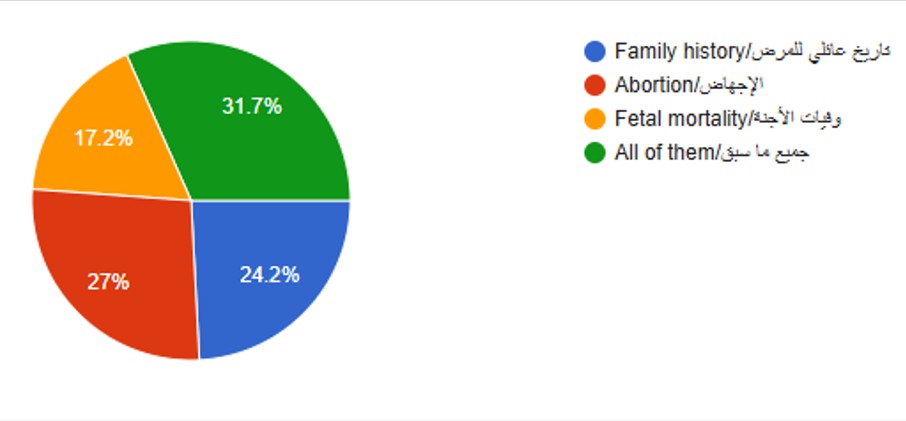
To validate the role gynecologists, play in diagnosing this disease, we have questioned the participants on this point. 23 percent believe that a thrombophilia test is necessary in the case of a genetic disease (24%), morbidity (17%), abortion (27%), or all of them (32%) (graph B). 53 percent say the gynecologist rarely requests a test related to this disease.

Circular diagram B: Shows participants opinions on whether the gynecologist should request a thrombophilia test.

Circular diagram B shows participants' opinions on whether the gynecologist should request a thrombophilia test. Gynecologist role In the latter section of our study, we questioned the women about including this test among the other tests they sought throughout their pregnancy. 16 percent do not demonstrate the significance of this test, whereas 86 percent do. In thrombophilia, 89% of individuals exhibit the need for formation.

Discussion

In the present study, the questionnaire on thrombophilia in pregnancy was validated with the examined population to ensure that the questionnaire was used correctly and accurately measured the desired outcomes with few errors or biases. The validation procedure must be carried out using a representative number of samples. In this study, 900 recruited patients correctly completed the questionnaire. This large number of completed questions ensured a decent validation procedure and showed that surveys on thrombophilia during pregnancy are powerful objective tools for monitoring expected outcomes. Thrombophilia accounts for approximately 50% of gestational VTEs ( ‎14 ). Recent research has suggested a relationship between thrombophilia and pregnancy loss, among other gestational vascular issues ( ‎14 ). However, there was insufficient evidence to recommend screening and treatment for these conditions during pregnancy ( ‎16 ). Our study has shown that a high percentage of women in Lebanon (42%) were not aware of thrombophilia. This percentage was associated with women who have a higher level of education. (Bachelor, Master, and Ph.D.). Moreover, 51% of women somewhat familiar with thrombophilia due to family cases correctly answered questions related to these diseases. Our results confirmed our hypothesis that women don’t have strong information about thrombophilia and the source is a family case. From here, it must be interesting to do more formation. The main participants showed that the disease of thrombophilia is either hereditary or acquired. However, thrombophilia disorders are either acquired, as in antiphospholipid syndrome, or hereditary, as in factor V Leiden ( ‎15 ). A high percentage of participants believe that the main conditions causing miscarriages in women were hereditary, confirming the lack of knowledge about thrombophilia. Moreover, the participants defined the disease of thrombophilia as a symptomatic disease. Tsikouras et al have shown that thrombophilia in pregnant women can be an asymptomatic disease. Another question in our study also examines the participants' information regarding the different symptoms present in pregnant women with thrombophilia. The main ones were choosing the swollen veins, heart palpitations, anxiety, and chest pain. However, the typical symptoms are unilateral leg pain and swelling, chest pain, anxiety, dizziness, and heart palpitations ( ‎15 ). This lack of information related to this disease is justified by the few studies on thrombophilia in Lebanon, as of now, we have few publications related to thrombophilia in patients who have studied the different factors introducing thrombophilia ( ‎17 ). As we know, there is little research related to thrombophilia in pregnant women in Lebanon ( ‎12 ). This may be due to a lack of funding and also to the disconnection between the gynecologist and the research laboratory. Limited studies showed a high recurrence risk (66-83%) in successive pregnancies among multiparous women with thrombophilia and severe pregnancy issues, with varying types of complications between pregnancies ( ‎20 ). In Lebanon, 2 of 100 healthy Lebanese women with no history of pregnancy loss and with at least 2 successful pregnancies ( ‎12 ). Early detection of pregnant women with risk factors for thrombosis, even without clinical symptoms, was crucial to reduce the incidence of this condition ( ‎19 ). The best treatment for asymptomatic pregnant women with hereditary thrombophilia was unknown and was only detected in cases of difficulties during pregnancy, such as recurrent miscarriages or hypertension ( ‎10 ). The questionnaire discussed this point by asking the participants if the gynecologist had requested the thrombophilia test and the importance of incorporating this test into various pregnancy examinations. The result showed that a high percentage of women confirmed that few gynecologists requested the test related to this condition and that they generally asked for it after the loss of a baby during the second pregnancy. However, potential indications include screening the general population, screening populations potentially enriched for thrombophilia, populations at increased risk of thrombosis, and testing symptomatic patients with incidental or recurrent thrombosis ( ‎21 ). These indications were controversial and should be considered in the context of the clinical presentation, except for general population screening ( ‎21 ). The clinical approach to thromboembolism was the same for pregnant women with and without thrombophilia. Based on the family history, clinical symptoms should be evaluated using simple, reliable, and affordable laboratory tests, such as prothrombin time and activated partial thromboplastin time. Early diagnosis and adequate prophylaxis against thrombosis lead to better maternal and perinatal outcomes ( ‎21 ). From this study, we can suggest that adding some sample tests can help gynecologists detect the presence of thrombophilia in pregnant women especially in women with no family case or asymptomatic. In Lebanon, numerous complications can limit gynecologists from requesting this type of test, such as the education of doctors on the indications and limitations of genetic tests, with the main developed laboratory located in the capital, and the most significant reason being the cost of these tests. Finally, our study shows a considerable lack of knowledge in Lebanon about thrombophilia; this is an important issue that needs to be addressed through extensive training and cooperation with the Ministry of Health.

Limitations: The current study relies on self-reported habits and beliefs, which have not been objectively reviewed and may be subject to memory biases and social desirability. Moreover, the current study's design prevented the use of other methodologies to validate health tools, such as concurrent and predictive validity.

Conclusion

Thrombophilia is still a pathological disease induced by a variety of risk factors. Thrombophilia is characterized by a prolonged hypercoagulable state and a proclivity for thrombosis. The questionnaire on thrombophilia in pregnant women provides adequate tools to provide knowledge about this disease in Lebanon.

Supplementary material: Supplementary materials associated with this article can be found in the online version a Thrombophilia in pregnancy Lebanese women – Google

Acknowledgments: The authors would like to thank the participants for their time and efforts in the present study.

References

  1.  Rosendaal F. R. (1999). Venous thrombosis: a multicausal disease. Lancet (London, England), 353(9159), 1167–1173.
  2. Cohen A. T; Agnelli G; Anderson F. A; Arcelus J. I; Bergqvist D; (2007). VTE Impact Assessment Group in Europe (VITAE) (2007). Venous thromboembolism (VTE) in Europe. The number of VTE events and associated morbidity and mortality. Thrombosis and haemostasis, 98(4), 756–764.
  3. Szecsi P. B; Jørgensen M; Klajnbard, A; Andersen M. R; Colov N. P; (2010). Haemostatic reference intervals in pregnancy. Thrombosis and haemostasis, 103(4), 718–727.
  4. Sarig G; Klil-Drori A. J; Chap-Marshak D; Brenner B; Drugan A. (2011). Activation of coagulation in amniotic fluid during normal human pregnancy. Thrombosis research, 128(5), 490–495.
  5. McLean K. C; Bernstein I. M; Brummel-Ziedins K. E. (2012). Tissue factor- dependent thrombin generation across pregnancy. American journal of obstetrics and gynecology, 207(2), 135.e1–135.e1356.
  6. Bates S. M. (2007). Management of pregnant women with thrombophilia or a history of venous thromboembolism. Hematology. American Society of Hematology. Education Program, 143–150.
  7. Bukhari S; Fatima S; Barakat A.F; Fogerty A.E; Weinberg I;  (2022). Venous thromboembolism during pregnancy and postpartum period. European journal of internal medicine, 97, 8–17.
  8. Alsheef M.A; Alabbad A. M; Albassam R.A; Alarfaj R. M; Zaidi A. R. Z; (2020). Pregnancy and Venous Thromboembolism: Risk Factors, Trends, Management, and Mortality. BioMed research international 4071892.
  9. Assaf N; Chamseddine F; Taher M; Mahfouz R; (2021). Prevalence of thrombophilia-associated mutations and their clinical significance in a large cohort of Lebanese patients, Meta Gene,Volume 29, 2021, 100936, ISSN 2214-5400,
  10. Tsikouras P; von Tempelhoff G. F; Rath W ; (2017). Epidemiologie, Risikofaktoren und Risikostratifizierung venöser Thromboembolien (VTE) in Schwangerschaft und Wochenbett [Epidemiology, Risk Factors and Risk Stratification of Venous Thromboembolism in Pregnancy and the Puerperium]. Zeitschrift fur Geburtshilfe und Neonatologie, 221(4), 161–174.
  11. Khalife S; Bissar-Tadmouri N; (2020). Inherited Thrombophilia in a Lebanese Family of Four Generations: A Case Report of Recurrent Miscarriage. Vascular health and risk management, 16, 53–56.
  12. Muwakkit S. A ; Majdalani M; Hourani R; Mahfouz R. A; Otrock Z. K; (2011). Inherited thrombophilia in childhood arterial stroke: data from Lebanon. Pediatric neurology, 45(3), 155–158.
  13. Otrock Z. K; Taher A.T; Shamseddeen W. A; Mahfouz R. A. (2008). Thrombophilic risk factors among 16 Lebanese patients with cerebral venous and sinus thrombosis. Journal of thrombosis and thrombolysis, 26(1), 41–43.
  14. American College of Obstetricians and Gynecologists Committee on Practice Bulletins–Obstetrics (2018). ACOG Practice Bulletin No. 197: Inherited Thrombophilias in Pregnancy. Obstetrics and Gynecology, 132(1), e18–e34.
  15. Khalife S; Geitani R. (2022). Association of Inherited Thrombophilia with Recurrent Pregnancy Loss in A Population of Lebanese Women: A Case Control Study.  International journal of fertility & sterility, 16(3), 247–251.
  16. D&#39 Uva M; Micco P. D; Strina I; Placido G. D. (2010). Recurrent pregnancy loss and thrombophilia. Journal of clinical medicine research, 2(1), 18–22.
  17. Battinelli E. M; Bauer K. A. (2011). Thrombophilias in pregnancy. Hematology/oncology clinics of North America, 25(2), 323–viii.
  18. Dresang L.T; Fontaine P; Leeman L; King V. J. (2008). Venous thromboembolism during pregnancy. American family physician, 77(12), 1709–1716.
  19. Khalife S; Bissar-Tadmouri N. (2020). Inherited Thrombophilia in a Lebanese Family of Four Generations: A Case Report of Recurrent Miscarriage. Vascular health and risk management, 16, 53–56.
  20. Kupferminc M. J. (2003). Thrombophilia and pregnancy.Reproductive biology and endocrinology: RB&E, 1, 111.
  21. Heit J. A. (2007). Thrombophilia: common questions on laboratory assessment and management. Hematology. American Society of Hematology. Education Program, 127–135.
TOP