Zimin wang*
Department of Orthopedics, Luohe Central Hospital, Luohe 462000, Henan, China
*Corresponding author
*Zimin wang, Department of Orthopedics, Luohe Central Hospital, Luohe 462000, Henan, China
Abstract
Pelvic fractures, often resulting from high-energy trauma, are associated with high mortality and significant complications. Traditional methods for treating anterior pelvic ring fractures, such as the InFix system, provide excellent biomechanical stability but involve complex procedures. This case report introduces the application of the spinal minimally invasive system for anterior pelvic ring fixation in a patient with a Tile C1 pelvic fracture. A 60-year-old female patient, admitted following a motor vehicle accident, presented with a Tile C1-type pelvic fracture. The surgical team opted for a minimally invasive approach using the spinal screw-rod system, which provided both simplicity in operation and reduced surgical time. Postoperative outcomes indicated successful fixation with no complications, and the patient regained preoperative functional status within two months. This report demonstrates that the spinal minimally invasive system is a viable alternative for anterior pelvic ring fixation, offering advantages in terms of reduced surgical trauma, faster recovery, and fewer complications, particularly for elderly and high-risk patients. Further studies and innovations, including hybrid approaches combining the advantages of both InFix and spinal systems, are warranted to optimize treatment for complex pelvic fractures.
Keywords: Pelvic fracture, minimally invasive surgery, spinal instrumentation, anterior pelvic ring fixation, Tile C1 fracture, surgical technique.
Background
Pelvic fractures are often caused by high-energy trauma and are associated with high mortality, disability rates, and significant complications1. Traditional methods for treating pelvic anterior ring fractures, such as the InFix system, have shown excellent biomechanical stability2. However, the InFix system’s operative procedure remains relatively complex and requires further simplification. In an effort to improve the operational simplicity of InFix, we applied the spinal minimally invasive screw-rod system for anterior pelvic ring fixation in a case of Tile C1 pelvic fracture. Rarely reported is the application of the spine minimally invasive system for fixing the anterior pelvic ring3.This case demonstrates that the spinal minimally invasive screw-rod system not only offers a minimally invasive approach and simple operation but also effectively shortens the surgical time. Here, we report our findings and further discuss the advantages and limitations of this system.
Case Presentation
A 60-year-old female patient was admitted to the hospital following a motor vehicle accident. Initial examinations revealed a Tile C1-type pelvic fracture involving the anterior pelvic ring, with right iliac wing and sacroiliac joint instability. The patient presented with pain and difficulty in movement but did not exhibit any signs of visceral injury. Imaging studies, including CT and X-rays, confirmed the diagnosis of a Tile C 1 pelvic fracture. Considering the patient's advanced age, high fracture severity, and the potential for complications, the surgical team decided to employ a minimally invasive surgical approach using the spinal minimally invasive screw-rod system for anterior ring stabilization.
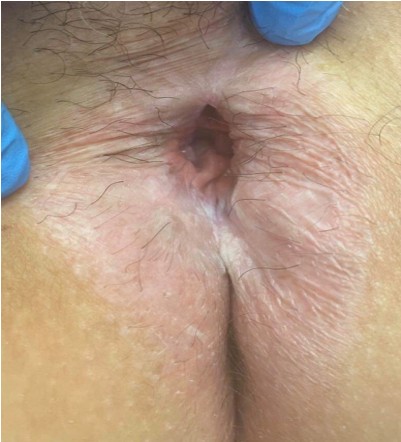
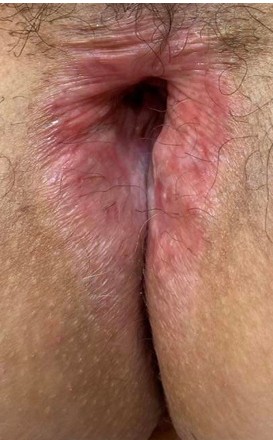
Figure 1: Macroscopic view of the lesion before plasmotherapy. External genital organs were post-simple vulvectomy state, with well circumscribed hyperemic areas, lo-cated laterally around the vaginal entrance. Against this background, prominating leucoplakic areas with spread to the perineum are noted.
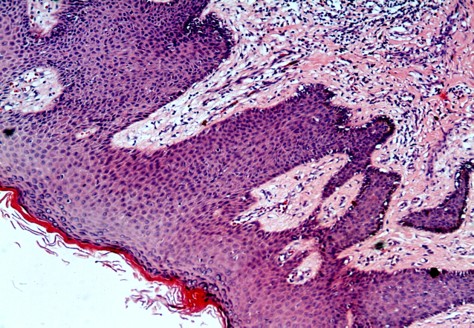
Figure 2: Squamous hyperplasia - mild hyperkeratosis, acanthosis, thickened and elongat-ed epidermal papillae that merge in places.
The patient was consulted with a dermatologist to rule out skin disease. The patient's complete blood count was within reference limits. Microbiological examination of vaginal fluid showed normal vaginal flora for the age.
A biopsy was taken from the specimen located in the vulvar area around the vaginal entrance to rule out a malignant component. The histological result was as follows: „Epidermis with hyperkeratosis, parakeratosis and acanthosis - squamous hyperplasia“ (fig. 2).
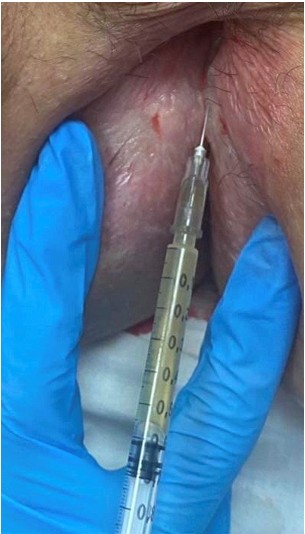
Figure 3: Performance of PRP - therapy of the external genitalia.
After the informed consent was discussed and signed by the patient, the first PRP-therapy of the vulva was performed on 21.03.2024 at University hospital “Saint Marina” – Pleven, Bulgaria, with local anesthesia with lidocaine (fig. 3).
Figure 4: Appearance of the lesion after the first PRP-therapy.
Autologous platelet-rich plasma is obtained as follows: 10 ml of autologous venous blood is drawn. The thickness of the needle should be at least 1.1 mm in diameter. The blood is placed in a special tube with a separating gel and with 2.5 ml of Acid Citrate A Anticoagulant solution. The tubes are moved to a centrifuge set at 3200 rpm for 5 minutes. The supernatant, a layer overlying the separating gel, is withdrawn with a syringe. Before manipulation, the skin is cleansed with Iodaseptsolutio 10% and treated topically with a cream containing Lidocaine and Prilocaine. Intradermal plasma injection: plasma is injected into the affected areas of the vulvar and perineal skin using 31-32 G calibre needles, 6-13 mm long. The injection technique is predominantly papular and micropapular, injections are performed from the centre to the periphery in all problem areas, the distance between injection points is 8-10 mm. The needle is inserted at a 45º angle to a depth of 4-6 mm. Post-injection treatment of the skin: cleansing with Iodaseptsolutio 10%, followed by application of tcream, which has anti-inflammatory, anti-exudative and reparative effects.
In this particular patient, a total of four plasma treatments were performed over 20 days. The very next day after the first treatment, the woman reported relief of discomfort (fig. 4).
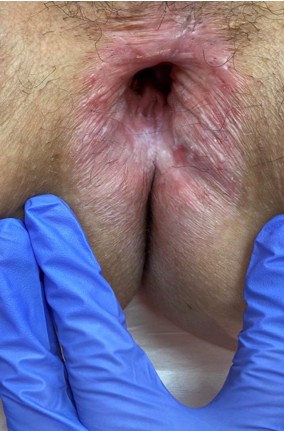
Figure 5: Appearance of the lesion after the fourth PRP-therapy.
At the follow-up examination performed one week after the fourth procedure, we found no symptoms. The patient reported that she felt well and that the dryness, pruritus and discomfort in the external genital area had disappeared (fig. 5).
The maintenance therapy schedule was discussed. We performed maintenance plasma treatments every third month for one year. The woman is now feeling well and leading a normal and full life. She reports no symptoms in the external genital area. She continues to visit the office only for check-ups every three months.
At each examination, the effect of the procedure is assessed. The intensity of pigmentation, absence of scabs, improved skin elasticity, moisturization, and turgor were noted. The patient reported a reduction in the incidence of pruritus, dyspareunia and dysuric complaints. A significant increase in quality of life was reported. No recurrence of the condition has been observed to date.
Discussion
The pathological changes that occur in the skin of the external genitalia in perimenopausal women are mainly represented by dystrophic lesions - squamous hyperplasia, lichen sclerosus, and a number of other skin diseases. The colposcopic image represents keratosis. On the skin in the area of the vulva, various types of dermatoses can be observed, which are also localized in other anatomical areas. They have a different clinical picture and are important to consider when making a differential diagnosis [2, 3].
Recent publications describing the effect of plasmotherapy on external genitalia in premenopausal and postmenopausal women demonstrate results similar to ours. Casanova and collaborators reported an increase in the quality of life and described the regenerative effect of intradermal plasmotherapy [4, 5, 6].
The Diakomanolis team presented a study in 2022 that compared the effect after treatment with clobetasol and with autologous PRP-therapy of dystrophic changes of the external genitalia in postmenopausal women. The authors found that regenerative changes in the dermis and improvement in skin turgor was statistically significantly higher in the group of patients who underwent plasmotherapy. A correspondingly significant improvement in quality of life was observed in this group. Moreover, plasmotherapy is administered according to a regimen and is more convenient for the patient compared to daily application of a cream [7].
Dhillon et al. cautioned that injection of autologous platelet-rich plasma is not without statin effects. However, these are solely provoked by the mechanism of administration. The authors describe cases of local infection and formation of cicatrices and calcifications [8]. In 2019, Latalski's team described a case of allergic reaction after plasmotherapy. Subsequently, controversy has been held regarding the safety of the method [9]. In contrast, no adverse reactions were observed in our case. Saleh and Abdelghani published a study in 2022 that proved that the administration of a-PRP in postmenopausal women with dystrophic vulvar lesions had a good effect. The authors reported similar results to ours: a significant reduction in symptoms such as discomfort, pruritus, pain, and dryness. Their patients reported improvement in their quality of life and sexual intercourse [10].
Conclusion
The case we described shows that a-PRP therapy shows good results in premenopausal patients. The method promotes tissue regeneration, contributes to symptom reduction and is a good alternative option for patients not responding to conservative therapy. Plasmotherapy is a modern, safe, effective, non-surgical and non-hormonal treatment and can be administered to a wide group of patients.
References
- Frierson H. F; S. E. Mills (1996). The vulva and vagina in Diagnostic surgical pathology Vol. 2, 2nd ed/editor Stephen S. Sternberg, Lippincott – Raven, Philadelphia: 2017 – 2055.
- Fistarol Skand and Itin PH (2013): Diagnosis and treatment of lichen sclerosus: an update. Am J Clin Dermatol;14(1): 27–47.
- Schlosser BJ, Mirowski GW (2015). Lichen sclerosus and lichen planus in women and girls. Clin Obstet Gynecol; 58(1):125–142.
- Behnia-Willison F; Reza Pour N; Mohamadi B; Willison N; and Rock M et al (2016). Use of platelet-rich plasma for vulvovaginal autoimmune conditions like lichen sclerosus. Plast. Reconstr. Surg. Glob. Open ;1124(4):1–4.
- Casabona F; Gambelli I; Casabona F; Santi P and Santori G ,et a(2017) . Autologous platelet-rich plasma (PRP) in chronic penile lichen sclerosus: the impact on tissue repair and patient quality of life. Int. Urol. Nephrol ;49(4):573–580.
- Goldstein A.T; King M; Runels C; Gloth M and Pfau R (2017). Intradermal injection of autologous platelet-rich plasma for the treatment of vulvar lichen sclerosus.J. Am. Acad. Dermatol ;76(1):158–160.
- Diakomanolis E.S; Haidopoulos D; Syndos M; Rodolakis A and Stefanidis K et al(2022). Vulvar lichen sclerosus in postmenopausal women: a comparative study for treating advanced disease with clobetasol propionate 0.05% Eur. J. Gynaecol. Oncol ;23(6):519–522.
- Dhillon, R. S; Schwarz, E. M and Maloney, M. D (2012). Platelet-rich plasma therapy-future or trend? Arthritis Research and Therapy. 16. 10.1186/ar3914.
- Latalski M; Walczyk A; Fatyga M, Rutz E; Szponder T and Bielecki T et al(2019). Allergic reaction to platelet-rich plasma (PRP): Case report. Medicine ;98:e14702.
- Saleh D (2022) ; Abdelghani R. Clinical evaluation of autologous platelet rich plasma injection in postmenopausal vulvovaginal atrophy: A pilot study. Journal of Cosmetic Dermatology , 4269-4275.